Are you gearing up for a career shift or aiming to ace your next interview? Look no further! We’ve curated a comprehensive guide to help you crack the interview for the coveted Clinical Instructor position. From understanding the key responsibilities to mastering the most commonly asked questions, this blog has you covered. So, buckle up and let’s embark on this journey together
Acing the interview is crucial, but landing one requires a compelling resume that gets you noticed. Crafting a professional document that highlights your skills and experience is the first step toward interview success. ResumeGemini can help you build a standout resume that gets you called in for that dream job.






Essential Interview Questions For Clinical Instructor
1. Describe your approach to effectively instructing clinical students in a hospital setting?
My approach to effectively instructing clinical students in a hospital setting involves:
- Creating a collaborative and supportive learning environment for students to feel comfortable asking questions and sharing their perspectives.
- Tailoring instruction to meet the individual learning needs, styles, and goals of each student through individualized learning plans.
- Integrating evidence-based practices and current clinical guidelines into teaching to ensure students are equipped with the most up-to-date knowledge and skills.
- Providing constructive feedback to guide students’ progress, enhance their critical thinking abilities, and promote self-reflection.
2. How would you balance the need to provide students with hands-on experience with ensuring patient safety?
Prioritizing Patient Safety
- Adhering to established hospital protocols and guidelines.
- Supervising students closely and providing guidance at all times.
- Ensuring students have the necessary skills and knowledge before performing any procedures.
Providing Hands-on Experience
- Gradually increasing students’ responsibilities as they gain experience and competence.
- Creating opportunities for students to observe experienced clinicians and participate in a variety of clinical settings.
- Using simulation and role-playing exercises to provide a safe environment for students to practice skills.
3. What strategies do you use to assess student learning and provide feedback?
My strategies for assessing student learning and providing feedback include:
- Direct Observation: Monitoring students during clinical rotations and providing immediate feedback on performance.
- Case Presentations: Encouraging students to present patient cases to the team, showcasing their clinical reasoning and communication skills.
- Written Assignments: Assigning reflective journals, care plans, and patient evaluations to assess students’ understanding and application of concepts.
- Regular Feedback Sessions: Holding scheduled meetings with students to discuss progress, strengths, and areas for improvement.
4. How do you foster a positive learning environment that promotes student growth and development?
I foster a positive learning environment that promotes student growth and development by:
- Creating a respectful and inclusive classroom where diverse perspectives are valued.
- Encouraging students to actively participate, ask questions, and share their ideas.
- Providing a safe space for students to make mistakes and learn from their experiences.
- Celebrating student successes and acknowledging their contributions to the learning process.
5. What are your strategies for managing challenging student behaviors in the clinical setting?
My strategies for managing challenging student behaviors in the clinical setting include:
- Early Intervention: Addressing concerns promptly and privately to prevent escalation.
- Clear Communication: Establishing clear expectations, roles, and consequences.
- Collaboration: Seeking support from supervisors, preceptors, and other professionals involved with the student.
- Individualized Support: Tailoring interventions to meet the specific needs and challenges of each student.
6. How do you stay up-to-date with advancements in clinical practice and incorporate them into your teaching?
I stay up-to-date with advancements in clinical practice and incorporate them into my teaching by:
- Continuing Education: Attending conferences, workshops, and online courses.
- Professional Reading: Reading medical journals, research articles, and textbooks.
- Collaboration: Networking with colleagues and experts in the field to exchange knowledge.
- Patient Care: Applying new knowledge and skills in my own clinical practice.
7. What are your strengths and weaknesses as a clinical instructor?
Strengths:
- Expertise in Clinical Practice: Possessing a deep understanding of medical principles and a proven track record in patient care.
- Excellent Communication Skills: Able to convey complex information clearly and effectively to students.
- Passion for Teaching: Enjoying the process of guiding and mentoring students in their clinical development.
Weaknesses:
- Balancing Time: Struggling at times to balance responsibilities between clinical practice, teaching, and research.
- Adapting to Different Learning Styles: Recognizing the need to continuously improve my ability to adapt to the diverse learning needs of students.
8. Can you describe a particularly challenging clinical situation you encountered as an instructor, and how you handled it?
A particularly challenging clinical situation I encountered as an instructor was a student who made a medication error. I handled it by:
- Ensuring Patient Safety: Prioritizing the patient’s well-being and taking immediate steps to mitigate any potential harm.
- Supporting the Student: Providing a supportive and non-judgmental environment for the student, recognizing that mistakes are part of the learning process.
- Conducting a Root Cause Analysis: Identifying the factors that contributed to the error and implementing measures to prevent similar occurrences in the future.
- Developing a Remediation Plan: Working with the student to develop a plan to address knowledge gaps and improve clinical skills.
9. What are your goals as a Clinical Instructor?
My goals as a Clinical Instructor are:
- Inspiring: Motivating students to become competent, compassionate, and lifelong learners in their clinical practice.
- Preparing: Equipping students with the knowledge, skills, and attitudes necessary to provide safe and effective patient care.
- Mentoring: Guiding and supporting students in their professional development and career aspirations.
- Collaborating: Fostering a collaborative learning environment where students, colleagues, and healthcare professionals work together to enhance patient outcomes.
10. How would you handle a student who consistently struggles in clinical rotations?
I would handle a student who consistently struggles in clinical rotations by:
- Early Intervention: Identifying areas of difficulty and providing additional support as early as possible.
- Collaboration: Working with the student, preceptors, and other educators to develop an individualized support plan.
- Remediation: Providing opportunities for the student to practice and improve specific skills through simulation, workshops, or additional clinical experiences.
- Reflective Practice: Encouraging the student to participate in self-reflection to identify strengths, weaknesses, and areas for improvement.
- Realistic Evaluation: Assessing the student’s progress objectively and making difficult decisions if necessary to ensure patient safety and academic standards are met.
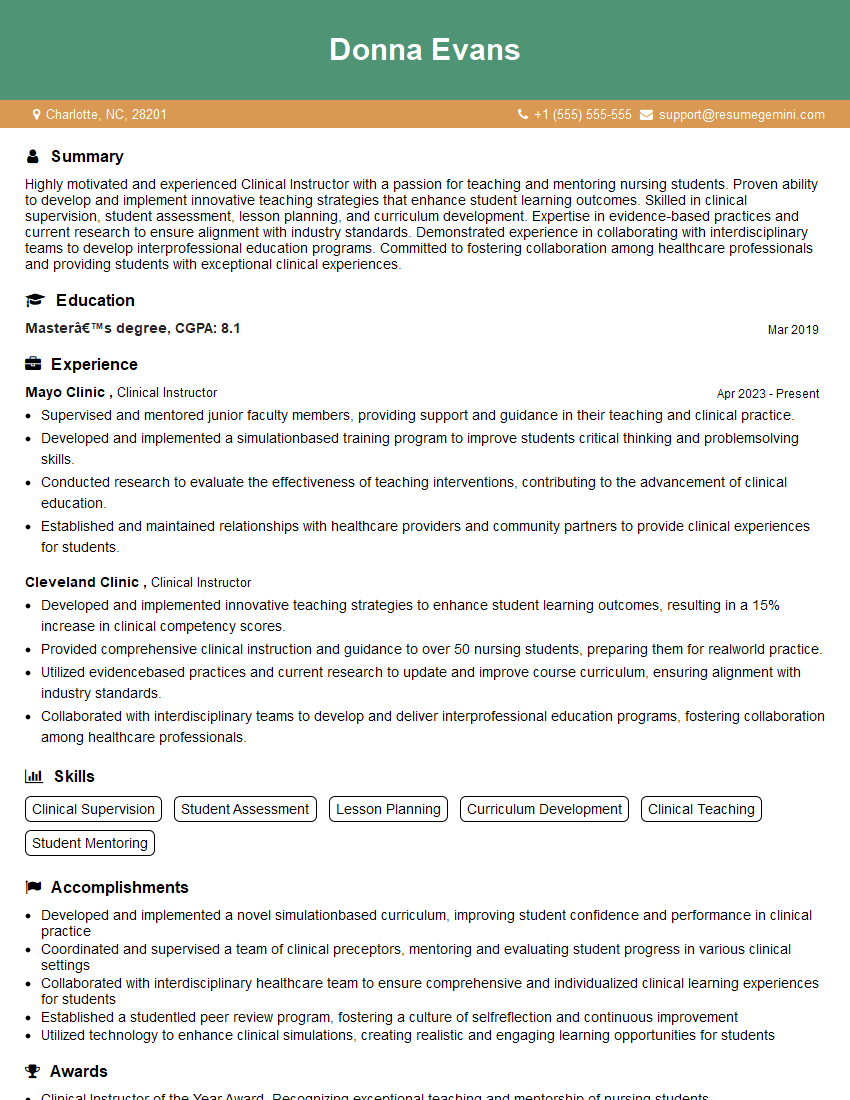
Interviewers often ask about specific skills and experiences. With ResumeGemini‘s customizable templates, you can tailor your resume to showcase the skills most relevant to the position, making a powerful first impression. Also check out Resume Template specially tailored for Clinical Instructor.
Career Expert Tips:
- Ace those interviews! Prepare effectively by reviewing the Top 50 Most Common Interview Questions on ResumeGemini.
- Navigate your job search with confidence! Explore a wide range of Career Tips on ResumeGemini. Learn about common challenges and recommendations to overcome them.
- Craft the perfect resume! Master the Art of Resume Writing with ResumeGemini’s guide. Showcase your unique qualifications and achievements effectively.
- Great Savings With New Year Deals and Discounts! In 2025, boost your job search and build your dream resume with ResumeGemini’s ATS optimized templates.
Researching the company and tailoring your answers is essential. Once you have a clear understanding of the Clinical Instructor‘s requirements, you can use ResumeGemini to adjust your resume to perfectly match the job description.
Key Job Responsibilities
A clinical instructor is a healthcare professional who is responsible for teaching and guiding students in a clinical setting. They play a vital role in ensuring that students receive the necessary knowledge and skills to become competent healthcare professionals. Key job responsibilities of a clinical instructor may include:Developing and implementing lesson plans: Clinical instructors are responsible for creating and delivering lesson plans that meet the educational needs of students.
1. Planning Course Curriculum
Collaborate with other educators to develop and revise course curriculum and materials
- Organize and lead discussions, lectures, and laboratory sessions
- Develop and administer tests and assignments to assess student learning
2. Teaching Clinical Skills
Supervise and instruct students in the clinical setting, providing guidance and feedback on patient care
- Demonstrate and teach clinical skills and procedures
- Evaluate student performance and provide feedback on their progress
3. Assessing Student Progress
Monitor and evaluate student progress, providing feedback and support as needed
- Assess student performance through observation, written work, and presentations
- Provide constructive feedback to students to help them improve their clinical skills and knowledge
4. Maintaining Professional Standards
Maintain professional standards and ethics in the clinical setting, serving as a role model for students
- Adhere to all applicable laws, regulations, and ethical guidelines
- Maintain confidentiality of patient information
Interview Tips
Preparing for a clinical instructor interview can be a daunting task, but by following these tips, you can increase your chances of success:1. Research the organization and the position: Before the interview, take some time to research the organization and the specific position you are applying for. This will help you understand the organization’s culture and the specific responsibilities of the role.
1. Know the Organization’s Mission and Values
Research the organization’s website and social media pages to learn about its mission, values, and goals
- Show that you are aligned with the organization’s culture and values in your answers
- Explain how your skills and experience align with the organization’s needs
2. Highlight Your Clinical Experience
Emphasize your clinical experience and expertise in your resume and during the interview
- Provide specific examples of how you have successfully taught and supervised students in a clinical setting
- Discuss your experience with developing and implementing lesson plans, and your ability to assess student progress
3. Demonstrate Your Passion for Teaching
Convey your passion for teaching and your commitment to student success in your interview
- Explain why you are passionate about teaching and what motivates you to help students learn
- Describe your teaching philosophy and how you create a positive and supportive learning environment
4. Be Prepared to Answer Behavioral Questions
Be prepared to answer behavioral questions that assess your skills and experience in specific situations
- Use the STAR method to answer behavioral questions (Situation, Task, Action, Result)
- Provide specific examples of how you have handled challenging situations in the past
Next Step:
Now that you’re armed with interview-winning answers and a deeper understanding of the Clinical Instructor role, it’s time to take action! Does your resume accurately reflect your skills and experience for this position? If not, head over to ResumeGemini. Here, you’ll find all the tools and tips to craft a resume that gets noticed. Don’t let a weak resume hold you back from landing your dream job. Polish your resume, hit the “Build Your Resume” button, and watch your career take off! Remember, preparation is key, and ResumeGemini is your partner in interview success.