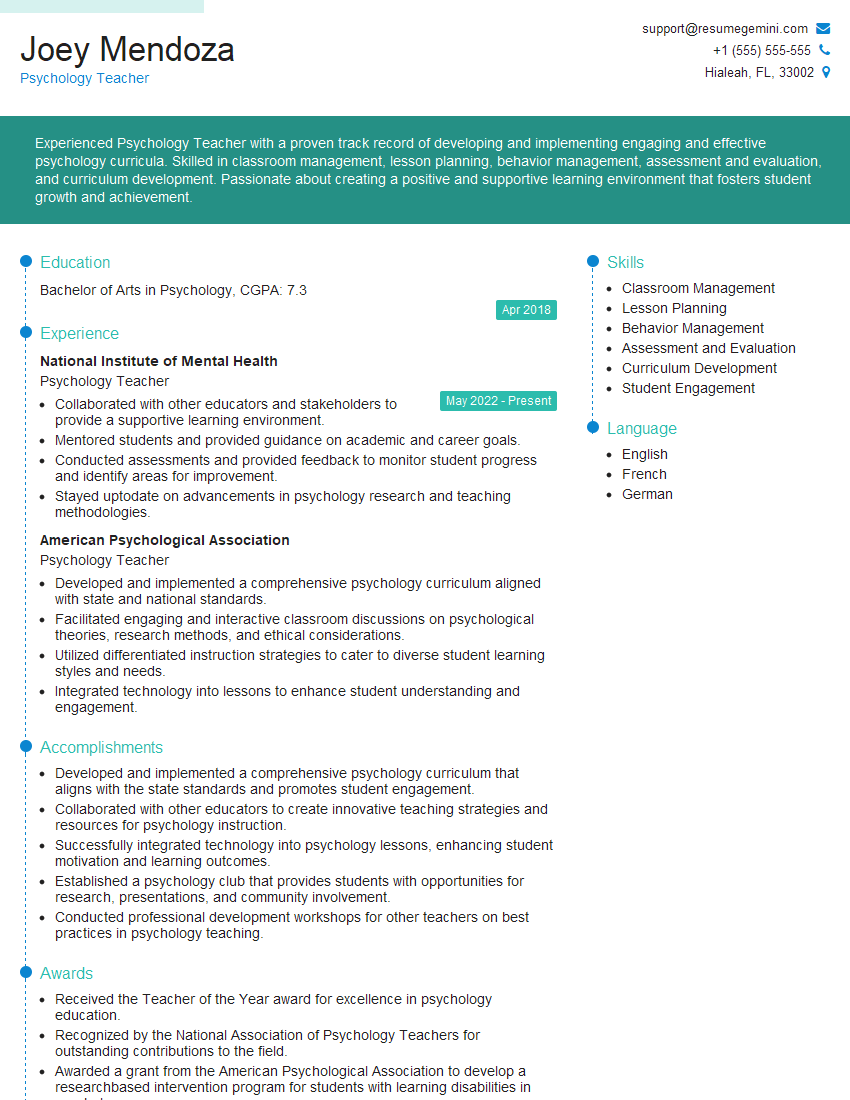
Are you gearing up for a career in Psychology Teacher? Feeling nervous about the interview questions that might come your way? Don’t worry, you’re in the right place. In this blog post, we’ll dive deep into the most common interview questions for Psychology Teacher and provide you with expert-backed answers. We’ll also explore the key responsibilities of this role so you can tailor your responses to showcase your perfect fit.
Acing the interview is crucial, but landing one requires a compelling resume that gets you noticed. Crafting a professional document that highlights your skills and experience is the first step toward interview success. ResumeGemini can help you build a standout resume that gets you called in for that dream job.






Essential Interview Questions For Psychology Teacher
1. What are the key concepts and theories of cognitive psychology?
Cognitive psychology is the study of the mind and how it processes information. Key concepts include:
- Attention: The process of focusing on specific stimuli and ignoring others.
- Memory: The process of encoding, storing, and retrieving information.
- Perception: The process of interpreting sensory information.
- Problem-solving: The process of finding solutions to problems.
Major theories of cognitive psychology include:
- Schema theory: The theory that people organize information into mental categories or schemas.
- Information-processing theory: The theory that the mind processes information like a computer.
- Connectionism: The theory that the mind is a network of interconnected neurons.
2. How do you create a supportive and engaging learning environment for students with diverse learning styles?
Creating a supportive and engaging learning environment for students with diverse learning styles requires:
Differentiated instruction
- Tailoring instruction to meet the needs of individual students.
- Using a variety of teaching methods and materials.
- Providing opportunities for students to learn in different ways.
Positive classroom climate
- Creating a welcoming and respectful classroom environment.
- Encouraging student participation and collaboration.
- Building relationships with students.
Flexible learning environment
- Adapting the learning environment to meet the needs of students.
- Providing flexible seating options.
- Offering a variety of learning activities.
3. How do you assess student learning in psychology?
Assessment in psychology should be:
- Valid: Measures what it claims to measure.
- Reliable: Consistent and accurate over time.
- Fair: Does not discriminate against any particular group of students.
- Practical: Can be administered within the constraints of time and resources.
Methods of assessment include:
- Formal assessments: Standardized tests, exams, and essays.
- Informal assessments: Observations, class participation, and presentations.
4. How do you motivate students to learn psychology?
Motivating students to learn psychology involves:
- Making psychology relevant: Connecting psychology to students’ lives.
- Creating a positive learning environment: Engaging students and respecting their interests.
- Providing opportunities for success: Setting realistic goals and providing scaffolding.
- Encouraging curiosity: Asking questions and exploring new ideas.
5. How do you stay current with the latest research in psychology?
To stay current with the latest research in psychology, I:
- Read academic journals and books.
- Attend conferences and workshops.
- Network with other professionals.
- Conduct my own research.
6. What are your strengths as a psychology teacher?
- In-depth knowledge of psychology and research methods.
- Strong communication and interpersonal skills.
- Ability to create and deliver engaging lessons.
- Experience in differentiated instruction.
- Proven track record of student success.
7. What are your weaknesses as a psychology teacher?
- Sometimes I get too enthusiastic about psychology and have to remind myself to slow down.
- I can be a bit of a perfectionist and sometimes spend too much time on lesson planning.
- I am always looking for ways to improve my teaching, so I sometimes try too many new things at once.
However, I am committed to my professional development and am always working to improve my skills.
8. What are your goals as a psychology teacher?
- To help students develop a deep understanding of psychology.
- To inspire students to pursue their interests in psychology.
- To prepare students for success in college and beyond.
- To create a positive and inclusive learning environment for all students.
- To stay current with the latest research in psychology and share my knowledge with my students.
9. What do you think are the biggest challenges facing psychology teachers today?
- The increasing diversity of students: Psychology teachers need to be prepared to meet the needs of students from all backgrounds.
- The need for more technology in the classroom: Psychology teachers need to be able to use technology effectively to enhance student learning.
- The pressure to prepare students for standardized tests: Psychology teachers need to be able to balance the need to prepare students for tests with the need to provide a well-rounded education.
10. What is your favorite topic in psychology to teach?
My favorite topic in psychology to teach is social psychology. I love teaching students about how people think, feel, and behave in social situations.
Social psychology is a fascinating field that has implications for our everyday lives. I enjoy teaching students about topics such as:
- Prejudice and discrimination
- Conformity and obedience
- Attraction and relationships
I find that social psychology is a great way to help students understand themselves and the world around them.
Interviewers often ask about specific skills and experiences. With ResumeGemini‘s customizable templates, you can tailor your resume to showcase the skills most relevant to the position, making a powerful first impression. Also check out Resume Template specially tailored for Psychology Teacher.
Career Expert Tips:
- Ace those interviews! Prepare effectively by reviewing the Top 50 Most Common Interview Questions on ResumeGemini.
- Navigate your job search with confidence! Explore a wide range of Career Tips on ResumeGemini. Learn about common challenges and recommendations to overcome them.
- Craft the perfect resume! Master the Art of Resume Writing with ResumeGemini’s guide. Showcase your unique qualifications and achievements effectively.
- Great Savings With New Year Deals and Discounts! In 2025, boost your job search and build your dream resume with ResumeGemini’s ATS optimized templates.
Researching the company and tailoring your answers is essential. Once you have a clear understanding of the Psychology Teacher‘s requirements, you can use ResumeGemini to adjust your resume to perfectly match the job description.
Key Job Responsibilities
Psychology teachers play a pivotal role in shaping the minds of future psychologists by providing them with a comprehensive understanding of the subject. Their key job responsibilities encompass the following:
1. Lesson Planning and Instruction
Develop and implement engaging lesson plans that align with established curriculum standards, catering to the diverse learning needs of students.
- Create and utilize a variety of teaching methods, such as lectures, discussions, group projects, and simulations, to foster active learning and critical thinking.
- Facilitate classroom discussions that promote in-depth analysis of psychological theories, concepts, and research findings.
2. Assessment and Evaluation
Design and administer assessments to gauge students’ understanding of the subject matter, providing timely and constructive feedback.
- Develop rubrics and grading criteria that ensure fair and accurate assessment of student performance.
- Provide both formative and summative assessments to monitor student progress and identify areas for improvement.
3. Student Support and Guidance
Offer support and guidance to students both inside and outside the classroom, fostering their academic and personal growth.
- Provide one-on-one tutoring sessions to address specific learning challenges and enhance students’ understanding.
- Collaborate with parents and guardians to discuss student progress and provide support as needed.
4. Professional Development and Collaboration
Continuously engage in professional development opportunities to stay abreast of the latest advancements in psychology and teaching methodologies.
- Attend conferences, workshops, and seminars to enhance subject matter knowledge and pedagogical skills.
- Collaborate with colleagues to share best practices and support student learning.
Interview Tips
Preparing thoroughly for an interview will significantly enhance your chances of success. Here are some crucial tips to help you ace your interview for a Psychology Teacher position:
1. Research the School and Position
Familiarize yourself with the school’s mission, values, and curriculum. Understand the specific job requirements and how your skills and experience align with them.
2. Preparation for Common Interview Questions
Anticipate questions related to your teaching philosophy, lesson planning, classroom management, and assessment strategies. Prepare thoughtful answers that showcase your expertise and passion for teaching psychology.
3. Highlight Your Passion for Psychology
Emphasize your enthusiasm for the field of psychology and demonstrate your ability to convey complex concepts in an engaging and accessible manner.
4. Share Examples of Effective Teaching
Provide specific examples of successful teaching strategies you have employed in previous experiences.
- Discuss how you fostered critical thinking, encouraged student participation, and facilitated a supportive learning environment.
5. Highlight Your Commitment to Student Success
Express your commitment to supporting the academic and personal growth of your students. Share examples of how you have gone beyond the classroom to provide guidance and mentorship.
6. Ask Thoughtful Questions
Ask insightful questions at the end of the interview to demonstrate your interest in the position and the school. This shows you are engaged and eager to learn more.
Next Step:
Now that you’re armed with the knowledge of Psychology Teacher interview questions and responsibilities, it’s time to take the next step. Build or refine your resume to highlight your skills and experiences that align with this role. Don’t be afraid to tailor your resume to each specific job application. Finally, start applying for Psychology Teacher positions with confidence. Remember, preparation is key, and with the right approach, you’ll be well on your way to landing your dream job. Build an amazing resume with ResumeGemini