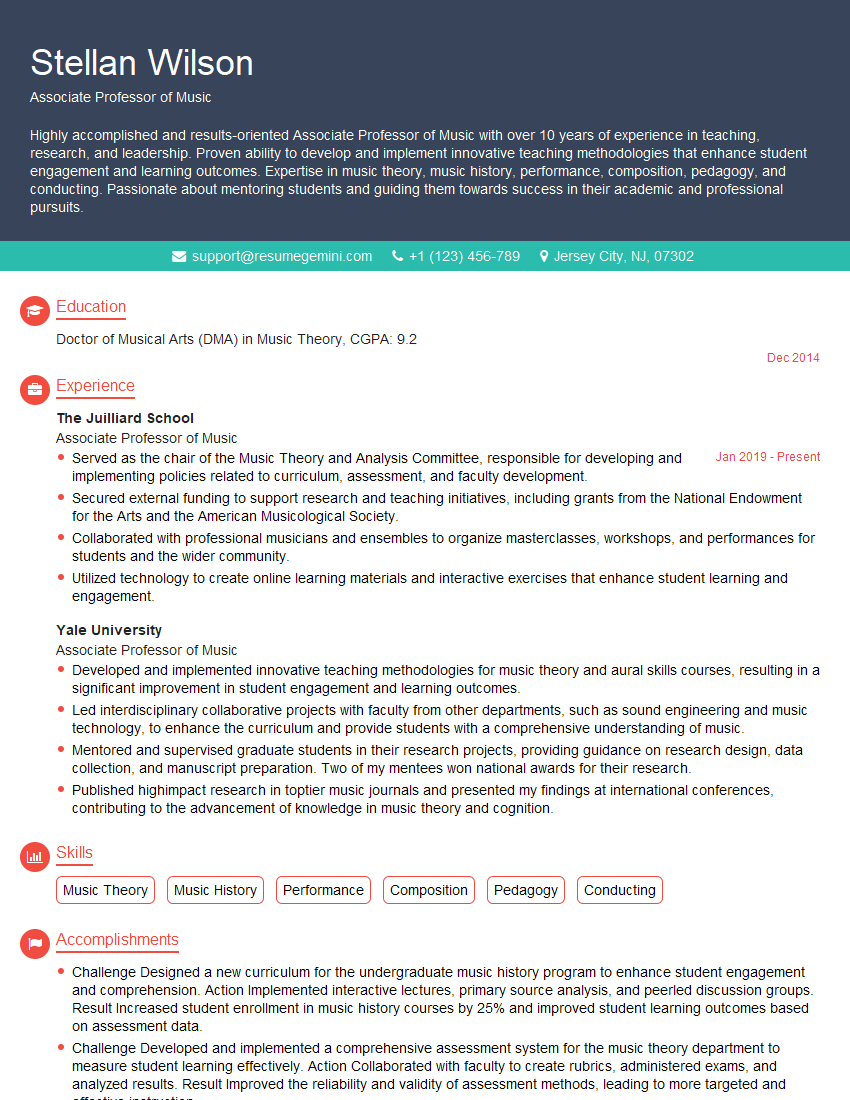
Feeling lost in a sea of interview questions? Landed that dream interview for Associate Professor of Music but worried you might not have the answers? You’re not alone! This blog is your guide for interview success. We’ll break down the most common Associate Professor of Music interview questions, providing insightful answers and tips to leave a lasting impression. Plus, we’ll delve into the key responsibilities of this exciting role, so you can walk into your interview feeling confident and prepared.
Acing the interview is crucial, but landing one requires a compelling resume that gets you noticed. Crafting a professional document that highlights your skills and experience is the first step toward interview success. ResumeGemini can help you build a standout resume that gets you called in for that dream job.






Essential Interview Questions For Associate Professor of Music
1. Describe your experience in developing and delivering music curricula for undergraduate and graduate students.
In my previous role as an Associate Professor of Music at Berklee College of Music, I was responsible for developing and delivering a wide range of music curricula for undergraduate and graduate students. I created and taught courses in music theory, music history, ear training, and music technology. I also developed and led several ensemble courses, including the Berklee Concert Jazz Orchestra and the Berklee Contemporary Music Ensemble.
2. How do you incorporate technology into your music teaching?
Using technology to enhance student learning
- I use a variety of technology tools to enhance student learning in my music courses. These tools include:
- Music notation software (e.g., Finale, Sibelius) for creating and editing musical scores.
- Audio recording and editing software (e.g., Pro Tools, Logic Pro) for recording and analyzing student performances.
- Interactive online learning platforms (e.g., Blackboard, Canvas) for delivering course materials and assessments.
Using technology to support student creativity
- In addition to using technology to enhance student learning, I also use it to support student creativity. For example, I use music production software (e.g., Ableton Live, FL Studio) to help students create original music compositions.
- I also use technology to give students opportunities to collaborate on musical projects with other students from around the world.
3. What are your research interests in music?
My research interests in music are primarily focused on the following areas:
- The use of artificial intelligence in music composition and performance.
- The development of new music technologies and instruments.
- The intersection of music and other disciplines, such as psychology and neuroscience.
4. How do you stay up-to-date on the latest developments in music theory and practice?
I stay up-to-date on the latest developments in music theory and practice through a variety of methods, including:
- Attending conferences and workshops.
- Reading academic journals and books.
- Listening to new music and attending concerts.
- Collaborating with other musicians and scholars.
5. What are your thoughts on the future of music education?
I believe that the future of music education is bright. There are many exciting new technologies and approaches that are emerging that can help us to teach music more effectively and engage students more deeply. I am particularly excited about the potential of online learning and the use of artificial intelligence in music education. I believe that these technologies can help us to reach a wider audience of students and provide them with more personalized and engaging learning experiences.
6. What are your strengths as a music educator?
My strengths as a music educator include:
- My passion for music and my commitment to sharing my love of music with others.
- My strong theoretical and practical knowledge of music.
- My ability to create and deliver engaging and effective lesson plans.
- My patience and my ability to work with students of all ages and levels.
7. What are your weaknesses as a music educator?
One of my weaknesses as a music educator is that I am sometimes too demanding of my students. I have high expectations for my students, and I sometimes push them harder than they are ready for. I am working on being more patient and understanding with my students, and I am learning to adjust my expectations to their individual needs.
8. What are your goals for your career as a music educator?
My goals for my career as a music educator are to:
- Inspire and motivate my students to reach their full potential.
- Create a positive and supportive learning environment for my students.
- Develop innovative and effective teaching methods.
- Conduct research on music education and share my findings with other educators.
9. What are your salary expectations for this position?
My salary expectations for this position are commensurate with my experience and qualifications. I am confident that I can make a significant contribution to your music program, and I am eager to discuss my salary expectations with you in more detail.
10. Do you have any questions for me?
I do have a few questions for you:
- What are the most important qualities that you are looking for in a candidate for this position?
- What are the biggest challenges that your music program is currently facing?
- What are your vision for the future of your music program?
Interviewers often ask about specific skills and experiences. With ResumeGemini‘s customizable templates, you can tailor your resume to showcase the skills most relevant to the position, making a powerful first impression. Also check out Resume Template specially tailored for Associate Professor of Music.
Career Expert Tips:
- Ace those interviews! Prepare effectively by reviewing the Top 50 Most Common Interview Questions on ResumeGemini.
- Navigate your job search with confidence! Explore a wide range of Career Tips on ResumeGemini. Learn about common challenges and recommendations to overcome them.
- Craft the perfect resume! Master the Art of Resume Writing with ResumeGemini’s guide. Showcase your unique qualifications and achievements effectively.
- Great Savings With New Year Deals and Discounts! In 2025, boost your job search and build your dream resume with ResumeGemini’s ATS optimized templates.
Researching the company and tailoring your answers is essential. Once you have a clear understanding of the Associate Professor of Music‘s requirements, you can use ResumeGemini to adjust your resume to perfectly match the job description.
Key Job Responsibilities
Associate Professors of Music are responsible for teaching, research, and service in their field of specialization. They play a vital role in the education and development of undergraduate and graduate students and contribute to the advancement of their discipline through research and creative activity.
1. Teaching
Associate Professors of Music typically teach a variety of courses in their area of expertise, such as music theory, music history, music performance, and music education. They develop and deliver lectures, lead discussions, and provide feedback to students on their work.
- Develop and teach undergraduate and graduate courses in music.
- Supervise and mentor undergraduate and graduate students.
- Advise students on academic and career planning.
2. Research and Creative Activity
Associate Professors of Music are expected to conduct research and engage in creative activities in their field. This may involve writing articles for scholarly journals, presenting at conferences, or composing and performing new music.
- Conduct research in music theory, history, performance, or education.
- Publish articles in scholarly journals and present at conferences.
- Compose and perform new music.
3. Service
Associate Professors of Music are expected to contribute to the service of their department, college, and university. This may involve serving on committees, organizing events, or representing the department at external functions.
- Serve on departmental, college, and university committees.
- Organize concerts, recitals, and other musical events.
- Represent the department at external functions.
4. Professional Development
Associate Professors of Music are expected to stay abreast of current trends in their field and to continue their professional development. This may involve attending conferences, workshops, or taking additional coursework.
- Attend conferences and workshops.
- Take additional coursework to stay abreast of current trends in music.
- Collaborate with colleagues on research and other projects.
Interview Tips
To ace an interview for an Associate Professor of Music position, it is important to be well-prepared and to have a strong understanding of the key job responsibilities. Here are a few tips to help you prepare for your interview:
1. Research the University and Department
Before the interview, take some time to research the university and the music department. This will help you to understand the institution’s mission, values, and areas of specialization. You should also familiarize yourself with the faculty members in the department and their research interests.
2. Prepare Your Teaching and Research Statements
You will likely be asked to submit a teaching statement and a research statement as part of your application. These statements should highlight your teaching philosophy, your research interests, and your accomplishments in both areas.
3. Practice Your Interview Skills
Once you have prepared your teaching and research statements, it is a good idea to practice your interview skills. You can do this by asking a friend or colleague to conduct a mock interview with you. This will help you to feel more confident and prepared when you go in for your actual interview.
4. Be Yourself
It is important to be yourself during your interview. The hiring committee wants to get to know the real you, so don’t try to be someone you’re not. Be confident in your abilities and be enthusiastic about your research and teaching.
5. Follow Up After the Interview
After the interview, be sure to send a thank-you note to the hiring committee. This will show your appreciation for their time and consideration.
Next Step:
Armed with this knowledge, you’re now well-equipped to tackle the Associate Professor of Music interview with confidence. Remember, a well-crafted resume is your first impression. Take the time to tailor your resume to highlight your relevant skills and experiences. And don’t forget to practice your answers to common interview questions. With a little preparation, you’ll be on your way to landing your dream job. So what are you waiting for? Start building your resume and start applying! Build an amazing resume with ResumeGemini.