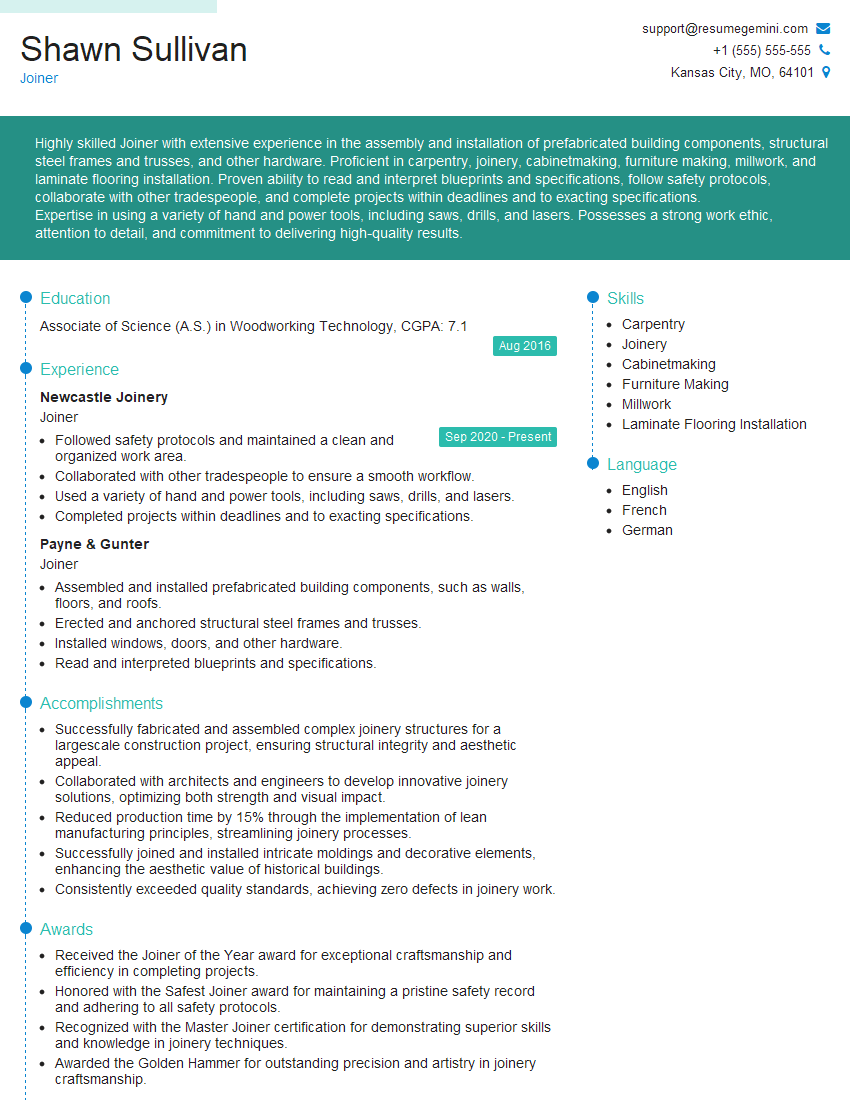
Feeling lost in a sea of interview questions? Landed that dream interview for Joiner but worried you might not have the answers? You’re not alone! This blog is your guide for interview success. We’ll break down the most common Joiner interview questions, providing insightful answers and tips to leave a lasting impression. Plus, we’ll delve into the key responsibilities of this exciting role, so you can walk into your interview feeling confident and prepared.
Acing the interview is crucial, but landing one requires a compelling resume that gets you noticed. Crafting a professional document that highlights your skills and experience is the first step toward interview success. ResumeGemini can help you build a standout resume that gets you called in for that dream job.






Essential Interview Questions For Joiner
1. What are the different types of joiners?
- General joiners: They work on all types of joinery, from simple repairs to custom-made furniture.
- Bench joiners: They specialize in making furniture in a workshop.
- Site joiners: They work on-site installing and fitting joinery, such as doors, windows, and cabinets.
- Machine joiners: They operate machines to cut, shape, and join wood.
2. What are the most common types of joints used in joinery?
- Butt joint: This is the simplest and most common type of joint, where two pieces of wood are joined together at their ends.
- Mortise and tenon joint: This is a stronger joint than a butt joint, where a mortise (a hole) is cut into one piece of wood and a tenon (a tongue) is cut into the other piece of wood, which is then inserted into the mortise.
- Dovetail joint: This is a very strong joint, where the interlocking pieces of wood resemble the tail of a dove.
- Mitre joint: This is a joint where two pieces of wood are joined together at a 90-degree angle.
3. What are the different types of wood used in joinery?
- Hardwoods: These are woods from deciduous trees, such as oak, maple, and cherry. They are strong and durable.
- Softwoods: These are woods from coniferous trees, such as pine, fir, and spruce. They are lighter and less durable than hardwoods.
- Plywood: This is a manufactured wood product made from thin layers of wood veneer glued together. It is strong and lightweight.
- MDF (medium-density fiberboard): This is another manufactured wood product made from wood fibers glued together. It is dense and strong.
4. What are the different types of tools used in joinery?
- Hand tools: These include saws, planes, chisels, and hammers.
- Power tools: These include drills, sanders, and routers.
- Measuring tools: These include rulers, tape measures, and levels.
- Clamping tools: These include clamps, vices, and nails.
5. What are the different safety precautions that should be taken when working in a joinery workshop?
- Always wear appropriate safety gear, such as safety glasses, earplugs, and dust masks.
- Be aware of your surroundings and the location of all tools and machinery.
- Never use a tool that you are not familiar with.
- Always use sharp tools.
- Never leave tools unattended.
6. What are the different factors to consider when choosing the right type of joint for a particular application?
- The strength of the joint
- The durability of the joint
- The appearance of the joint
- The cost of the joint
- The time required to make the joint
7. What are the different methods of finishing a joinery project?
- Sanding
- Staining
- Painting
- Varnishing
- Oiling
8. What are the different types of joinery projects that you have experience with?
- Furniture making
- Cabinets making
- Door making
- Window making
- Roofing
9. What are your strengths and weaknesses as a joiner?
Strengths
- I am a skilled craftsman with over 10 years of experience in joinery.
- I am proficient in all aspects of joinery, from design to installation.
- I am a hard worker and I am always willing to go the extra mile.
- I am a team player and I am always willing to help out my colleagues.
Weaknesses
- I am sometimes too perfectionist and I can be hard on myself when I make mistakes.
- I am not always the best at communicating with clients, but I am always willing to listen to their feedback and make changes as needed.
10. What are your career goals?
- I would like to continue to develop my skills as a joiner and eventually become a master joiner.
- I would like to start my own joinery business and specialize in making custom furniture.
- I would like to teach joinery to other people and help them to develop their skills.
Interviewers often ask about specific skills and experiences. With ResumeGemini‘s customizable templates, you can tailor your resume to showcase the skills most relevant to the position, making a powerful first impression. Also check out Resume Template specially tailored for Joiner.
Career Expert Tips:
- Ace those interviews! Prepare effectively by reviewing the Top 50 Most Common Interview Questions on ResumeGemini.
- Navigate your job search with confidence! Explore a wide range of Career Tips on ResumeGemini. Learn about common challenges and recommendations to overcome them.
- Craft the perfect resume! Master the Art of Resume Writing with ResumeGemini’s guide. Showcase your unique qualifications and achievements effectively.
- Great Savings With New Year Deals and Discounts! In 2025, boost your job search and build your dream resume with ResumeGemini’s ATS optimized templates.
Researching the company and tailoring your answers is essential. Once you have a clear understanding of the Joiner‘s requirements, you can use ResumeGemini to adjust your resume to perfectly match the job description.
Key Job Responsibilities
A Joiner has various essential responsibilities within the construction industry. Their primary roles involve:
1. Fabrication and Installation
Joiners build and install various wooden structures, including:
- Fitting doors, windows, and stairs
- Constructing partitions, ceilings, and frameworks
2. Measuring and Marking
Before fabrication, Joiners meticulously measure and mark wood and other materials to ensure precise cuts and accurate assembly.
3. Cutting and Shaping
Joiners use specialized saws, drills, and other tools to cut and shape wood components according to specified dimensions.
4. Jointing and Assembly
They employ various joining techniques, such as nailing, gluing, and doweling, to assemble wooden parts into complete structures.
5. Finishing Touches
Joiners may apply finishes like sanding, varnishing, or painting to enhance the appearance and durability of their creations.
Interview Tips
To prepare effectively for a Joiner interview, follow these expert tips:
1. Research the Company and Position
- Learn about the company’s values, services, and industry standing.
- Thoroughly review the job description to identify the specific requirements and expectations.
2. Practice Common Interview Questions
- Prepare answers to frequently asked questions about your experience, skills, and why you’re interested in the position.
- Consider rehearsing your responses with a friend or mentor for feedback.
3. Highlight Relevant Experience and Skills
- Emphasize your experience in joinery, carpentry, or similar fields.
- Showcase your proficiency in using hand and power tools, as well as your knowledge of construction materials and techniques.
4. Demonstrate Your Attention to Detail
- Throughout the interview, pay attention to details and be precise in your answers.
- Highlight your ability to work accurately and produce high-quality craftsmanship.
5. Enthusiasm and Interest
- Convey your passion for joinery and your desire to contribute to the company’s projects.
- Ask thoughtful questions about the company and the role to demonstrate your interest and engagement.
Next Step:
Armed with this knowledge, you’re now well-equipped to tackle the Joiner interview with confidence. Remember, a well-crafted resume is your first impression. Take the time to tailor your resume to highlight your relevant skills and experiences. And don’t forget to practice your answers to common interview questions. With a little preparation, you’ll be on your way to landing your dream job. So what are you waiting for? Start building your resume and start applying! Build an amazing resume with ResumeGemini.