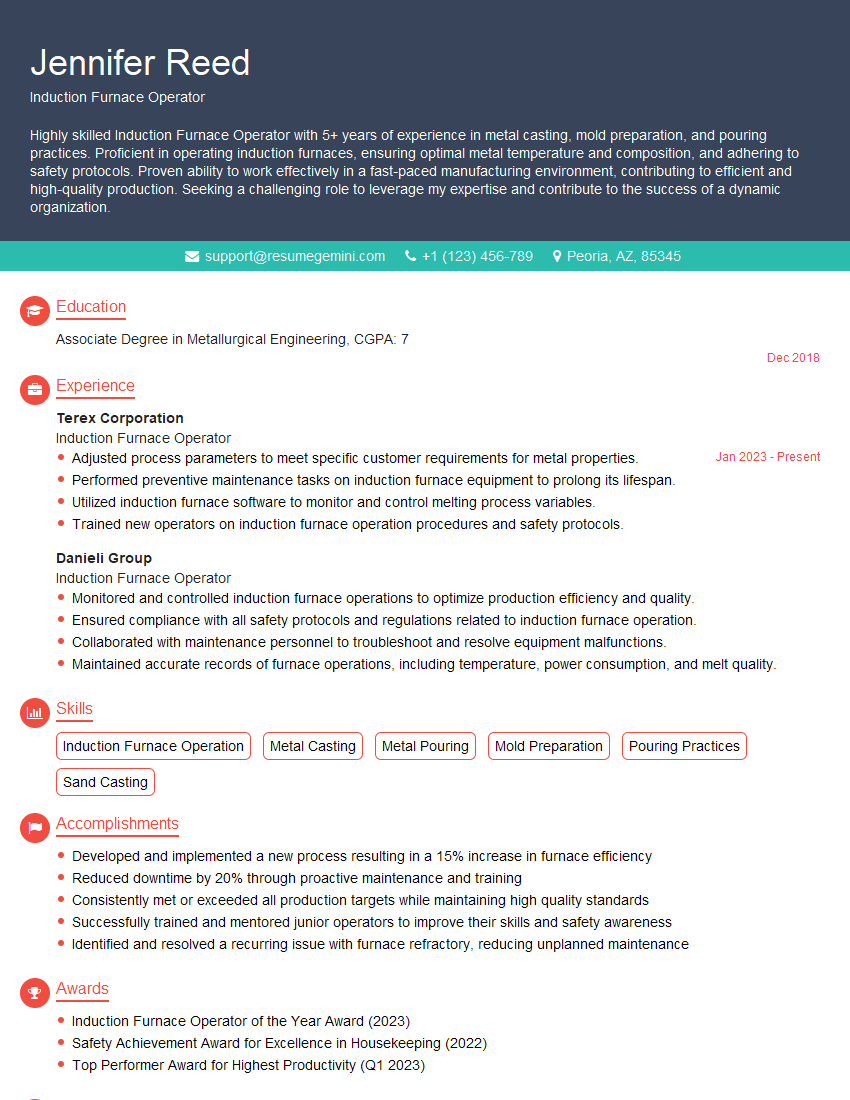
Ever felt underprepared for that crucial job interview? Or perhaps you’ve landed the interview but struggled to articulate your skills and experiences effectively? Fear not! We’ve got you covered. In this blog post, we’re diving deep into the Induction Furnace Operator interview questions that you’re most likely to encounter. But that’s not all. We’ll also provide expert insights into the key responsibilities of a Induction Furnace Operator so you can tailor your answers to impress potential employers.
Acing the interview is crucial, but landing one requires a compelling resume that gets you noticed. Crafting a professional document that highlights your skills and experience is the first step toward interview success. ResumeGemini can help you build a standout resume that gets you called in for that dream job.






Essential Interview Questions For Induction Furnace Operator
1. What are the key responsibilities of an Induction Furnace Operator?
The primary responsibilities of an Induction Furnace Operator include:
- Operating and maintaining induction furnaces used in melting, refining, and heat-treating metals
- Monitoring and controlling furnace temperatures, power levels, and metal composition
- Maintaining proper furnace conditions to prevent defects or contamination
- Inspecting and cleaning furnaces regularly to ensure optimal performance
- Following safety procedures and regulations to minimize risks
2. Describe the different types of induction furnaces.
Coreless Induction Furnaces
- Used for melting and refining metals
- Have a crucible surrounded by a coil, creating an electromagnetic field that induces currents in the metal
Channel Induction Furnaces
- Used for melting and holding molten metal
- Have a U-shaped channel with the coil wrapped around the arms
Vacuum Induction Furnaces
- Used for melting and refining metals in a vacuum
- Provide a controlled atmosphere to prevent oxidation and contamination
3. What are the factors that affect the efficiency of induction furnaces?
The efficiency of induction furnaces is influenced by several factors, including:
- Furnace design and coil configuration
- Metal type and composition
- Power supply frequency and voltage
- Furnace temperature and holding time
- Proper maintenance and insulation
4. How do you ensure the proper temperature control in induction furnaces?
To maintain proper temperature control in induction furnaces, I follow these steps:
- Calibrate and monitor thermocouples regularly for accurate readings
- Adjust power levels and frequencies to control the heating rate and temperature
- Use temperature recorders to track and analyze temperature profiles
- Implement cooling systems or insulation to prevent overheating
5. Describe the safety precautions that must be taken when operating induction furnaces.
Ensuring safety when operating induction furnaces is crucial. I strictly adhere to the following precautions:
- Wear appropriate personal protective equipment (PPE) such as gloves, safety glasses, and earplugs
- Maintain a clean and organized work area to prevent tripping hazards
- Inspect furnaces regularly for any signs of damage or malfunction
- Follow proper electrical safety protocols to avoid shocks and electrocution
- Be aware of potential hazards such as molten metal splashes or radiation exposure
6. How do you handle and resolve common malfunctions in induction furnaces?
To handle common malfunctions in induction furnaces, I take the following steps:
- Identify the symptoms of the malfunction and consult troubleshooting guides
- Check electrical connections, water cooling systems, and thermocouple readings
- If necessary, isolate the fault and contact maintenance personnel for repairs
- Record the malfunction and corrective actions taken for future reference
7. What techniques do you use to prevent contamination in induction furnace operations?
Preventing contamination is essential in induction furnace operations. I employ these techniques:
- Use high-quality raw materials and additives
- Maintain a clean furnace environment and charge materials properly
- Monitor and control metal composition regularly to prevent impurities
- Implement proper slag management and skimming techniques
- Inspect furnaces for any signs of refractory damage or corrosion
8. How do you determine the optimal power settings for different types of metals and alloys in induction furnaces?
Determining optimal power settings requires knowledge of metal properties and furnace characteristics:
- Consult technical data sheets and reference materials for recommended power ranges
- Experiment with different power levels and monitor temperature profiles
- Consider factors such as metal resistivity, melting point, and desired heating rate
- Optimize power settings to achieve efficient melting, refining, or heat-treating processes
9. Describe the proper maintenance procedures for induction furnaces.
Regular maintenance is crucial for optimal furnace performance. I follow these procedures:
- Inspect coils, refractory linings, and cooling systems regularly
- Clean and replace worn or damaged components as needed
- Calibrate and maintain temperature control systems for accurate readings
- Monitor power consumption and adjust settings to minimize energy usage
- Keep detailed maintenance records for future reference and troubleshooting
10. Explain the environmental regulations related to induction furnace operations.
I am aware of the environmental regulations governing induction furnace operations, including:
- Air pollution control measures to minimize emissions of particulate matter, sulfur dioxide, and nitrogen oxides
- Waste management guidelines for proper disposal of slag, refractory materials, and spent cooling fluids
- Energy efficiency standards to reduce electricity consumption and greenhouse gas emissions
- Noise pollution control measures to minimize sound levels
- Regular reporting and compliance with environmental regulations
Interviewers often ask about specific skills and experiences. With ResumeGemini‘s customizable templates, you can tailor your resume to showcase the skills most relevant to the position, making a powerful first impression. Also check out Resume Template specially tailored for Induction Furnace Operator.
Career Expert Tips:
- Ace those interviews! Prepare effectively by reviewing the Top 50 Most Common Interview Questions on ResumeGemini.
- Navigate your job search with confidence! Explore a wide range of Career Tips on ResumeGemini. Learn about common challenges and recommendations to overcome them.
- Craft the perfect resume! Master the Art of Resume Writing with ResumeGemini’s guide. Showcase your unique qualifications and achievements effectively.
- Great Savings With New Year Deals and Discounts! In 2025, boost your job search and build your dream resume with ResumeGemini’s ATS optimized templates.
Researching the company and tailoring your answers is essential. Once you have a clear understanding of the Induction Furnace Operator‘s requirements, you can use ResumeGemini to adjust your resume to perfectly match the job description.
Key Job Responsibilities
An Induction Furnace Operator operates and maintains induction furnaces, which are used to melt and refine metals.
1. Equipment Operation and Maintenance
Operates and monitors induction furnaces to ensure proper melting and refining of metals.
- Sets up and operates induction furnaces according to specifications.
- Monitors furnace temperature, pressure, and other parameters to ensure optimal performance.
- Adjusts furnace settings as needed to optimize metal quality and production efficiency.
- Performs preventive maintenance on induction furnaces, including cleaning, lubrication, and repairs.
2. Metal Handling
Loads, unloads, and handles molten metal safely and efficiently.
- Prepares molds and crucibles for molten metal.
- Pours molten metal into molds and crucibles.
- Removes castings and slag from furnaces.
3. Quality Control
Ensures the quality of melted and refined metals by conducting inspections and tests.
- Inspects molten metal for defects and impurities.
- Conducts chemical and physical tests on metals to verify quality.
- Maintains records of metal quality control tests.
4. Safety and Environmental Compliance
Adheres to all safety regulations and environmental standards.
- Wears appropriate personal protective equipment (PPE).
- Follows proper handling and storage procedures for hazardous materials.
- Maintains a clean and safe work area.
Interview Tips
To ace your interview for an Induction Furnace Operator position, here are some tips to follow:
1. Research the Company and Industry
Learn about the company’s products, services, and industry before the interview.
- Visit the company’s website and social media pages.
- Read industry news and articles to stay informed about current trends.
- This will show the interviewer that you are interested in the company and the industry.
2. Practice Answering Common Interview Questions
Prepare for common interview questions about your experience, skills, and qualifications.
- Develop clear and concise answers that highlight your relevant skills and experience.
- Practice answering questions out loud or with a friend or family member.
- This will help you feel more confident and prepared during the interview.
3. Be Enthusiastic and Positive
Show the interviewer that you are enthusiastic about the opportunity and the potential to work with the company.
- Smile, make eye contact, and speak clearly and confidently.
- Convey your passion for the industry and your desire to contribute to the company’s success.
4. Ask Questions
At the end of the interview, ask thoughtful questions that demonstrate your interest and engagement.
- Ask about the company’s culture, growth opportunities, and commitment to safety.
- This shows the interviewer that you are interested in more than just the job itself.
Next Step:
Armed with this knowledge, you’re now well-equipped to tackle the Induction Furnace Operator interview with confidence. Remember, a well-crafted resume is your first impression. Take the time to tailor your resume to highlight your relevant skills and experiences. And don’t forget to practice your answers to common interview questions. With a little preparation, you’ll be on your way to landing your dream job. So what are you waiting for? Start building your resume and start applying! Build an amazing resume with ResumeGemini.