Are you gearing up for a career shift or aiming to ace your next interview? Look no further! We’ve curated a comprehensive guide to help you crack the interview for the coveted Karate Teacher position. From understanding the key responsibilities to mastering the most commonly asked questions, this blog has you covered. So, buckle up and let’s embark on this journey together.
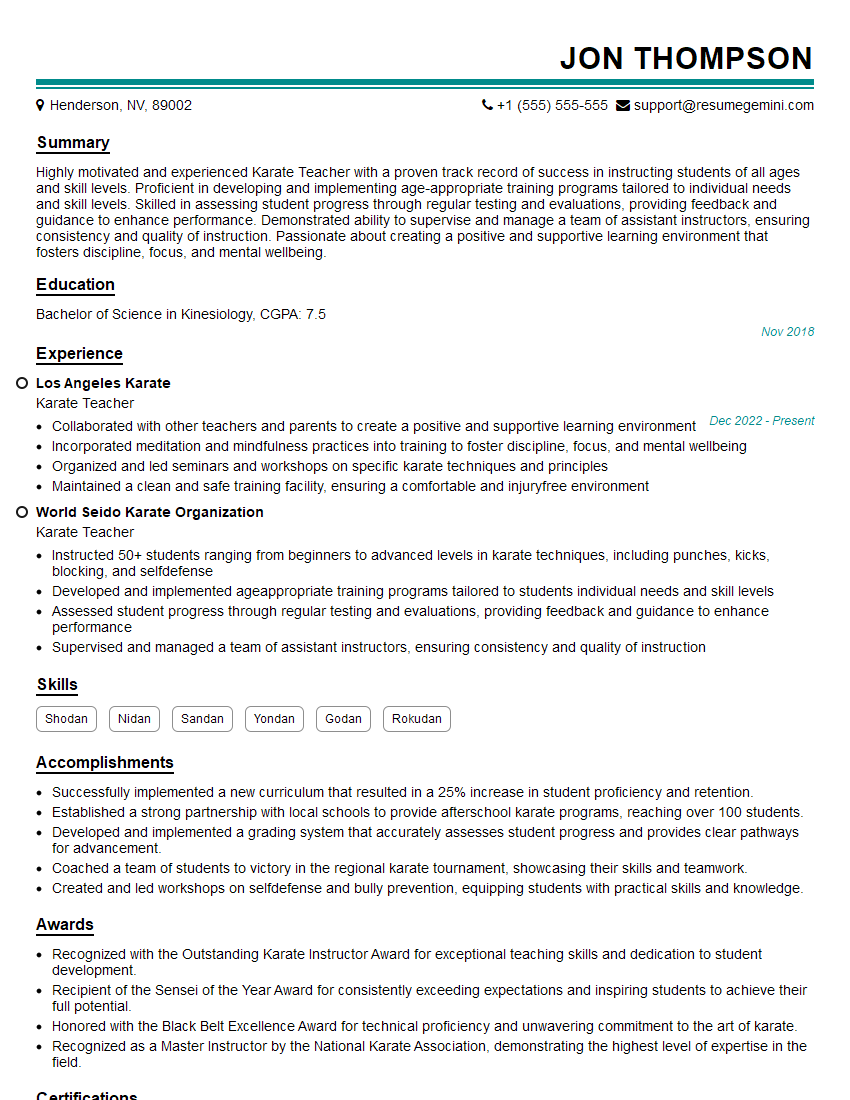
Acing the interview is crucial, but landing one requires a compelling resume that gets you noticed. Crafting a professional document that highlights your skills and experience is the first step toward interview success. ResumeGemini can help you build a standout resume that gets you called in for that dream job.






Essential Interview Questions For Karate Teacher
1. Explain the philosophy behind karate and how do you incorporate this philosophy into your teaching?
The philosophy of karate is centered around self-defense, self-improvement, and the development of one’s character. As a karate teacher, I strive to instill these principles in my students through my teaching methods and personal interactions.
- First, I emphasize the importance of self-defense skills, ensuring that students can protect themselves in real-world situations.
- Second, I focus on fostering self-improvement through the practice of karate. Regular training helps students develop physical fitness, mental clarity, and emotional resilience.
- Third, I encourage students to embrace the character-building aspects of karate. The discipline and respect practiced in the dojo translate into positive behaviors outside of the training environment.
2. Describe your approach to teaching karate to students of different ages and skill levels.
Tailoring to Different Ages:
- For young children, I prioritize making classes fun and engaging while introducing basic karate concepts.
- With teens and adults, I focus on technique development, sparring skills, and the practical application of karate principles.
Addressing Skill Levels:
- For beginners, I start with the fundamentals, gradually introducing more advanced techniques as they progress.
- For intermediate and advanced students, I provide individualized instruction to help them refine their skills and prepare for higher-level training.
3. How do you stay up-to-date with the latest karate techniques and training methods?
It is crucial for me to stay current with the latest developments in karate. I do this through:
- Attending workshops and seminars conducted by renowned karate masters.
- Subscribing to karate publications and reading books to enhance my knowledge and understanding.
- Engaging in discussions with fellow karate practitioners to exchange ideas and techniques.
4. Have you ever had to deal with difficult or unmotivated students? How did you handle those situations?
Handling difficult or unmotivated students requires patience, empathy, and adaptability. When encountering such students:
- I first try to understand their reasons for being difficult or unmotivated.
- I then communicate my expectations clearly and provide them with achievable goals to help them progress.
- I use positive reinforcement and constructive feedback to motivate them and boost their confidence.
- If necessary, I may have a private conversation with the student or their parents to address any underlying issues.
5. What are your thoughts on the role of kata in karate training?
Kata plays a vital role in karate training. It helps students to:
- Develop proper technique and coordination.
- Understand the principles and applications of karate.
- Improve their physical fitness, including flexibility, balance, and power.
6. How do you assess your students’ progress and provide feedback?
I assess my students’ progress through:
- Observing their performance in class and during training drills.
- Providing regular feedback on their technique and application of karate principles.
- Conducting periodic belt exams to evaluate their overall progress and readiness for advancement.
7. What safety precautions do you take during your karate classes?
Ensuring the safety of my students is paramount. I take the following precautions:
- Warming up properly before training to prevent injuries.
- Teaching proper technique to minimize the risk of accidents.
- Providing adequate supervision during all activities.
- Using safety equipment, such as pads and mats, whenever appropriate.
- Having a first-aid kit on hand in case of emergencies.
8. How do you promote a positive and inclusive learning environment in your karate classes?
I believe that a positive and inclusive learning environment is essential for students’ growth and enjoyment. I foster this by:
- Treating all students with respect and kindness.
- Creating a welcoming and supportive atmosphere where everyone feels comfortable participating.
- Encouraging students to support and learn from each other.
- Celebrating diversity and recognizing the unique strengths of each student.
9. How do you handle students who are injured or have physical limitations?
I recognize that not all students have the same physical capabilities. To accommodate those with injuries or limitations:
- I assess their individual needs and adjust training exercises accordingly.
- I provide them with alternative exercises that still allow them to participate and develop their skills.
- I encourage them to listen to their bodies and take breaks when necessary.
- I work closely with them to ensure their safety and progress.
10. What sets you apart from other karate teachers and makes you the best candidate for this position?
My unique combination of skills and experience sets me apart as an exceptional karate teacher:
- I hold a black belt and have extensive training in traditional and contemporary karate styles.
- I have over a decade of experience teaching karate to students of all ages and skill levels.
- I am passionate about sharing my knowledge and helping students achieve their full potential.
- My ability to create a safe, supportive, and inclusive learning environment fosters student growth and enjoyment.
Interviewers often ask about specific skills and experiences. With ResumeGemini‘s customizable templates, you can tailor your resume to showcase the skills most relevant to the position, making a powerful first impression. Also check out Resume Template specially tailored for Karate Teacher.
Career Expert Tips:
- Ace those interviews! Prepare effectively by reviewing the Top 50 Most Common Interview Questions on ResumeGemini.
- Navigate your job search with confidence! Explore a wide range of Career Tips on ResumeGemini. Learn about common challenges and recommendations to overcome them.
- Craft the perfect resume! Master the Art of Resume Writing with ResumeGemini’s guide. Showcase your unique qualifications and achievements effectively.
- Great Savings With New Year Deals and Discounts! In 2025, boost your job search and build your dream resume with ResumeGemini’s ATS optimized templates.
Researching the company and tailoring your answers is essential. Once you have a clear understanding of the Karate Teacher‘s requirements, you can use ResumeGemini to adjust your resume to perfectly match the job description.
Key Job Responsibilities
As a Karate Teacher, you will be responsible for teaching students the art of karate, including its techniques, principles, and history. You will also be responsible for creating and maintaining a safe and positive learning environment for your students.
1. Teaching Karate Techniques
You will be responsible for teaching students the basic techniques of karate, including punches, kicks, blocks, and throws. You will also teach students how to combine these techniques into effective combinations and sequences.
2. Teaching Karate Principles
In addition to teaching karate techniques, you will also be responsible for teaching students the principles of karate, including respect, discipline, and self-control. You will help students to develop a strong sense of character and to apply the principles of karate to their daily lives.
3. Teaching Karate History
You will be responsible for teaching students the history of karate, including its origins, development, and major figures. You will help students to understand the cultural and philosophical context of karate, and to appreciate its value as a martial art and a way of life.
4. Creating and Maintaining a Safe and Positive Learning Environment
You will be responsible for creating and maintaining a safe and positive learning environment for your students. You will ensure that your classroom is clean and well-maintained, and that your students feel comfortable and respected. You will also set clear rules and expectations for your students, and you will enforce these rules fairly and consistently.
Interview Tips
Preparing for an interview for a Karate Teacher position can be daunting, but by following these tips, you can increase your chances of success.
1. Research the School and Position
Before your interview, be sure to research the karate school and the specific position you are applying for. This will help you to understand the school’s philosophy, curriculum, and teaching methods. You should also learn as much as you can about the specific position you are applying for, including the responsibilities, qualifications, and experience required.
2. Practice Your Karate Skills
It is important to practice your karate skills before your interview. This will help you to demonstrate your proficiency in the art and to show the interviewer that you are serious about teaching. You should also be prepared to answer questions about your karate experience and qualifications.
3. Dress Professionally
First impressions matter, so it is important to dress professionally for your interview. You should wear clean, pressed clothes that are appropriate for a teaching environment. You should also avoid wearing anything too revealing or distracting.
4. Be Enthusiastic and Positive
Interviewers are looking for candidates who are enthusiastic and passionate about teaching karate. Be sure to show your love for the art during your interview. You should also be positive and upbeat, and you should be able to articulate your reasons for wanting to teach karate.
5. Be Prepared to Answer Questions
Interviewers will likely ask you a variety of questions about your karate experience, qualifications, and teaching methods. Be prepared to answer these questions in a clear and concise manner. You should also be able to provide examples of your teaching experience and how you have helped students to learn and grow.
Next Step:
Now that you’re armed with interview-winning answers and a deeper understanding of the Karate Teacher role, it’s time to take action! Does your resume accurately reflect your skills and experience for this position? If not, head over to ResumeGemini. Here, you’ll find all the tools and tips to craft a resume that gets noticed. Don’t let a weak resume hold you back from landing your dream job. Polish your resume, hit the “Build Your Resume” button, and watch your career take off! Remember, preparation is key, and ResumeGemini is your partner in interview success.