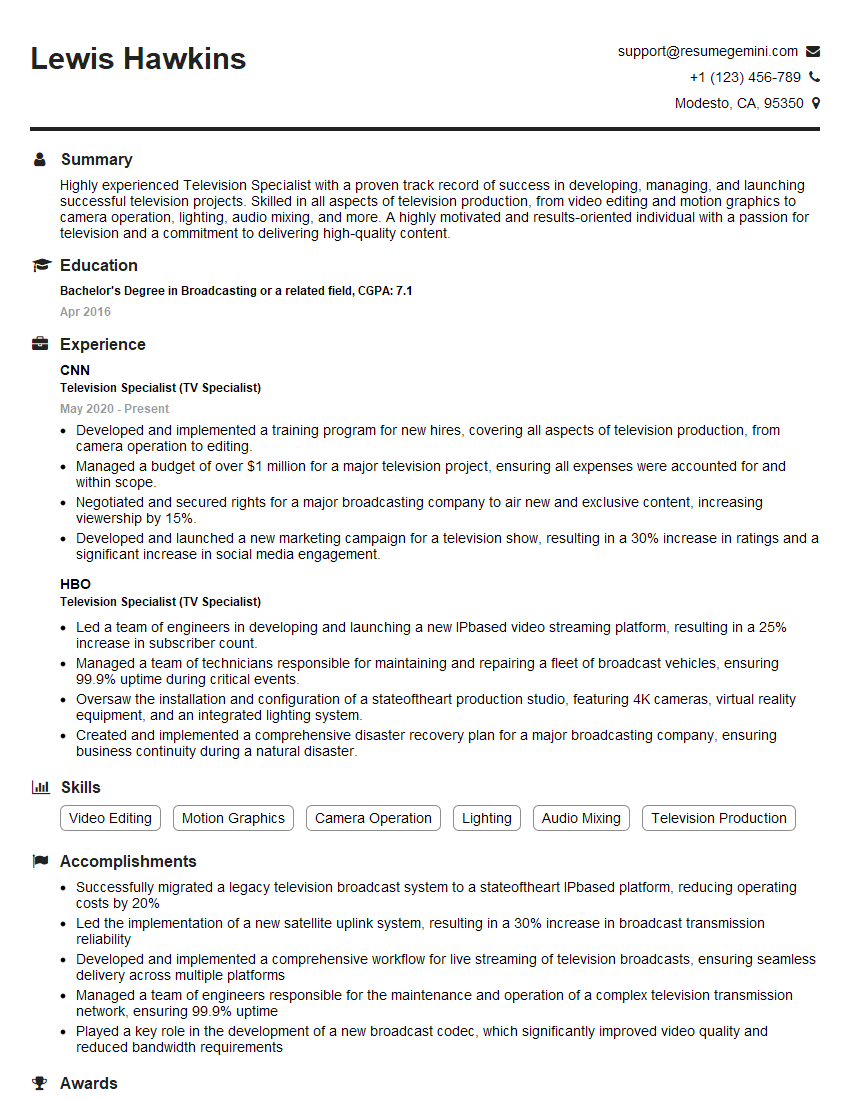
Ever felt underprepared for that crucial job interview? Or perhaps you’ve landed the interview but struggled to articulate your skills and experiences effectively? Fear not! We’ve got you covered. In this blog post, we’re diving deep into the Television Specialist (TV Specialist) interview questions that you’re most likely to encounter. But that’s not all. We’ll also provide expert insights into the key responsibilities of a Television Specialist (TV Specialist) so you can tailor your answers to impress potential employers.
Acing the interview is crucial, but landing one requires a compelling resume that gets you noticed. Crafting a professional document that highlights your skills and experience is the first step toward interview success. ResumeGemini can help you build a standout resume that gets you called in for that dream job.






Essential Interview Questions For Television Specialist (TV Specialist)
1. Explain the key aspects of a television camera system.
A television camera system comprises several essential components, including:
- Camera body (lens, image sensor, and electronics)
- Lens (controls field of view and depth of field)
- Image sensor (converts light into electrical signals)
- Color filter array (captures color information)
- Processing circuits (adjusts image quality and prepares for transmission)
2. Describe the principles of video signal processing.
Analog Video Processing
- Converts analog electrical signals from the camera into digital data
- Includes techniques like color correction, noise reduction, and compositing
Digital Video Processing
- Operates on digital video data
- Allows for more advanced processing, such as compression, filtering, and special effects
3. Discuss the different types of television broadcasting formats.
Various television broadcasting formats exist, including:
- NTSC (used in North America, Japan, and parts of South America)
- PAL (used in Europe, Africa, and parts of Asia)
- SECAM (used in parts of Africa and Europe)
- DVB-T (digital terrestrial television broadcast standard)
- ATSC (digital television standard used in North America)
4. Explain the fundamentals of video compression.
Video compression techniques reduce the size of video files for efficient transmission and storage.
- Lossless compression: Preserves all the data, but may not compress as much
- Lossy compression: Removes some data, resulting in lower file size but possible loss of visual quality
- Codecs (encoders and decoders): Algorithms that perform video compression and decompression
5. Describe the process of video transmission.
Video transmission involves sending video signals from a source to a receiver.
- Modulation: Converts video signals into radio waves or other transmission formats
- Transmission: Sends modulated signals through a transmission medium (e.g., cable, satellite, or fiber optics)
- Reception: Receives and demodulates signals to recover the original video content
6. Discuss the principles of video editing.
Video editing involves manipulating and assembling video footage to create a desired outcome.
- Trimming and cutting: Removing unwanted sections of footage
- Splicing and joining: Combining multiple clips into a single sequence
- Transitions: Adding visual effects between clips (e.g., fades, wipes, dissolves)
- Color grading: Adjusting colors and light to enhance the visual appeal
7. Explain the concept of video distribution.
Video distribution refers to the delivery of video content to end users.
- Broadcast: Transmits video signals over the airwaves
- Cable: Delivers video content through coaxial cables
- Satellite: Transmits video signals from satellites in space
- Streaming: Delivers video content over the internet
8. Discuss the emerging trends in television technology.
The television industry is constantly evolving with new technologies.
- Ultra-high definition (UHD) and 8K resolution: Higher image quality with more detail
- High dynamic range (HDR): Wider range of colors and contrast
- Virtual reality (VR) and augmented reality (AR): Immersive video experiences
- Artificial intelligence (AI): Enhancing video production, editing, and distribution
9. Describe the key challenges and opportunities in the television industry.
Challenges
- Competition from streaming services
- Declining viewership of traditional TV
- Need for innovation
Opportunities
- Growth of video on demand (VOD)
- New advertising models
- Expansion into new markets
10. How do you stay up-to-date with the latest advancements in television technology?
I keep myself informed about the latest advancements in television technology through various means:
- Attending industry conferences and webinars
- Reading technical publications and online resources
- Networking with professionals in the field
- Experimenting with new technologies and software
Interviewers often ask about specific skills and experiences. With ResumeGemini‘s customizable templates, you can tailor your resume to showcase the skills most relevant to the position, making a powerful first impression. Also check out Resume Template specially tailored for Television Specialist (TV Specialist).
Career Expert Tips:
- Ace those interviews! Prepare effectively by reviewing the Top 50 Most Common Interview Questions on ResumeGemini.
- Navigate your job search with confidence! Explore a wide range of Career Tips on ResumeGemini. Learn about common challenges and recommendations to overcome them.
- Craft the perfect resume! Master the Art of Resume Writing with ResumeGemini’s guide. Showcase your unique qualifications and achievements effectively.
- Great Savings With New Year Deals and Discounts! In 2025, boost your job search and build your dream resume with ResumeGemini’s ATS optimized templates.
Researching the company and tailoring your answers is essential. Once you have a clear understanding of the Television Specialist (TV Specialist)‘s requirements, you can use ResumeGemini to adjust your resume to perfectly match the job description.
Key Job Responsibilities
Television Specialists, also known as TV Specialists, are responsible for a wide range of duties related to television production and broadcasting. They work closely with producers, directors, and other crew members to ensure that television programs are produced and aired smoothly.
1. Production Management
TV Specialists assist in the planning and execution of television productions. They may be involved in tasks such as:
- Scheduling shoots
- Booking crew and equipment
- Managing budgets
2. Technical Operations
TV Specialists have a deep understanding of television technology and are responsible for ensuring that the technical aspects of a production run smoothly. This may include tasks such as:
- Operating cameras and other equipment
- Editing and post-producing footage
- Maintaining and troubleshooting equipment
3. Creative Input
While TV Specialists primarily focus on the technical aspects of television production, they may also provide creative input on projects. They may work with producers and directors to brainstorm ideas, develop storylines, and create visuals.
4. Client Relations
TV Specialists often work directly with clients to ensure that their needs are met. They may be responsible for tasks such as:
- Presenting proposals
- Negotiating contracts
- Providing customer service
Interview Tips
Preparing for an interview for a Television Specialist position requires a combination of technical knowledge, industry experience, and soft skills. Here are some tips to help you ace the interview:
1. Research the Company and the Role
Take the time to research the company you’re applying to and the specific role you’re interviewing for. This will help you understand the company’s culture, values, and the specific responsibilities of the position. You can find this information on the company’s website, LinkedIn page, and other online resources.
2. Highlight Your Technical Skills
TV Specialists need to have a strong understanding of television production technology. In your interview, be sure to highlight your skills in operating cameras, editing footage, and troubleshooting equipment. You can also mention any relevant certifications or training programs you’ve completed.
3. Showcase Your Industry Experience
If you have any previous experience in the television industry, be sure to highlight it in your interview. This could include internships, freelance work, or even volunteer experience. Any experience that demonstrates your understanding of the industry and your ability to work in a television production environment will be valuable.
4. Demonstrate Your Soft Skills
In addition to technical skills and industry experience, TV Specialists also need to have strong soft skills. These skills include communication, teamwork, and problem-solving. In your interview, be sure to highlight your ability to work well with others, your ability to solve problems quickly and efficiently, and your ability to communicate clearly and effectively.
5. Prepare Questions for the Interviewer
Asking thoughtful questions at the end of an interview shows that you’re engaged and interested in the position. It also gives you an opportunity to learn more about the company and the role. Some good questions to ask include:
- What are the biggest challenges facing the television industry today?
- What are the company’s goals for the future?
- What are the expectations for the Television Specialist role?
Next Step:
Armed with this knowledge, you’re now well-equipped to tackle the Television Specialist (TV Specialist) interview with confidence. Remember, preparation is key. So, start crafting your resume, highlighting your relevant skills and experiences. Don’t be afraid to tailor your application to each specific job posting. With the right approach and a bit of practice, you’ll be well on your way to landing your dream job. Build your resume now from scratch or optimize your existing resume with ResumeGemini. Wish you luck in your career journey!