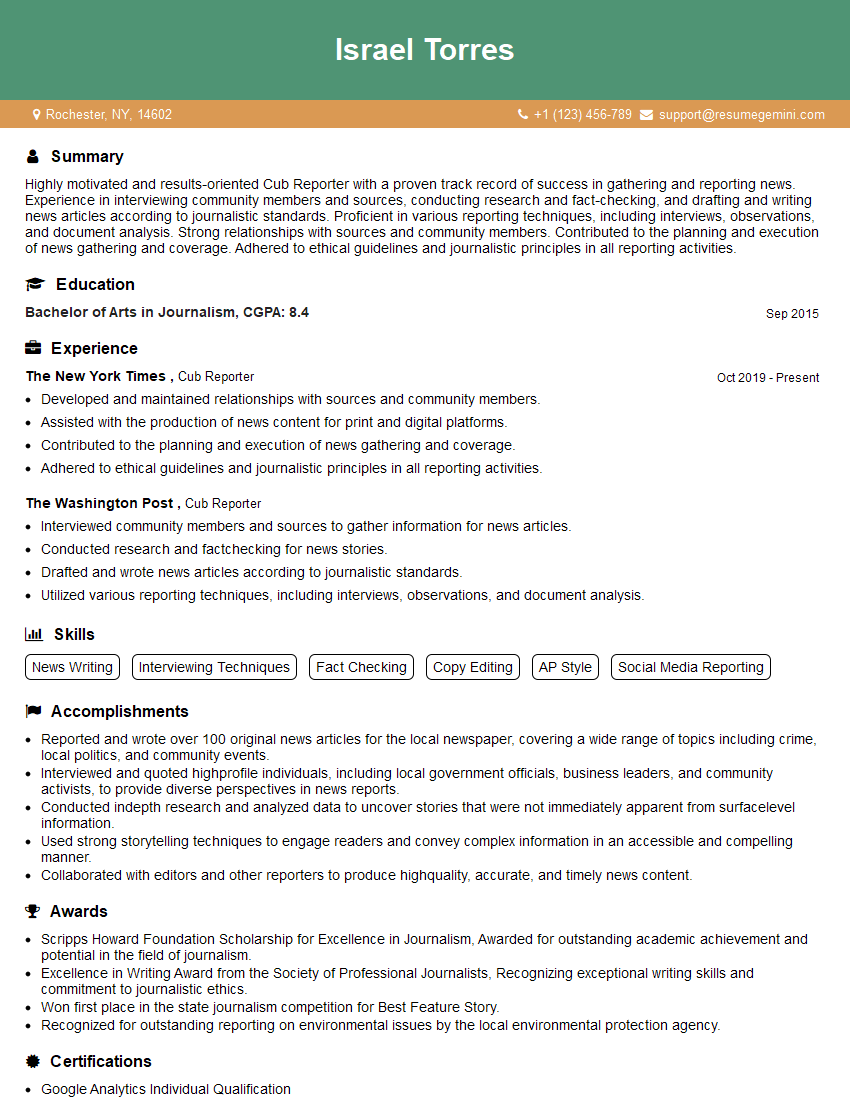
Are you gearing up for a career in Cub Reporter? Feeling nervous about the interview questions that might come your way? Don’t worry, you’re in the right place. In this blog post, we’ll dive deep into the most common interview questions for Cub Reporter and provide you with expert-backed answers. We’ll also explore the key responsibilities of this role so you can tailor your responses to showcase your perfect fit.
Acing the interview is crucial, but landing one requires a compelling resume that gets you noticed. Crafting a professional document that highlights your skills and experience is the first step toward interview success. ResumeGemini can help you build a standout resume that gets you called in for that dream job.






Essential Interview Questions For Cub Reporter
1. How would you approach gathering information for a story about a local business opening?
- Contact the business owner or manager for an interview.
- Research the business online, including its website and social media pages.
- Attend the business opening and speak with customers and staff.
- Check with the local chamber of commerce or other business organizations.
- Reach out to local residents to get their perspective on the new business.
2. What are some of the most important ethical considerations for a cub reporter?
Accuracy
- Verify information from multiple sources.
- Be transparent about any potential biases or conflicts of interest.
- Correct errors promptly and publicly.
Objectivity
- Avoid sensationalism and bias in reporting.
- Present both sides of a story fairly.
- Use neutral language and avoid personal opinions.
Confidentiality
- Protect the privacy of sources.
- Do not reveal confidential information unless it is in the public interest.
- Obtain consent before using quotes or other personal information.
3. How would you go about writing a compelling lede that will grab the reader’s attention?
- Use a strong hook, such as a surprising fact, a question, or a quote.
- Keep it short and concise, no more than 30-40 words.
- Provide enough information to pique the reader’s interest and make them want to read more.
- Use active voice and strong verbs.
- Avoid clichés and jargon.
4. What are some of the most important qualities of a successful cub reporter?
- Curiosity and a passion for storytelling.
- Strong writing and communication skills.
- Ability to meet deadlines and work independently.
- Persistence and determination.
- Ethical and professional standards.
5. How would you handle a situation where you are covering a controversial topic and there are multiple perspectives on the issue?
- Research the issue thoroughly and gather information from all sides.
- Interview a variety of sources with different perspectives.
- Present all sides of the issue fairly and objectively.
- Avoid stating opinions as facts.
- Be transparent about any potential biases or conflicts of interest.
6. What is your understanding of the role of social media in journalism?
- Social media can be a valuable tool for gathering information.
- It can be used to connect with sources and build relationships.
- It can be used to promote stories and engage with readers.
- It is important to use social media responsibly and ethically.
- Reporters should be aware of the potential risks of using social media, such as misinformation and harassment.
7. How would you go about developing a story idea and pitching it to an editor?
- Identify a newsworthy topic that is relevant to the target audience.
- Research the topic thoroughly and gather some preliminary information.
- Write a brief pitch that outlines the story idea, the main points, and the potential sources.
- Be prepared to answer questions from the editor about the story.
- Be willing to revise the pitch based on the editor’s feedback.
8. What are some of the most important things to keep in mind when writing a news story?
- Accuracy and fairness.
- Clarity and conciseness.
- Objectivity and balance.
- Proper attribution and sourcing.
- Strong lede and compelling narrative.
9. How would you handle a situation where you are working on a story that is sensitive or potentially harmful to someone involved?
- Be respectful and compassionate.
- Obtain informed consent before using any information or quotes.
- Protect the privacy of sources and individuals involved.
- Consider the potential impact of the story on all parties involved.
- Be willing to listen to feedback and make changes if necessary.
10. What are your aspirations for your career in journalism?
- To become a skilled and ethical reporter.
- To write stories that make a difference in the community.
- To advance my skills and knowledge through experience and training.
- To work for a reputable news organization.
- To contribute to the public discourse and hold those in power accountable.
Interviewers often ask about specific skills and experiences. With ResumeGemini‘s customizable templates, you can tailor your resume to showcase the skills most relevant to the position, making a powerful first impression. Also check out Resume Template specially tailored for Cub Reporter.
Career Expert Tips:
- Ace those interviews! Prepare effectively by reviewing the Top 50 Most Common Interview Questions on ResumeGemini.
- Navigate your job search with confidence! Explore a wide range of Career Tips on ResumeGemini. Learn about common challenges and recommendations to overcome them.
- Craft the perfect resume! Master the Art of Resume Writing with ResumeGemini’s guide. Showcase your unique qualifications and achievements effectively.
- Great Savings With New Year Deals and Discounts! In 2025, boost your job search and build your dream resume with ResumeGemini’s ATS optimized templates.
Researching the company and tailoring your answers is essential. Once you have a clear understanding of the Cub Reporter‘s requirements, you can use ResumeGemini to adjust your resume to perfectly match the job description.
Key Job Responsibilities
Cub Reporters are entry-level journalists who are responsible for writing short, fact-based news stories for newspapers and other publications. They typically work under the supervision of more experienced reporters and editors.
1. Write news stories
Cub Reporters are responsible for writing short, fact-based news stories about a variety of topics. These stories may be about local events, national news, or international affairs. Cub Reporters must be able to write clearly and concisely, and they must be able to meet deadlines.
- Gather information from sources such as interviews, press releases, and public records.
- Write accurate and unbiased news stories that meet the publication’s style and standards.
2. Conduct interviews
Cub Reporters often conduct interviews with sources to gather information for their stories. They must be able to ask probing questions and get sources to open up. Cub Reporters must also be able to build relationships with sources so that they can continue to get information from them in the future.
- Interview sources to gather information for news stories.
- Build relationships with sources to maintain a steady flow of information.
3. Research stories
Cub Reporters must be able to research stories to gather information. They may use online databases, public records, and other sources to find information about people, places, and events.
- Research stories to gather information and develop story ideas.
- Use a variety of sources to find information, such as online databases, public records, and interviews.
4. Edit and proofread stories
Cub Reporters must be able to edit and proofread their own stories before submitting them for publication. They must check for grammar, spelling, and punctuation errors, and they must make sure that the stories are clear and concise.
- Edit and proofread stories to ensure accuracy and clarity.
- Meet deadlines and follow publication guidelines.
Interview Tips
Preparing for a job interview can be daunting, but there are a few things you can do to increase your chances of success.
1. Research the company and the position
Before you go on an interview, it is important to research the company and the position you are applying for. This will help you understand the company’s culture and values, and it will also help you answer questions about the position.
- Visit the company’s website and social media pages.
- Read articles about the company and its industry.
- Talk to people who work at the company, if possible.
2. Practice answering common interview questions
There are a few common interview questions that you are likely to be asked, such as “Tell me about yourself” and “Why are you interested in this position?” It is helpful to practice answering these questions in advance so that you can deliver your answers confidently and clearly.
- Use the STAR method to answer behavioral questions.
- Prepare examples of your work that demonstrate your skills and experience.
- Practice answering questions with a friend or family member.
3. Dress professionally
First impressions matter, so it is important to dress professionally for your interview. This means wearing clean, pressed clothes that are appropriate for the workplace.
- Choose clothes that are comfortable and allow you to move freely.
- Avoid wearing clothing that is too revealing or too casual.
- Make sure your shoes are clean and polished.
4. Be on time
Punctuality is important, so make sure you arrive for your interview on time. If you are running late, call or email the interviewer to let them know.
- Plan your route in advance and allow extra time for traffic.
- If you are running late, call or email the interviewer as soon as possible.
- Arrive at the interview location a few minutes early to give yourself time to calm down and prepare.
5. Be yourself
The most important thing is to be yourself during your interview. The interviewer wants to get to know the real you, so don’t try to be someone you’re not. Just be confident, answer the questions honestly, and let your personality shine through.
- Be honest about your skills and experience.
- Don’t try to be someone you’re not.
- Let your personality shine through.
Next Step:
Now that you’re armed with a solid understanding of what it takes to succeed as a Cub Reporter, it’s time to turn that knowledge into action. Take a moment to revisit your resume, ensuring it highlights your relevant skills and experiences. Tailor it to reflect the insights you’ve gained from this blog and make it shine with your unique qualifications. Don’t wait for opportunities to come to you—start applying for Cub Reporter positions today and take the first step towards your next career milestone. Your dream job is within reach, and with a polished resume and targeted applications, you’ll be well on your way to achieving your career goals! Build your resume now with ResumeGemini.