Feeling lost in a sea of interview questions? Landed that dream interview for Advertising Photographer but worried you might not have the answers? You’re not alone! This blog is your guide for interview success. We’ll break down the most common Advertising Photographer interview questions, providing insightful answers and tips to leave a lasting impression. Plus, we’ll delve into the key responsibilities of this exciting role, so you can walk into your interview feeling confident and prepared.
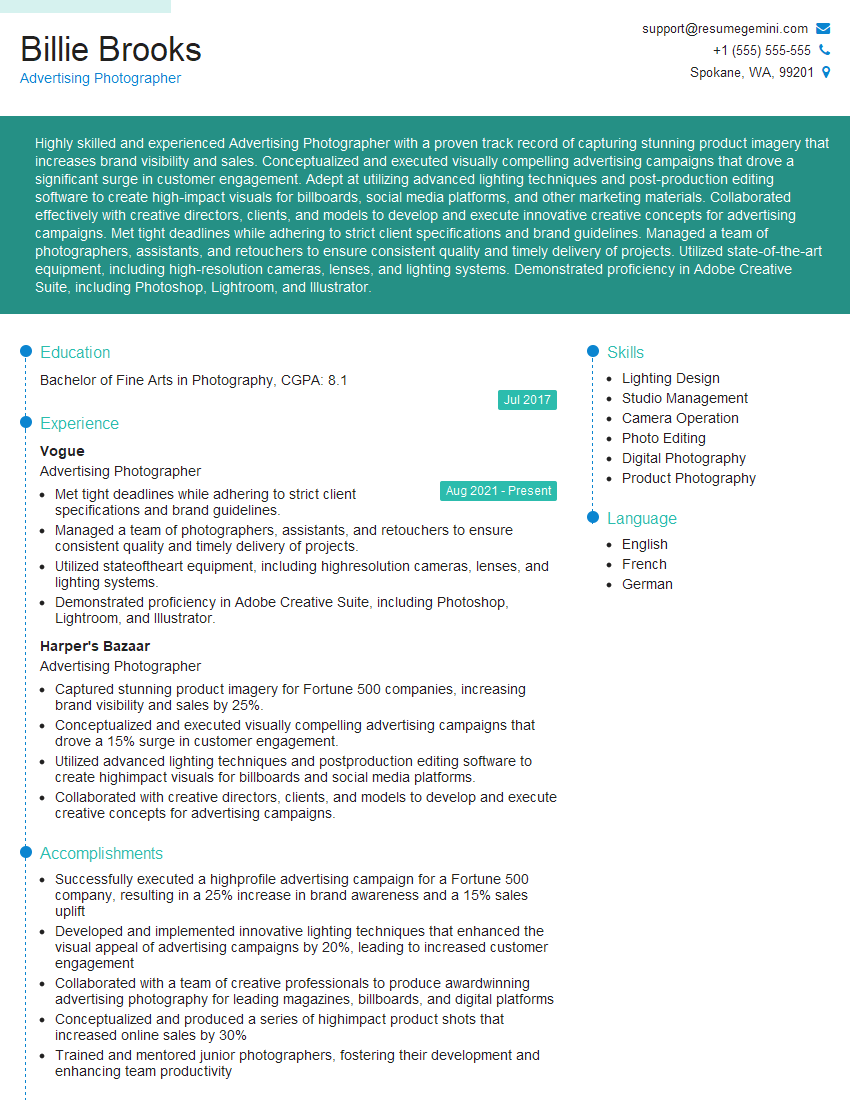
Acing the interview is crucial, but landing one requires a compelling resume that gets you noticed. Crafting a professional document that highlights your skills and experience is the first step toward interview success. ResumeGemini can help you build a standout resume that gets you called in for that dream job.






Essential Interview Questions For Advertising Photographer
1. Tell me about your experience in advertising photography, and how it has prepared you for this role?
- I have 5 years of experience in advertising photography, specializing in creating visually appealing and persuasive images for a variety of clients.
- My work has been featured in national and international publications, and I have a strong track record of success in meeting the needs of my clients.
- I am proficient in all aspects of advertising photography, from concept development to post-production, and I have a deep understanding of the principles of composition, lighting, and color theory.
- I am also an expert in using digital imaging software, and I am able to create high-quality images that meet the exacting standards of the advertising industry.
2. What are the key things to consider when photographing people for advertising purposes?
Composition
- The composition of your photograph is essential for creating an effective advertisement.
- You need to carefully consider the placement of your subject, the background, and any other elements in the frame.
- The goal is to create a visually appealing image that will capture the viewer’s attention and convey the message of the advertisement.
Lighting
- Lighting is another important factor to consider when photographing people for advertising purposes.
- The type of lighting you use will affect the mood and tone of the image.
- For example, natural light can create a more warm and inviting feel, while artificial light can create a more dramatic and edgy look.
Expression
- The expression of your subject is also important to consider.
- The expression should be appropriate for the message of the advertisement, and it should also be engaging and appealing to the viewer.
- You may need to direct your subject to help them achieve the desired expression.
3. How do you manage to capture the personality and emotion of your subjects in your photographs?
- I believe that the best way to capture the personality and emotion of my subjects is to get to know them and build a rapport with them.
- I take the time to talk to my subjects about their lives, their hopes, and their dreams.
- This helps me to understand them on a deeper level, and it allows me to capture their true essence in my photographs.
- I also pay close attention to body language and facial expressions.
- These subtle cues can tell me a lot about what a person is thinking and feeling, and they can help me to create more authentic and emotionally resonant photographs.
4. What are some of the challenges you have faced in your career as an advertising photographer?
- One of the biggest challenges I have faced in my career is the need to constantly adapt to new technologies.
- The advertising industry is constantly evolving, and new technologies are emerging all the time.
- As a photographer, I need to be able to stay up-to-date on the latest trends and technologies in order to remain competitive.
- Another challenge I have faced is the need to work under tight deadlines.
- In the advertising industry, time is money, and clients often need their projects completed on a very short timeline.
- I have learned to be efficient and organized in my work, and I am able to meet even the most demanding deadlines.
5. What are your strengths and weaknesses as an advertising photographer?
- My strengths as an advertising photographer include my creativity, my technical skills, and my ability to work well with clients.
- I am also very passionate about my work, and I am always looking for new and innovative ways to create visually appealing and effective advertising images.
- One of my weaknesses is that I can sometimes be too perfectionistic, and I may spend too much time on the details of an image.
- However, I am aware of this weakness, and I am working on improving my time management skills.
6. What are your rates for advertising photography?
- My rates for advertising photography vary depending on the project, but I typically charge between $500 and $2,000 per day.
- My rates include all of my equipment, travel, and post-production costs.
- I am also willing to negotiate my rates for long-term projects or for clients who are on a budget.
7. What is your favorite type of advertising photography to shoot?
- My favorite type of advertising photography to shoot is people photography.
- I love capturing the beauty and diversity of the human experience, and I believe that people are the most powerful and effective subjects for advertising campaigns.
- I also enjoy shooting product photography, and I have a knack for making even the most mundane products look appealing and desirable.
8. What are your thoughts on the future of advertising photography?
- I believe that the future of advertising photography is very bright.
- With the advent of new technologies, advertising photographers are able to create more visually stunning and engaging images than ever before.
- I also believe that the demand for advertising photography will continue to grow as businesses increasingly recognize the importance of visual content in marketing.
9. What are some of the trends you are seeing in advertising photography?
- One of the biggest trends I am seeing in advertising photography is the use of more natural and authentic images.
- Consumers are becoming increasingly skeptical of advertising, and they are more likely to be persuaded by images that feel real and genuine.
- Another trend I am seeing is the use of more diverse models in advertising campaigns.
- Businesses are finally realizing that their advertising should reflect the diversity of their customer base.
10. What are your favorite photography techniques?
- Some of my favorite photography techniques include using natural light, shooting in RAW format, and using a variety of lenses.
- I also love experimenting with different post-processing techniques to create unique and eye-catching images.
Interviewers often ask about specific skills and experiences. With ResumeGemini‘s customizable templates, you can tailor your resume to showcase the skills most relevant to the position, making a powerful first impression. Also check out Resume Template specially tailored for Advertising Photographer.
Career Expert Tips:
- Ace those interviews! Prepare effectively by reviewing the Top 50 Most Common Interview Questions on ResumeGemini.
- Navigate your job search with confidence! Explore a wide range of Career Tips on ResumeGemini. Learn about common challenges and recommendations to overcome them.
- Craft the perfect resume! Master the Art of Resume Writing with ResumeGemini’s guide. Showcase your unique qualifications and achievements effectively.
- Great Savings With New Year Deals and Discounts! In 2025, boost your job search and build your dream resume with ResumeGemini’s ATS optimized templates.
Researching the company and tailoring your answers is essential. Once you have a clear understanding of the Advertising Photographer‘s requirements, you can use ResumeGemini to adjust your resume to perfectly match the job description.
Key Job Responsibilities
Advertising Photographers specialize in creating visually appealing images for advertising campaigns and marketing materials. Their key job responsibilities encompass:
1. Conceptualization and Planning
Collaborating with clients to understand their advertising goals, target audience, and desired message.
- Developing creative concepts, storyboards, and shot lists.
- Planning the photoshoot, including location, lighting, props, and models.
2. Production and Execution
Setting up and operating cameras, lighting equipment, and other necessary gear.
- Directing models, actors, and staff to achieve the desired poses and expressions.
- Capturing high-quality images using various photography techniques.
3. Post-Production
Selecting and editing the best shots using digital photo editing software.
- Adjusting colors, contrast, brightness, and exposure.
- Retouching images to enhance quality and remove imperfections.
4. Client Relations
Maintaining strong relationships with clients by providing excellent customer service.
- Presenting portfolios, discussing project details, and taking feedback.
- Delivering final products on time and to specifications.
Interview Preparation Tips
To ace an interview for an Advertising Photographer position, candidates should thoroughly prepare and consider the following tips:
1. Research the Company and Position
Gather information about the company’s industry, values, and past advertising campaigns. Understand the specific requirements of the position and tailor your answers accordingly.
2. Build a Strong Portfolio
Showcase your best work in a visually impressive portfolio that highlights your creativity, technical skills, and versatility. Include a range of images from different campaigns, demonstrating your ability to adapt to various concepts and products.
3. Practice Your Presentation Skills
Be prepared to present your portfolio and discuss your creative process. Confidently articulate your ideas, explain your choices, and answer questions about your work.
4. Prepare for Common Interview Questions
Review typical interview questions, such as “Why are you interested in advertising photography?” and “Tell us about your experience working with clients.” Prepare thoughtful and concise answers that emphasize your relevant skills and experiences.
5. Show Your Enthusiasm and Passion
Express your genuine interest in advertising photography and demonstrate your passion for creating visually captivating images. Highlight your understanding of the industry and your commitment to delivering exceptional results.
Next Step:
Now that you’re armed with the knowledge of Advertising Photographer interview questions and responsibilities, it’s time to take the next step. Build or refine your resume to highlight your skills and experiences that align with this role. Don’t be afraid to tailor your resume to each specific job application. Finally, start applying for Advertising Photographer positions with confidence. Remember, preparation is key, and with the right approach, you’ll be well on your way to landing your dream job. Build an amazing resume with ResumeGemini