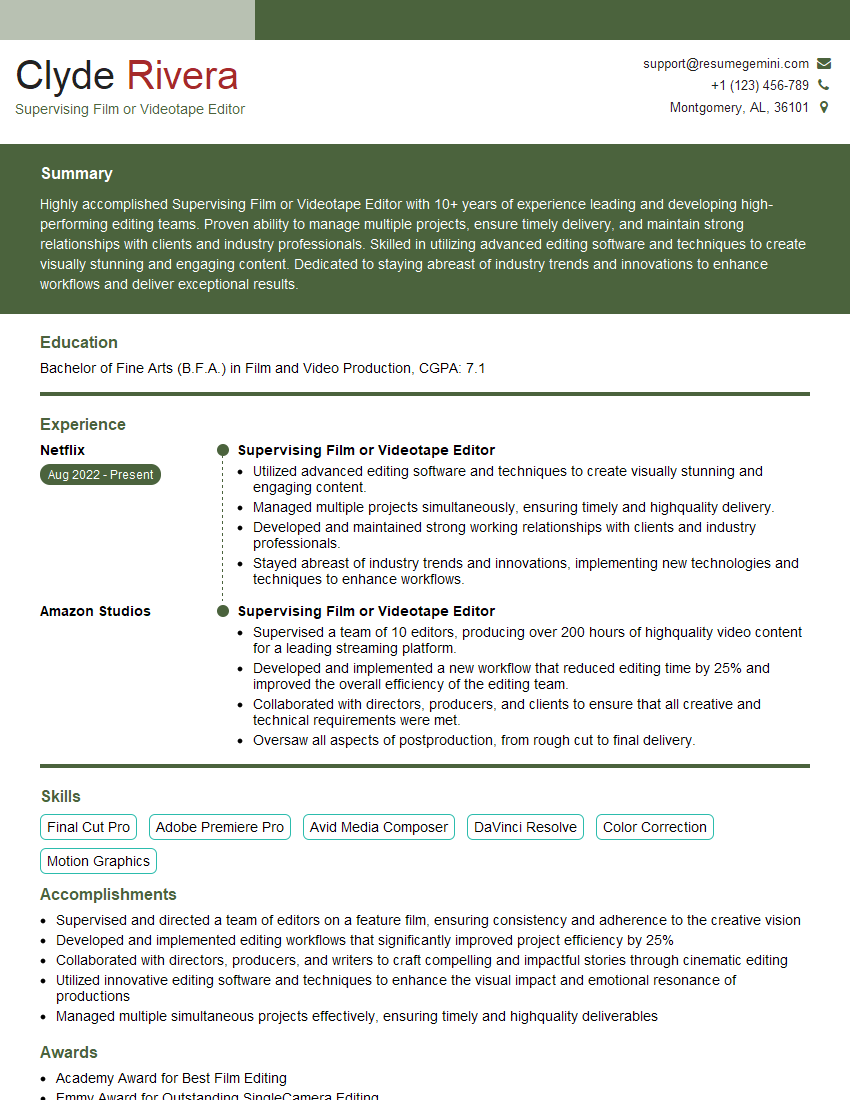
Are you gearing up for a career in Supervising Film or Videotape Editor? Feeling nervous about the interview questions that might come your way? Don’t worry, you’re in the right place. In this blog post, we’ll dive deep into the most common interview questions for Supervising Film or Videotape Editor and provide you with expert-backed answers. We’ll also explore the key responsibilities of this role so you can tailor your responses to showcase your perfect fit.
Acing the interview is crucial, but landing one requires a compelling resume that gets you noticed. Crafting a professional document that highlights your skills and experience is the first step toward interview success. ResumeGemini can help you build a standout resume that gets you called in for that dream job.






Essential Interview Questions For Supervising Film or Videotape Editor
1. Describe the process of editing a long-form documentary?
The editing process of a long-form documentary typically involves the following steps:
- Ingesting and organizing footage: Import all raw footage into the editing software and organize it into bins or folders based on scene, subject, or other relevant criteria.
- Creating a rough cut: Assemble a rough cut of the documentary by placing the footage in a logical order and trimming it to remove unnecessary material.
- Developing a structure: Determine the overall structure and narrative arc of the documentary and make adjustments to the rough cut to enhance its coherence and impact.
- Fine-tuning the edit: Refine the timing, pacing, and transitions of the footage to create a smooth and engaging viewing experience.
- Adding additional elements: Incorporate elements such as music, sound effects, and graphics to enhance the documentary’s emotional impact and storytelling.
- Collaboration and feedback: Share the edit with collaborators such as the director, producers, and other stakeholders and gather their input to improve the final cut.
- Export and delivery: Export the final cut in the desired format and deliver it to the necessary channels for distribution.
2. How do you manage and collaborate with a team of editors on a large-scale project?
Establishing a clear workflow
- Define roles and responsibilities for each editor.
- Create a shared editing system with organized folders and naming conventions.
- Set up regular communication channels for project updates and feedback.
Promoting collaboration
- Facilitate regular review sessions where editors share their work and receive feedback.
- Encourage open communication and brainstorming to generate creative ideas.
- Use project management tools to track progress and coordinate tasks.
3. What are the key differences between linear and non-linear editing?
- Linear editing:
- Footage is arranged on a physical timeline, similar to traditional film editing.
- Cuts and transitions are made by physically cutting and splicing the footage.
- Limited flexibility in making changes, as footage cannot be easily rearranged or adjusted.
- Non-linear editing:
- Footage is stored digitally and arranged on a virtual timeline.
- Cuts, transitions, and other effects can be applied digitally, allowing for greater flexibility.
- Changes can be made quickly and easily, as footage can be rearranged, shortened, or extended.
4. How do you approach color correction and grading for different types of projects?
- Documentary: Aim for a natural and realistic color palette that enhances the authenticity of the footage.
- Commercial: Use vibrant and eye-catching colors to convey the brand’s message and evoke emotions.
- Narrative film: Adjust colors to create a specific mood, atmosphere, or visual style that supports the story.
- Music video: Experiment with unconventional and creative color grading techniques to complement the music and create a unique visual experience.
5. Describe your experience in using advanced editing techniques, such as compositing and special effects?
- Compositing:
- Combining multiple layers of footage to create a single, seamless image.
- Used for creating visual effects, removing unwanted elements, or adding virtual backgrounds.
- Special effects:
- Adding digital effects such as explosions, weather simulations, or character animations.
- Used to enhance the visual impact and create a more immersive viewing experience.
- Specific examples and projects where these techniques were applied
6. How do you stay up-to-date with the latest editing software and technology?
- Attend industry conferences and workshops.
- Read industry publications and blogs.
- Experiment with new software and techniques in personal projects.
- Network with other editors and professionals in the field.
- Take online courses or certifications to enhance skills.
7. What are the ethical considerations when editing footage?
- Objectivity: Maintain an impartial stance when editing, avoiding bias or manipulation of the footage.
- Informed consent: Obtain consent from subjects before using their footage, especially if it involves sensitive or personal information.
- Accuracy: Ensure that the edited footage accurately represents the events or story being portrayed.
- Contextualization: Provide sufficient context to avoid misinterpretation or confusion.
- Respect for privacy: Blur or remove faces or other identifying features if necessary to protect individuals’ privacy.
8. How do you handle feedback and criticism on your editing work?
- Listen attentively: Pay attention to the feedback and try to understand the perspective of the reviewer.
- Evaluate objectively: Consider the feedback objectively and assess its validity and relevance.
- Ask clarifying questions: Seek clarification if necessary to ensure a clear understanding of the feedback.
- Implement constructive criticism: Incorporate constructive criticism into your work to improve the final product.
- Communicate professionally: Respond to feedback respectfully and professionally, even if you do not agree with it entirely.
9. Describe your process for creating a compelling and impactful story through editing?
- Identifying the story arc: Determine the main narrative and emotional journey of the story.
- Structuring the footage: Arrange the footage in a logical order that supports the story arc and builds tension.
- Crafting transitions: Use transitions to connect scenes seamlessly and maintain the flow of the story.
- Using pacing and rhythm: Adjust the pacing and rhythm of the edit to enhance the emotional impact and engagement.
- Highlighting key moments: Emphasize important moments or plot points through editing techniques such as slow motion or close-ups.
10. What are the qualities of an effective Supervising Film or Videotape Editor?
- Technical proficiency: In-depth knowledge of editing software, color correction tools, and other technical aspects.
- Storytelling skills: Ability to identify and craft compelling narratives through editing.
- Team leadership: Proven ability to manage and inspire a team of editors.
- Communication skills: Excellent written and verbal communication to convey ideas effectively.
- Adaptability: Ability to handle multiple projects and deadlines while maintaining high standards.
- Attention to detail: Meticulousness and precision in ensuring the final product meets the highest quality standards.
Interviewers often ask about specific skills and experiences. With ResumeGemini‘s customizable templates, you can tailor your resume to showcase the skills most relevant to the position, making a powerful first impression. Also check out Resume Template specially tailored for Supervising Film or Videotape Editor.
Career Expert Tips:
- Ace those interviews! Prepare effectively by reviewing the Top 50 Most Common Interview Questions on ResumeGemini.
- Navigate your job search with confidence! Explore a wide range of Career Tips on ResumeGemini. Learn about common challenges and recommendations to overcome them.
- Craft the perfect resume! Master the Art of Resume Writing with ResumeGemini’s guide. Showcase your unique qualifications and achievements effectively.
- Great Savings With New Year Deals and Discounts! In 2025, boost your job search and build your dream resume with ResumeGemini’s ATS optimized templates.
Researching the company and tailoring your answers is essential. Once you have a clear understanding of the Supervising Film or Videotape Editor‘s requirements, you can use ResumeGemini to adjust your resume to perfectly match the job description.
Key Job Responsibilities
Supervising Film or Videotape Editors are responsible for overseeing and coordinating the work of other editors, as well as performing editing tasks themselves. They work with directors and producers to determine the overall vision for a project and ensure that it is executed according to plan.
1. Plan and Supervise Editing Projects
Supervising Editors plan and supervise all aspects of editing projects, from pre-production to post-production. They work with directors and producers to develop a creative vision for the project and ensure that it is executed according to plan.
- Develop and implement editing plans
- Supervise the work of other editors
- Review and approve edited footage
- Collaborate with directors and producers to ensure that the final product meets their creative vision
2. Edit Video Footage
Supervising Editors are also responsible for editing video footage themselves. They use a variety of editing software and techniques to create polished and professional-looking videos.
- Edit video footage using a variety of software and techniques
- Create transitions, effects, and titles
- Color correct and grade footage
- Add music and sound effects
3. Manage Editing Team
Supervising Editors manage a team of other editors and are responsible for their training, development, and performance.
- Supervise and mentor other editors
- Provide feedback and guidance
- Set deadlines and ensure that projects are completed on time and within budget
- Resolve conflicts and issues
4. Stay Up-to-Date on Editing Trends and Technologies
Supervising Editors must stay up-to-date on the latest editing trends and technologies. They must be familiar with the latest software and techniques in order to create cutting-edge videos.
- Stay up-to-date on the latest editing trends and technologies
- Attend workshops and conferences
- Read industry publications
- Experiment with new software and techniques
Interview Tips
Here are some interview tips for Supervising Film or Videotape Editors:
1. Prepare Your Portfolio
Your portfolio is one of the most important things you can bring to an interview. It will showcase your skills and experience and give the interviewer a sense of your creative vision. Make sure to include a variety of your work, including both short and long-form videos.
- Include a variety of your work, including both short and long-form videos
- Highlight your skills and experience
- Tailor your portfolio to the specific job you are applying for
2. Practice Your Editing Skills
Before your interview, practice your editing skills so that you can demonstrate your proficiency to the interviewer. You can do this by editing a short video or by creating a reel of your best work.
- Edit a short video or create a reel of your best work
- Practice using a variety of editing software and techniques
- Be prepared to discuss your editing process
3. Research the Company and the Position
Before your interview, research the company and the position you are applying for. This will show the interviewer that you are interested in the job and that you have taken the time to learn about the company.
- Visit the company website
- Read industry publications
- Talk to people who work at the company
- Prepare questions to ask the interviewer
4. Be Yourself
The most important thing you can do in an interview is to be yourself. Don’t try to be someone you’re not, because the interviewer will be able to tell. Just relax, be confident, and let your personality shine through.
- Be yourself
- Relax and be confident
- Let your personality shine through
Next Step:
Now that you’re armed with a solid understanding of what it takes to succeed as a Supervising Film or Videotape Editor, it’s time to turn that knowledge into action. Take a moment to revisit your resume, ensuring it highlights your relevant skills and experiences. Tailor it to reflect the insights you’ve gained from this blog and make it shine with your unique qualifications. Don’t wait for opportunities to come to you—start applying for Supervising Film or Videotape Editor positions today and take the first step towards your next career milestone. Your dream job is within reach, and with a polished resume and targeted applications, you’ll be well on your way to achieving your career goals! Build your resume now with ResumeGemini.