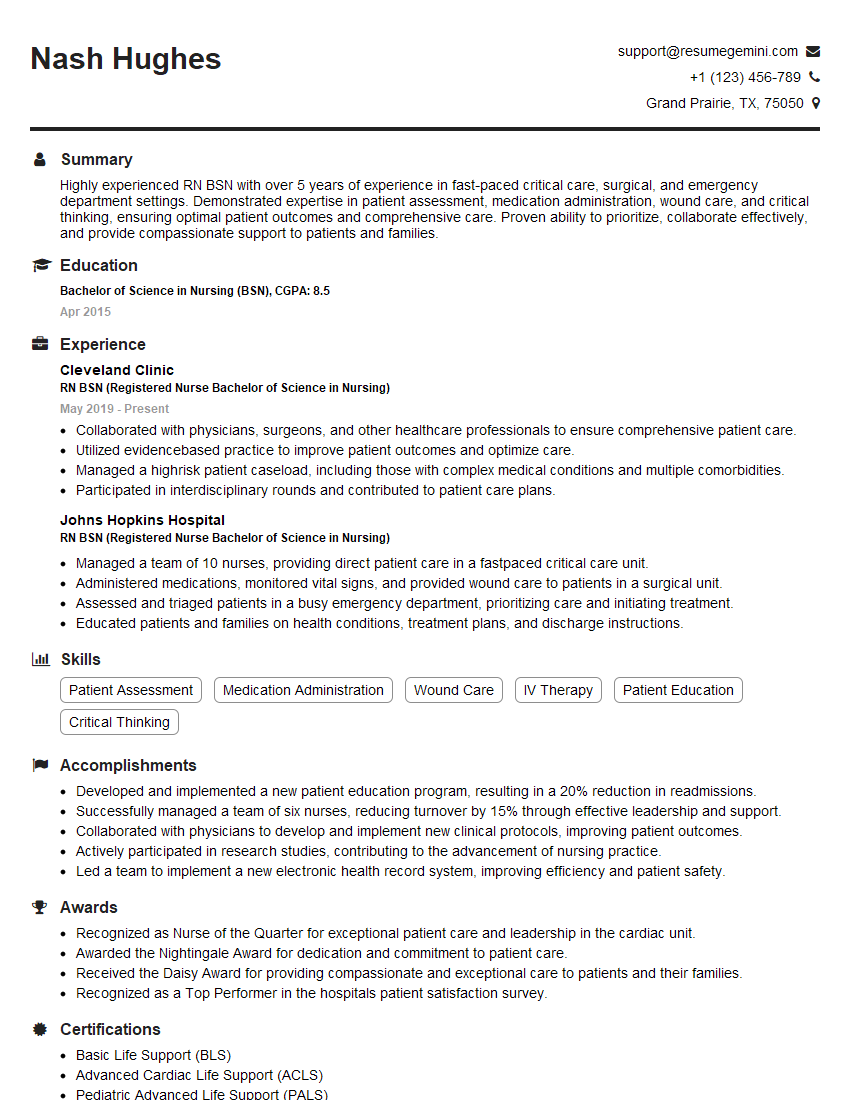
Feeling lost in a sea of interview questions? Landed that dream interview for RN BSN (Registered Nurse Bachelor of Science in Nursing) but worried you might not have the answers? You’re not alone! This blog is your guide for interview success. We’ll break down the most common RN BSN (Registered Nurse Bachelor of Science in Nursing) interview questions, providing insightful answers and tips to leave a lasting impression. Plus, we’ll delve into the key responsibilities of this exciting role, so you can walk into your interview feeling confident and prepared.
Acing the interview is crucial, but landing one requires a compelling resume that gets you noticed. Crafting a professional document that highlights your skills and experience is the first step toward interview success. ResumeGemini can help you build a standout resume that gets you called in for that dream job.






Essential Interview Questions For RN BSN (Registered Nurse Bachelor of Science in Nursing)
1. How would you prioritize care for multiple patients with varying needs?
- Triage according to severity of condition and urgency of need.
- Consult with other healthcare professionals to determine appropriate interventions.
- Delegate tasks to other members of the healthcare team as appropriate.
- Communicate effectively with patients and families to keep them informed and address their concerns.
- Reassess patients frequently to adjust care plans as needed.
2. Describe your experience with wound care management, including assessment, treatment, and documentation.
subheading of the answer
- Assess the wound for size, depth, type, and drainage.
- Clean and dress the wound according to best practices.
- Monitor the wound for signs of infection or complications.
- Document all wound care interventions and observations.
subheading of the answer
- Collaborate with other healthcare professionals to develop a comprehensive wound care plan.
- Educate patients and families on wound care techniques.
- Stay up-to-date on best practices for wound care management.
3. How would you manage a patient with acute respiratory distress syndrome (ARDS)?
- Monitor vital signs and oxygen saturation closely.
- Administer oxygen and other respiratory support as needed.
- Position the patient appropriately to promote ventilation.
- Manage fluids and electrolytes to prevent fluid overload or pulmonary edema.
- Provide sedation and analgesia as needed to reduce patient anxiety and improve comfort.
4. Describe your experience with administering and monitoring IV medications.
- Verify the medication order and perform a patient safety check.
- Prepare the medication according to the manufacturer’s instructions.
- Administer the medication via the prescribed route and method.
- Monitor the patient for any adverse effects or reactions.
- Document all IV medication administration and monitoring activities.
5. How would you respond to a patient who is experiencing a mental health crisis?
- Approach the patient calmly and respectfully.
- Listen to the patient’s concerns and try to understand their perspective.
- Avoid judgment or confrontation.
- Reassure the patient that they are safe and that help is available.
- Contact the appropriate healthcare professional for further assessment and treatment.
6. Describe your experience with providing patient education and counseling.
- Assess the patient’s learning needs and preferences.
- Develop and deliver patient education materials that are clear, concise, and culturally appropriate.
- Discuss the patient’s condition, treatment options, and discharge instructions in a way that is understandable.
- Answer patient questions and address their concerns.
- Provide ongoing support and reinforcement of patient education.
7. How would you advocate for a patient who is being discharged to a skilled nursing facility?
- Discuss the patient’s needs and preferences with the skilled nursing facility staff.
- Ensure that the patient’s medical records are complete and up-to-date.
- Provide the patient and their family with information about the skilled nursing facility and what to expect.
- Answer any questions or concerns that the patient or their family may have.
- Follow up with the patient after they have been discharged to the skilled nursing facility to ensure that their needs are being met.
8. Describe your experience with using electronic health records (EHRs).
- Document patient information, including vital signs, assessments, and interventions.
- Order medications and other treatments electronically.
- Communicate with other healthcare professionals through the EHR system.
- Use the EHR system to track patient progress and outcomes.
9. How would you handle a situation where you disagree with a physician’s orders?
- Clarify the order with the physician to ensure understanding.
- Express your concerns respectfully and provide evidence to support your position.
- Discuss alternative options and seek a compromise if possible.
- If the disagreement cannot be resolved, escalate the issue to the appropriate supervisor or manager.
- Document the disagreement and the steps taken to resolve it.
10. What are your continuing education goals as an RN BSN?
- Maintain certification in critical care nursing (CCRN).
- Complete a master’s degree in nursing education.
- Attend conferences and workshops on the latest advances in critical care nursing.
- Read peer-reviewed journals and research articles.
- Participate in online discussion forums and collaborate with colleagues on best practices.
Interviewers often ask about specific skills and experiences. With ResumeGemini‘s customizable templates, you can tailor your resume to showcase the skills most relevant to the position, making a powerful first impression. Also check out Resume Template specially tailored for RN BSN (Registered Nurse Bachelor of Science in Nursing).
Career Expert Tips:
- Ace those interviews! Prepare effectively by reviewing the Top 50 Most Common Interview Questions on ResumeGemini.
- Navigate your job search with confidence! Explore a wide range of Career Tips on ResumeGemini. Learn about common challenges and recommendations to overcome them.
- Craft the perfect resume! Master the Art of Resume Writing with ResumeGemini’s guide. Showcase your unique qualifications and achievements effectively.
- Great Savings With New Year Deals and Discounts! In 2025, boost your job search and build your dream resume with ResumeGemini’s ATS optimized templates.
Researching the company and tailoring your answers is essential. Once you have a clear understanding of the RN BSN (Registered Nurse Bachelor of Science in Nursing)‘s requirements, you can use ResumeGemini to adjust your resume to perfectly match the job description.
Key Job Responsibilities
RN BSNs are responsible for providing direct patient care in a variety of settings, including hospitals, clinics, and long-term care facilities. They work under the supervision of physicians and other healthcare professionals to assess patients’ needs, develop and implement care plans, and monitor patients’ progress.
1. Patient Care
RN BSNs are responsible for providing a wide range of patient care services, including:
- Assessing patients’ needs
- Developing and implementing care plans
- Monitoring patients’ progress
- Administering medications
- Providing wound care
- Educating patients and their families about health conditions and treatments
2. Collaboration with Healthcare Team
RN BSNs work closely with other members of the healthcare team, including physicians, nurse practitioners, pharmacists, and social workers. They share information about patients’ conditions and progress, and collaborate to develop and implement care plans.
3. Education and Research
RN BSNs are expected to stay up-to-date on the latest clinical research and best practices. They may participate in continuing education programs, read professional journals, and attend conferences to enhance their knowledge and skills.
4. Advocacy
RN BSNs are advocates for their patients. They ensure that patients’ rights are respected and that they receive the best possible care.
Interview Tips
Interviewing for an RN BSN position can be a daunting task, but there are a few things you can do to prepare and increase your chances of success.
1. Research the Organization
Before your interview, take some time to research the organization you’re applying to. This will help you understand their mission, values, and culture. You can also learn about their specific needs and how your skills and experience can benefit their organization.
2. Practice Your Answers
Once you’ve researched the organization, take some time to practice your answers to common interview questions. This will help you feel more confident and prepared during your interview.
3. Dress Professionally
First impressions matter, so make sure you dress professionally for your interview. This means wearing a suit or business casual attire.
4. Be On Time
Punctuality is important, so make sure you arrive for your interview on time. This shows the interviewer that you’re respectful of their time.
5. Be Yourself
The most important thing is to be yourself during your interview. Don’t try to be someone you’re not, because the interviewer will be able to tell.
6. Follow Up
After your interview, send a thank-you note to the interviewer. This shows your appreciation for their time and consideration.
Next Step:
Now that you’re armed with a solid understanding of what it takes to succeed as a RN BSN (Registered Nurse Bachelor of Science in Nursing), it’s time to turn that knowledge into action. Take a moment to revisit your resume, ensuring it highlights your relevant skills and experiences. Tailor it to reflect the insights you’ve gained from this blog and make it shine with your unique qualifications. Don’t wait for opportunities to come to you—start applying for RN BSN (Registered Nurse Bachelor of Science in Nursing) positions today and take the first step towards your next career milestone. Your dream job is within reach, and with a polished resume and targeted applications, you’ll be well on your way to achieving your career goals! Build your resume now with ResumeGemini.