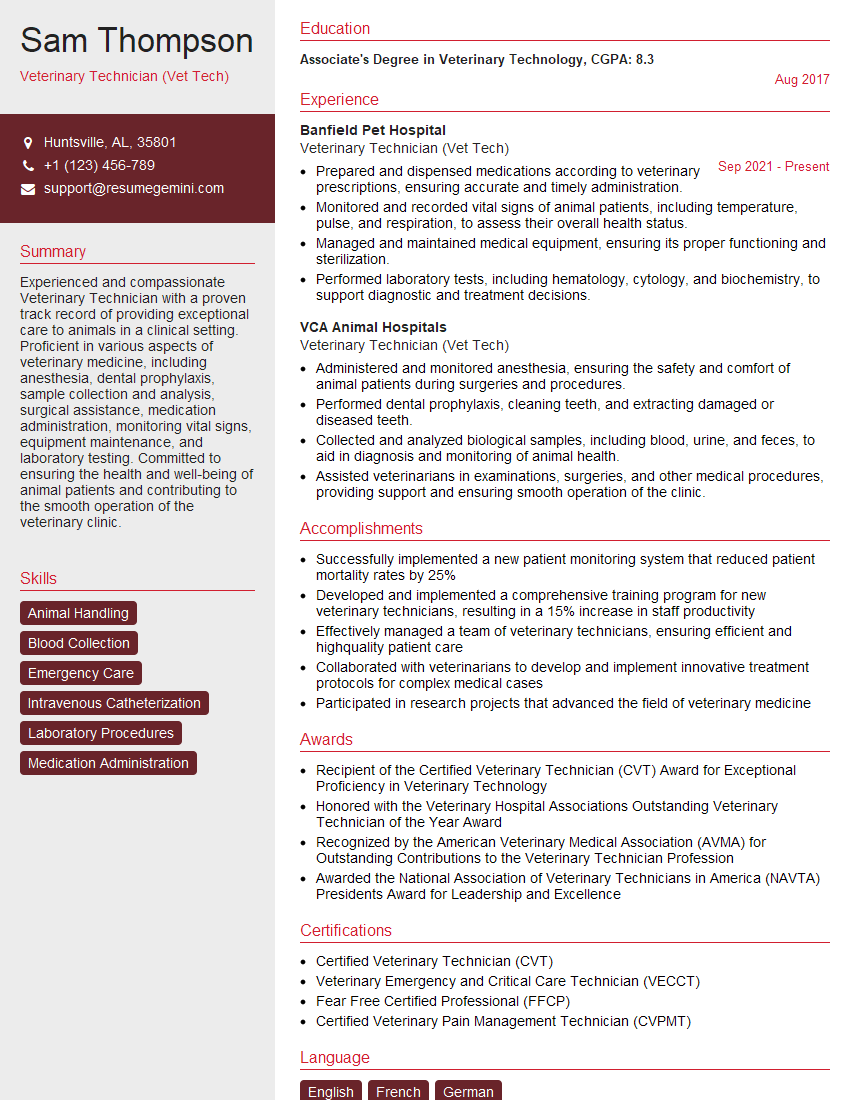
Feeling lost in a sea of interview questions? Landed that dream interview for Veterinary Technician (Vet Tech) but worried you might not have the answers? You’re not alone! This blog is your guide for interview success. We’ll break down the most common Veterinary Technician (Vet Tech) interview questions, providing insightful answers and tips to leave a lasting impression. Plus, we’ll delve into the key responsibilities of this exciting role, so you can walk into your interview feeling confident and prepared.
Acing the interview is crucial, but landing one requires a compelling resume that gets you noticed. Crafting a professional document that highlights your skills and experience is the first step toward interview success. ResumeGemini can help you build a standout resume that gets you called in for that dream job.






Essential Interview Questions For Veterinary Technician (Vet Tech)
1. Describe the steps involved in preparing a patient for surgery.
- Obtain a complete medical history and perform a physical examination.
- Fast the patient for 12-24 hours prior to surgery.
- Administer pre-anesthetic medication.
- Induce anesthesia.
- Position the patient for surgery.
2. What are the different types of anesthesia used in veterinary medicine?
subheading of the answer
- Inhalant anesthesia
- Injectable anesthesia
subheading of the answer
- Local anesthesia
- Regional anesthesia
3. What are the risks and complications associated with anesthesia?
- Respiratory depression
- Cardiovascular depression
- Aspiration
- Hypothermia
- Malignant hyperthermia
4. How do you monitor a patient during anesthesia?
- Heart rate and rhythm
- Respiratory rate and depth
- Oxygen saturation
- End-tidal carbon dioxide
- Temperature
5. What are the different types of surgical instruments used in veterinary medicine?
- Scalpels
- Scissors
- Hemostats
- Needle drivers
- Sutures
6. How do you suture a wound?
- Choose the appropriate suture material.
- Prepare the wound.
- Place the suture.
- Tie the suture.
- Trim the suture.
7. What are the different types of bandages used in veterinary medicine?
- Adhesive bandages
- Gauze bandages
- Elastic bandages
- Cohesive bandages
- Splints and casts
8. How do you apply a bandage to a wound?
- Clean the wound.
- Apply a sterile dressing.
- Secure the dressing with a bandage.
- Check the bandage regularly and change it as needed.
9. What are the different types of diagnostic tests used in veterinary medicine?
- Blood tests
- Urine tests
- Fecal tests
- Radiographs
- Ultrasound
10. How do you interpret a blood test result?
- Look at the reference ranges.
- Compare the patient’s results to the reference ranges.
- Identify any abnormalities.
- Consider the patient’s clinical signs and history.
- Make a diagnosis and recommend treatment.
Interviewers often ask about specific skills and experiences. With ResumeGemini‘s customizable templates, you can tailor your resume to showcase the skills most relevant to the position, making a powerful first impression. Also check out Resume Template specially tailored for Veterinary Technician (Vet Tech).
Career Expert Tips:
- Ace those interviews! Prepare effectively by reviewing the Top 50 Most Common Interview Questions on ResumeGemini.
- Navigate your job search with confidence! Explore a wide range of Career Tips on ResumeGemini. Learn about common challenges and recommendations to overcome them.
- Craft the perfect resume! Master the Art of Resume Writing with ResumeGemini’s guide. Showcase your unique qualifications and achievements effectively.
- Great Savings With New Year Deals and Discounts! In 2025, boost your job search and build your dream resume with ResumeGemini’s ATS optimized templates.
Researching the company and tailoring your answers is essential. Once you have a clear understanding of the Veterinary Technician (Vet Tech)‘s requirements, you can use ResumeGemini to adjust your resume to perfectly match the job description.
Key Job Responsibilities
Veterinary Technicians (Vet Techs) are highly skilled professionals who provide invaluable assistance to veterinarians in the care and treatment of animals.
1. Patient Care
Vet Techs are responsible for providing direct patient care, including monitoring vital signs, administering medications, and assisting with surgeries.
- Monitor patients’ vital signs, including temperature, pulse, and respiration
- Administer medications and fluids orally, intramuscularly, and intravenously
- Assist with surgeries, including preparing patients, monitoring anesthesia, and providing post-operative care
2. Clinical Procedures
Vet Techs perform a variety of clinical procedures, such as drawing blood, taking X-rays, and collecting samples for laboratory analysis.
- Draw blood from animals for laboratory testing
- Take X-rays and other diagnostic images
- Collect samples for laboratory analysis, including urine, feces, and skin scrapings
3. Animal Handling and Restraint
Vet Techs are skilled in handling and restraining animals of all sizes and temperaments.
- Handle and restrain animals for examinations, procedures, and treatments
- Use various techniques to sedate and anesthetize animals
- Provide comfort and support to animals during stressful situations
4. Client Communication
Vet Techs play a crucial role in communicating with clients about their pets’ health and care.
- Educate clients about pet care, including nutrition, vaccination, and parasite prevention
- Answer client questions and provide support
- Build relationships with clients and their pets
Interview Tips
Preparing thoroughly for a Veterinary Technician interview can significantly increase your chances of success.
1. Research the clinic and industry
Familiarize yourself with the clinic’s website, social media, and online reviews. Learn about their services, specialties, and team.
- Visit the clinic’s website to learn about their services, staff, and values.
- Read online reviews to get an idea of the clinic’s reputation and client experiences.
- Follow the clinic on social media to stay up-to-date on their latest news and events.
2. Practice your answers
Prepare for common interview questions by practicing your answers out loud. This will help you feel more confident and articulate during the interview.
- Prepare for questions about your experience, skills, and why you are interested in the position.
- Practice answering questions in a clear and concise manner.
- Use the STAR method to answer behavioral questions by providing specific examples from your experience.
3. Dress professionally
Make a good first impression by dressing professionally for the interview. This shows that you respect the interviewer and the position.
- Wear clean, pressed clothes that are appropriate for a professional setting.
- Avoid wearing revealing or casual clothing.
- Make sure your shoes are clean and polished.
4. Be enthusiastic and positive
Show the interviewer that you are passionate about veterinary medicine and eager to contribute to the clinic.
- Be yourself and let your personality shine through.
- Smile and make eye contact with the interviewer.
- Ask questions about the position and the clinic.
Next Step:
Now that you’re armed with a solid understanding of what it takes to succeed as a Veterinary Technician (Vet Tech), it’s time to turn that knowledge into action. Take a moment to revisit your resume, ensuring it highlights your relevant skills and experiences. Tailor it to reflect the insights you’ve gained from this blog and make it shine with your unique qualifications. Don’t wait for opportunities to come to you—start applying for Veterinary Technician (Vet Tech) positions today and take the first step towards your next career milestone. Your dream job is within reach, and with a polished resume and targeted applications, you’ll be well on your way to achieving your career goals! Build your resume now with ResumeGemini.