Are you gearing up for a career shift or aiming to ace your next interview? Look no further! We’ve curated a comprehensive guide to help you crack the interview for the coveted Audiometrist position. From understanding the key responsibilities to mastering the most commonly asked questions, this blog has you covered. So, buckle up and let’s embark on this journey together.
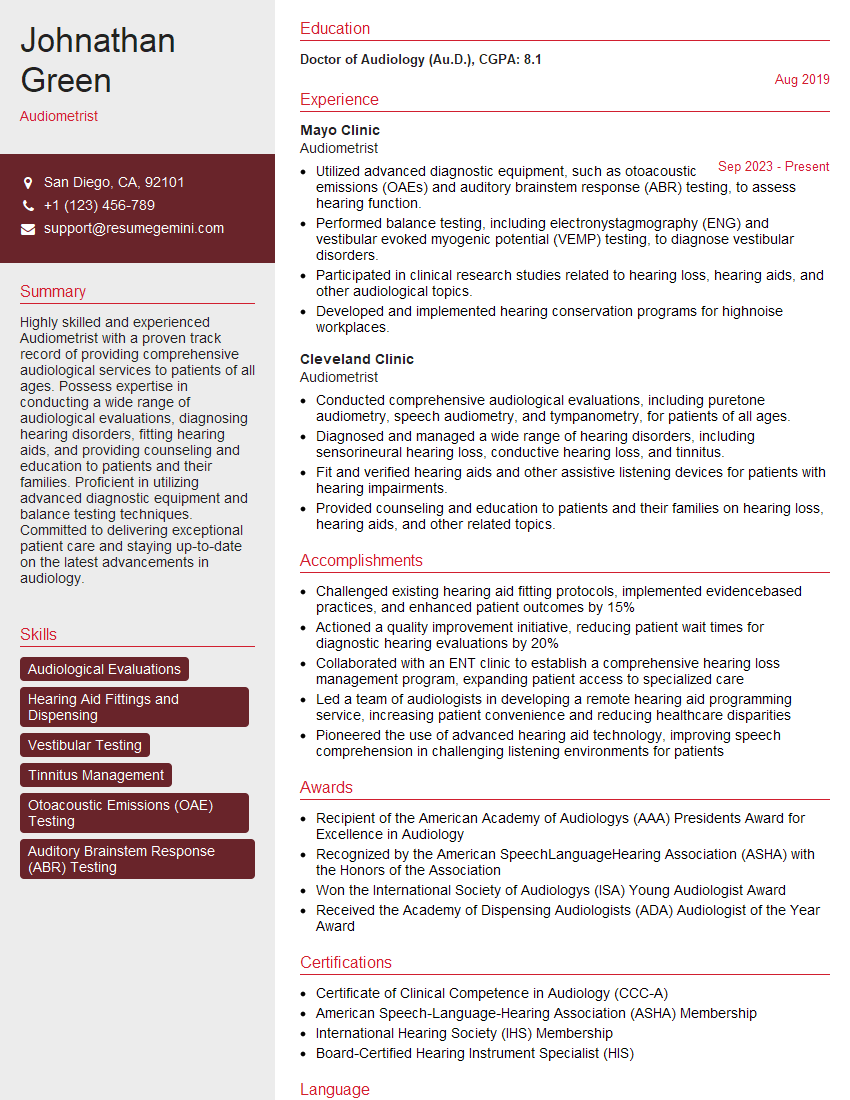
Acing the interview is crucial, but landing one requires a compelling resume that gets you noticed. Crafting a professional document that highlights your skills and experience is the first step toward interview success. ResumeGemini can help you build a standout resume that gets you called in for that dream job.






Essential Interview Questions For Audiometrist
1. What are the different types of audiometric tests and when would you use each one?
- Pure-tone audiometry: This is the most common type of audiometric test and is used to measure hearing thresholds at different frequencies.
- Speech audiometry: This test is used to measure a person’s ability to understand speech in noise.
- Otoacoustic emissions (OAEs): This test is used to measure the function of the outer hair cells in the cochlea.
- Auditory brainstem response (ABR): This test is used to measure the function of the auditory nerve and brainstem.
2. How would you interpret the results of an audiogram?
Frequency Range Affected
- Low frequency hearing loss: Difficulty hearing low-pitched sounds, such as the hum of a refrigerator or the rumble of thunder.
- Mid frequency hearing loss: Difficulty hearing sounds in the middle range of frequencies, such as human speech.
- High frequency hearing loss: Difficulty hearing high-pitched sounds, such as birds chirping or the ringing of a doorbell.
Severity of Hearing Loss
- Mild hearing loss: Hearing loss of 26-40 dB HL.
- Moderate hearing loss: Hearing loss of 41-55 dB HL.
- Severe hearing loss: Hearing loss of 56-70 dB HL.
- Profound hearing loss: Hearing loss of 71-90 dB HL.
3. What are the different types of hearing aids and how do they work?
- Behind-the-ear (BTE): These hearing aids are worn behind the ear and are connected to a small earmold that fits in the ear canal.
- In-the-ear (ITE): These hearing aids are worn in the ear canal and are custom-molded to fit the wearer’s ear.
- In-the-canal (ITC): These hearing aids are smaller than ITE hearing aids and are worn deeper in the ear canal.
- Completely-in-the-canal (CIC): These hearing aids are the smallest type of hearing aid and are worn completely in the ear canal.
4. What are the indications and contraindications for cochlear implants?
Indications
- Profound sensorineural hearing loss
- Limited benefit from hearing aids
- Motivation and realistic expectations
Contraindications
- Unrealistic expectations
- Active middle ear infection
- Anatomic abnormalities that prevent implantation
5. How would you counsel a patient about the risks and benefits of cochlear implants?
- Benefits: Cochlear implants can significantly improve hearing and speech understanding, especially in noisy environments.
- Risks: Cochlear implants can cause complications such as infection, tinnitus, and facial nerve paralysis.
6. What are the different types of vestibular tests and when would you use each one?
- Caloric stimulation: This test is used to measure the function of the vestibular system by irrigating the ear canal with warm and cold water.
- Rotary chair: This test is used to measure the function of the vestibular system by rotating the patient in a chair.
- Video head impulse test (vHIT): This test is used to measure the function of the vestibular system by recording the patient’s eye movements in response to head movements.
7. How would you interpret the results of a vestibular test?
- Normal results: The patient’s eye movements are normal and there is no evidence of vestibular dysfunction.
- Abnormal results: The patient’s eye movements are abnormal and there is evidence of vestibular dysfunction.
8. What are the different types of vestibular disorders and how would you treat them?
- Benign paroxysmal positional vertigo (BPPV): This is a common disorder that causes brief episodes of vertigo. It is treated with a series of head movements called the Epley maneuver.
- Meniere’s disease: This is a disorder that causes episodes of vertigo, hearing loss, and tinnitus. It is treated with medications and, in some cases, surgery.
- Vestibular neuritis: This is a disorder that causes inflammation of the vestibular nerve. It is treated with medications and rest.
9. What are the different types of tinnitus and how would you treat them?
- Subjective tinnitus: This is the most common type of tinnitus and is caused by a problem in the auditory system. It can be treated with medications, sound therapy, or tinnitus retraining therapy.
- Objective tinnitus: This type of tinnitus is caused by a physical problem in the ear, such as a tumor or a blood vessel disorder. It is treated by addressing the underlying cause.
10. What are the ethical considerations in audiology?
- Confidentiality: Audiologists must maintain the confidentiality of patient information.
- Informed consent: Audiologists must obtain informed consent from patients before performing any procedures.
- Competence: Audiologists must be competent in the services they provide.
- Avoidance of harm: Audiologists must avoid causing harm to patients.
Interviewers often ask about specific skills and experiences. With ResumeGemini‘s customizable templates, you can tailor your resume to showcase the skills most relevant to the position, making a powerful first impression. Also check out Resume Template specially tailored for Audiometrist.
Career Expert Tips:
- Ace those interviews! Prepare effectively by reviewing the Top 50 Most Common Interview Questions on ResumeGemini.
- Navigate your job search with confidence! Explore a wide range of Career Tips on ResumeGemini. Learn about common challenges and recommendations to overcome them.
- Craft the perfect resume! Master the Art of Resume Writing with ResumeGemini’s guide. Showcase your unique qualifications and achievements effectively.
- Great Savings With New Year Deals and Discounts! In 2025, boost your job search and build your dream resume with ResumeGemini’s ATS optimized templates.
Researching the company and tailoring your answers is essential. Once you have a clear understanding of the Audiometrist‘s requirements, you can use ResumeGemini to adjust your resume to perfectly match the job description.
Key Job Responsibilities
Audiometrists fulfill a vital role in healthcare, specializing in the science of hearing and balance. Their duties revolve around diagnosing and treating hearing and vestibular disorders. Here are the key job responsibilities of an Audiometrist:
1. Audiological Evaluation
Conduct comprehensive audiological evaluations to assess hearing thresholds, speech perception, and other auditory functions.
2. Hearing Aid Selection and Fitting
Evaluate patients’ hearing needs, recommend appropriate hearing aids, and fit and adjust devices to optimize hearing.
3. Balance Assessment and Treatment
Perform balance assessments, including vestibular testing, to diagnose and treat vestibular disorders.
4. Tinnitus Management
Provide counseling and support to patients with tinnitus, offering strategies and therapies to reduce its impact.
5. Patient Education and Counseling
Educate patients about hearing and balance disorders, treatment options, and preventive measures.
6. Research and Continuing Education
Stay abreast of the latest advancements in audiology through research and continuing education activities.
Interview Tips
Preparing for an Audiometrist interview requires a combination of technical knowledge and effective communication skills. Here are some tips to help you ace the interview:
1. Research the Organization and Position
Thoroughly research the hospital, clinic, or organization you’re applying to and the specific Audiometrist position. Understanding their mission, values, and services will enable you to tailor your answers and demonstrate your alignment with their goals.
2. Highlight Your Audiological Expertise
Showcase your comprehensive knowledge and skills in audiological evaluations, hearing aid fitting, balance assessment, and tinnitus management. Provide specific examples of successful patient outcomes and innovative techniques you’ve employed.
3. Emphasize Patient-Centered Care
Audiometry requires a compassionate and patient-centered approach. Highlight your ability to build strong relationships with patients, effectively communicate complex concepts, and provide empathetic support throughout their journey.
4. Demonstrate Continuous Improvement
Audiology is a rapidly evolving field. Discuss your commitment to continuing education and staying up-to-date with the latest advancements in the profession. Share examples of conferences you’ve attended or research projects you’ve been involved in.
5. Practice and Prepare
Thorough preparation is key. Practice answering common interview questions, prepare questions to ask the interviewer, and anticipate potential scenarios that might be presented during the interview. The more prepared you are, the more confident and composed you’ll appear.
Next Step:
Now that you’re armed with the knowledge of Audiometrist interview questions and responsibilities, it’s time to take the next step. Build or refine your resume to highlight your skills and experiences that align with this role. Don’t be afraid to tailor your resume to each specific job application. Finally, start applying for Audiometrist positions with confidence. Remember, preparation is key, and with the right approach, you’ll be well on your way to landing your dream job. Build an amazing resume with ResumeGemini