Are you gearing up for a career shift or aiming to ace your next interview? Look no further! We’ve curated a comprehensive guide to help you crack the interview for the coveted Chlorinator position. From understanding the key responsibilities to mastering the most commonly asked questions, this blog has you covered. So, buckle up and let’s embark on this journey together
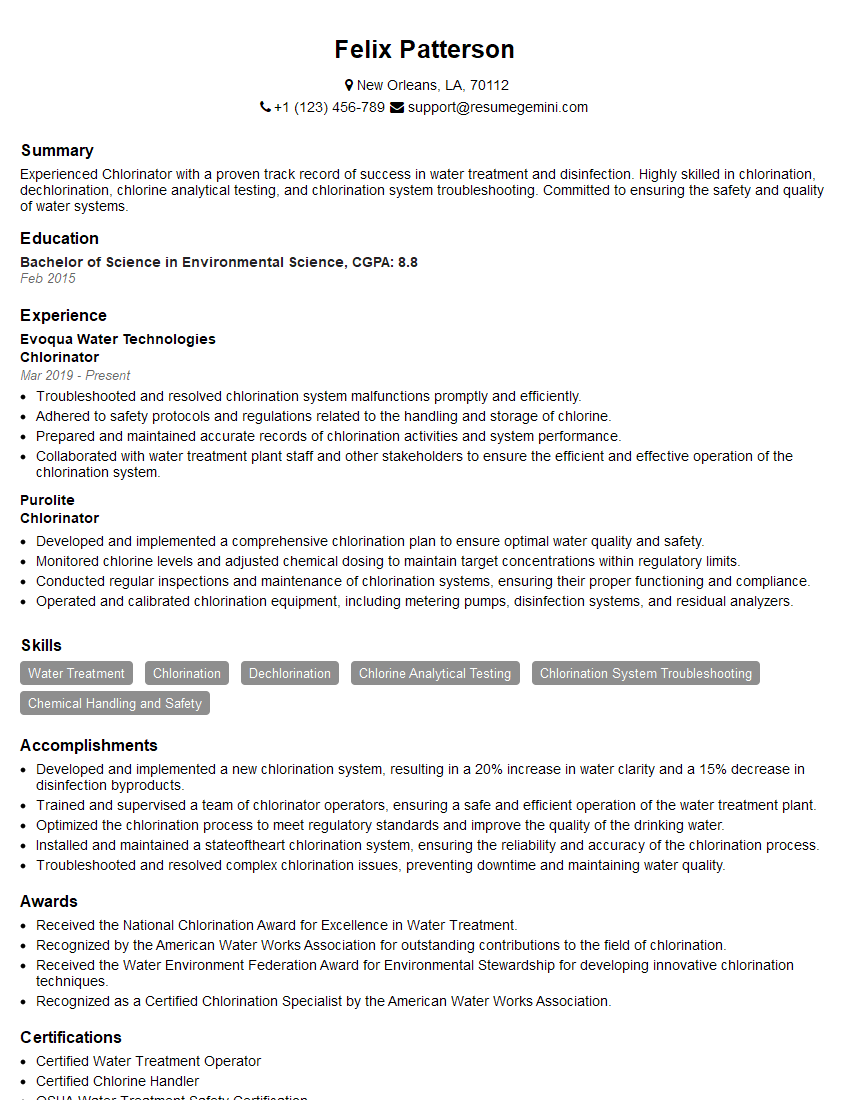
Acing the interview is crucial, but landing one requires a compelling resume that gets you noticed. Crafting a professional document that highlights your skills and experience is the first step toward interview success. ResumeGemini can help you build a standout resume that gets you called in for that dream job.






Essential Interview Questions For Chlorinator
1. Explain the process of chlorination and its importance in water treatment?
Chlorination is the process of adding chlorine to water to kill bacteria and other microorganisms. It is an important part of water treatment and helps to ensure that water is safe to drink.
Chlorine works by damaging the cell walls of bacteria and other microorganisms, which causes them to die. It is also effective against viruses and parasites.
- Chlorination is a relatively inexpensive and effective way to disinfect water.
- It has been used for over 100 years and is considered to be one of the most effective ways to prevent waterborne diseases.
2. Describe the different types of chlorinators and their applications?
Manual Chlorinators:
- These are the simplest type of chlorinators
- They require manual addition of chlorine
- Suitable for small pools or spas
Semi-Automatic Chlorinators:
- They use a timer to control the addition of chlorine.
- More accurate than manual chlorinators
- Suitable for larger pools or spas
Automatic Chlorinators:
- They use a sensor to monitor the chlorine level in the water.
- Automatically adjust the chlorine addition rate based on the sensor reading.
- Most accurate and reliable type of chlorinator
- Suitable for large pools or commercial applications
3. How do you determine the correct dosage of chlorine for a specific application?
The correct dosage of chlorine depends on a number of factors, including the volume of water, the temperature of the water, the pH of the water, and the presence of other contaminants.
- For most applications, a chlorine level of 1-2 ppm is sufficient to provide adequate disinfection.
- It is important to test the chlorine level regularly to ensure that it is within the desired range.
4. What are the safety precautions that must be taken when handling chlorine?
Chlorine is a toxic gas and can be dangerous if not handled properly. It is important to take the following safety precautions when handling chlorine:
- Wear appropriate safety gear, including gloves, eye protection, and a respirator.
- Handle chlorine in a well-ventilated area.
- Do not mix chlorine with other chemicals.
- Store chlorine in a safe and secure location.
5. What are the common problems that can occur with chlorinators and how do you troubleshoot them?
Chlorinator not adding chlorine:
- Check the chlorine level in the tank.
- Check the chlorine injector for clogs or debris.
- Check the timer or sensor (for semi-automatic or automatic chlorinators).
Chlorinator adding too much chlorine:
- Check the chlorine level in the tank.
- Check the chlorine injector for leaks.
- Adjust the timer or sensor (for semi-automatic or automatic chlorinators).
Chlorinator leaking:
- Inspect the chlorinator for any cracks or leaks.
- Replace any damaged parts.
- Tighten any loose connections.
6. What are the maintenance requirements for chlorinators?
Regular maintenance is essential to ensure that chlorinators are operating properly and safely. Maintenance tasks include:
- Checking the chlorine level in the tank.
- Cleaning the chlorine injector.
- Inspecting the chlorinator for leaks.
- Calibrating the timer or sensor (for semi-automatic or automatic chlorinators).
7. What are the advantages and disadvantages of using chlorination in water treatment?
Advantages:
- Effective against a wide range of microorganisms
- Relatively inexpensive
- Easy to apply
Disadvantages:
- Can produce harmful byproducts
- Can be corrosive to metal fixtures
- Can cause skin and eye irritation
8. What are the alternative methods of water disinfection that can be used instead of chlorination?
- Ultraviolet (UV) disinfection
- Ozone disinfection
- Electrochlorination
- Chlorine dioxide disinfection
9. What are the latest trends in chlorination technology?
- Development of new chlorination systems that are more efficient and environmentally friendly.
- Use of alternative disinfection methods, such as UV disinfection and ozone disinfection.
- Development of new sensors and monitoring systems to improve the accuracy and reliability of chlorination.
10. How do you stay up-to-date on the latest developments in chlorination technology?
- Attend industry conferences and workshops.
- Read technical journals and articles.
- Network with other professionals in the field.
- Participate in online forums and discussion groups.
Interviewers often ask about specific skills and experiences. With ResumeGemini‘s customizable templates, you can tailor your resume to showcase the skills most relevant to the position, making a powerful first impression. Also check out Resume Template specially tailored for Chlorinator.
Career Expert Tips:
- Ace those interviews! Prepare effectively by reviewing the Top 50 Most Common Interview Questions on ResumeGemini.
- Navigate your job search with confidence! Explore a wide range of Career Tips on ResumeGemini. Learn about common challenges and recommendations to overcome them.
- Craft the perfect resume! Master the Art of Resume Writing with ResumeGemini’s guide. Showcase your unique qualifications and achievements effectively.
- Great Savings With New Year Deals and Discounts! In 2025, boost your job search and build your dream resume with ResumeGemini’s ATS optimized templates.
Researching the company and tailoring your answers is essential. Once you have a clear understanding of the Chlorinator‘s requirements, you can use ResumeGemini to adjust your resume to perfectly match the job description.
Key Job Responsibilities
Chlorinators are responsible for the operation and maintenance of chlorination systems in water treatment facilities. They ensure that the water supply is disinfected properly, meeting regulatory standards and protecting public health.
1. Monitoring and Control
Chlorinators monitor chlorine levels, flow rates, and other parameters of the chlorination system to ensure optimal disinfection.
- Monitor chlorine residual levels in water
- Adjust chlorine dosage rates based on water quality and demand
- Control chlorine flow rate to maintain desired disinfection levels
2. System Maintenance
Chlorinators perform routine maintenance and repairs on chlorination equipment, ensuring proper operation and preventing failures.
- Inspect and clean chlorine generators, pumps, and pipelines
- Replace worn or damaged components
- Calibrate and maintain monitoring equipment
3. Safety and Compliance
Chlorinators handle potentially hazardous chemicals, so they must follow safety protocols and comply with relevant regulations.
- Wear appropriate personal protective equipment
- Follow established safety procedures for handling chlorine
- Maintain accurate records of chlorine use and disposal
- Stay abreast of safety regulations and guidelines
4. Record Keeping and Reporting
Chlorinators keep detailed records of chlorine usage, system performance, and maintenance activities for documentation and regulatory compliance.
- Maintain daily logs of chlorine residuals and other water quality data
- Generate reports on chlorine usage and system performance
- Submit reports to regulatory agencies as required
Interview Tips
Preparing for a chlorinator interview requires a combination of technical knowledge, safety awareness, and a commitment to water quality.
1. Research and Preparation
Familiarize yourself with the specific responsibilities of a chlorinator, including the operation and maintenance of chlorination systems, safety protocols, and regulatory compliance.
- Review relevant industry standards and regulations
- Read articles and case studies on chlorination systems
- Practice answering common interview questions
2. Highlight Your Skills and Experience
Emphasize your technical skills in operating and maintaining chlorination systems. Showcase your understanding of chlorine chemistry, disinfection principles, and safety procedures.
- Quantify your experience with specific chlorination systems
- Provide examples of how you have resolved problems or improved processes
- Demonstrate your commitment to safety and compliance
3. Communicate Effectively
As a chlorinator, you need to be able to communicate effectively with engineers, operators, and other stakeholders. Prepare by practicing your communication skills and preparing clear responses to potential questions.
- Practice explaining technical concepts in a clear and concise manner
- Role-play answering questions about safety protocols and emergency procedures
- Show your ability to work in a team and collaborate with others
4. Be Enthusiastic and Professional
Demonstrate your passion for water quality and your commitment to protecting public health. Show the interviewer that you are enthusiastic about the role and eager to contribute to the organization’s mission.
- Express your understanding of the importance of chlorination
- Share any personal experiences or interests that align with the role
- Dress professionally and arrive on time for the interview
Next Step:
Armed with this knowledge, you’re now well-equipped to tackle the Chlorinator interview with confidence. Remember, a well-crafted resume is your first impression. Take the time to tailor your resume to highlight your relevant skills and experiences. And don’t forget to practice your answers to common interview questions. With a little preparation, you’ll be on your way to landing your dream job. So what are you waiting for? Start building your resume and start applying! Build an amazing resume with ResumeGemini.