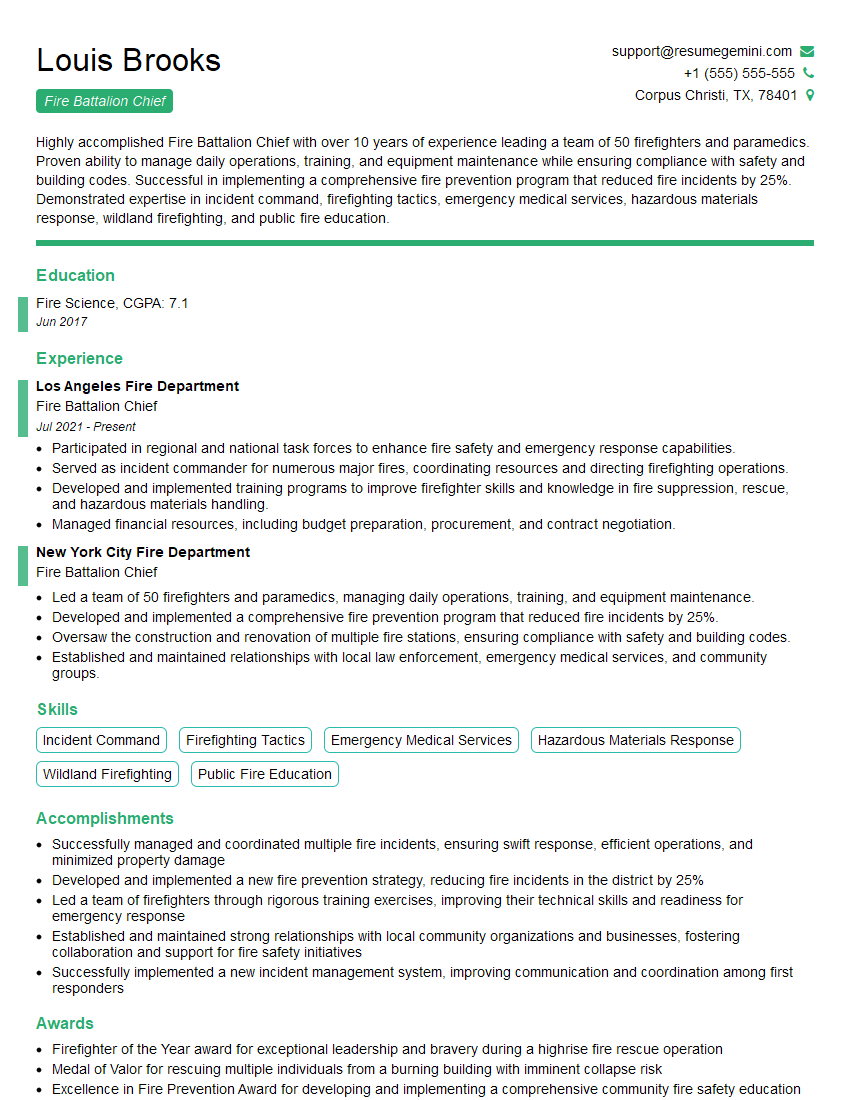
Feeling lost in a sea of interview questions? Landed that dream interview for Fire Battalion Chief but worried you might not have the answers? You’re not alone! This blog is your guide for interview success. We’ll break down the most common Fire Battalion Chief interview questions, providing insightful answers and tips to leave a lasting impression. Plus, we’ll delve into the key responsibilities of this exciting role, so you can walk into your interview feeling confident and prepared.
Acing the interview is crucial, but landing one requires a compelling resume that gets you noticed. Crafting a professional document that highlights your skills and experience is the first step toward interview success. ResumeGemini can help you build a standout resume that gets you called in for that dream job.






Essential Interview Questions For Fire Battalion Chief
1. Describe your experience in developing and implementing fire safety plans for complex and high-risk structures?
- Authored and executed comprehensive fire safety plans for skyscrapers, hospitals, and chemical processing facilities, ensuring compliance with fire codes and industry best practices.
- Conducted thorough risk assessments, identifying potential hazards and vulnerabilities, and implemented mitigation strategies to prevent and control fires.
- Collaborated with architects, engineers, and building owners to integrate fire safety measures into structural designs and facility operations.
- Led training sessions for building occupants on fire prevention, evacuation procedures, and the use of fire safety equipment.
2. How would you approach managing a large-scale fire incident with multiple casualties and structural damage?
Incident Command System (ICS) Implementation
- Establish an incident command post and assume the role of Incident Commander.
- Activate and manage multiple divisions within the ICS, including operations, planning, logistics, and safety.
- Communicate effectively with stakeholders, including emergency responders, law enforcement, and the public.
Resource Management
- Coordinate the deployment of fire apparatus, personnel, and equipment from various agencies.
- Establish triage areas and medical treatment facilities for casualties.
- Secure the incident scene and mitigate hazards to protect responders and the public.
Incident Investigation and Recovery
- Appoint a fire investigator to determine the cause and origin of the fire.
- Initiate damage assessment and coordinate recovery operations, including building stabilization and overhaul.
- Provide ongoing support to victims and affected communities.
3. Discuss your strategies for building and maintaining a cohesive and high-performing fire battalion?
- Foster a culture of trust, respect, and accountability within the battalion.
- Provide ongoing training and professional development opportunities to enhance skills and knowledge.
- Empower firefighters with decision-making authority and responsibility.
- Promote teamwork and collaboration through regular drills and exercises.
- Recognize and reward outstanding performance and contributions.
4. How do you stay abreast of emerging trends and best practices in fire prevention and response?
- Attend industry conferences, workshops, and seminars.
- Subscribe to professional journals and publications.
- Network with fire service professionals and experts.
- Participate in research and development initiatives.
- Review and analyze incident reports and data to identify areas for improvement.
5. Describe your experience in working with other emergency response agencies and organizations?
- Developed and implemented mutual aid agreements with neighboring fire departments, EMS agencies, and law enforcement.
- Participated in joint training exercises to enhance interoperability and coordination.
- Established relationships with local hospitals, disaster response organizations, and community groups.
- Collaborated on public safety initiatives, such as fire prevention campaigns and emergency preparedness programs.
6. How would you manage a situation where there is a conflict or disagreement among members of your battalion?
- Address the conflict promptly and directly, creating a safe and respectful environment.
- Listen attentively to all perspectives and identify the underlying issues.
- Facilitate open communication and encourage dialogue between the individuals involved.
- Work with the firefighters to develop a solution that is fair and equitable.
- Follow up to ensure that the conflict is resolved and that there are no lingering negative effects.
7. Describe your understanding of the National Incident Management System (NIMS) and how it applies to fire incident management?
- NIMS provides a standardized framework for managing incidents of all types and sizes.
- It establishes a common language, operating procedures, and incident command system.
- NIMS enhances interoperability among different agencies and jurisdictions.
- In fire incident management, NIMS allows fire departments to work effectively with other emergency responders, such as EMS, law enforcement, and public health agencies.
8. How do you balance the need for firefighter safety with the need to protect property and save lives?
- Firefighter safety is paramount.
- Conduct thorough risk assessments before entering hazardous areas.
- Follow established safety protocols and wear appropriate protective gear.
- Train firefighters on situational awareness, self-rescue techniques, and emergency procedures.
- Make decisions that protect firefighters without compromising the safety of victims or the integrity of the structure.
9. Describe your experience in using technology to improve fire department operations?
- Implemented a mobile data terminal system to enhance communication and situational awareness during incidents.
- Utilized computer-aided dispatch (CAD) to streamline call handling and resource allocation.
- Incorporated GPS tracking into fire apparatus to improve response time and incident management.
- Explored the use of drones for aerial surveillance and damage assessment.
10. How would you approach a situation where there is a potential for a hazardous materials incident?
- Identify the type of hazardous materials involved and assess the potential risks.
- Establish an isolation zone and evacuate non-essential personnel.
- Contact the appropriate hazardous materials response team for assistance.
- Follow established incident management protocols and coordinate with other emergency responders.
- Provide ongoing updates to the incident command post and stakeholders.
Interviewers often ask about specific skills and experiences. With ResumeGemini‘s customizable templates, you can tailor your resume to showcase the skills most relevant to the position, making a powerful first impression. Also check out Resume Template specially tailored for Fire Battalion Chief.
Career Expert Tips:
- Ace those interviews! Prepare effectively by reviewing the Top 50 Most Common Interview Questions on ResumeGemini.
- Navigate your job search with confidence! Explore a wide range of Career Tips on ResumeGemini. Learn about common challenges and recommendations to overcome them.
- Craft the perfect resume! Master the Art of Resume Writing with ResumeGemini’s guide. Showcase your unique qualifications and achievements effectively.
- Great Savings With New Year Deals and Discounts! In 2025, boost your job search and build your dream resume with ResumeGemini’s ATS optimized templates.
Researching the company and tailoring your answers is essential. Once you have a clear understanding of the Fire Battalion Chief‘s requirements, you can use ResumeGemini to adjust your resume to perfectly match the job description.
Key Job Responsibilities
Fire Battalion Chiefs play a vital role in the fire service, leading and managing teams in emergency situations and overseeing fire prevention and suppression initiatives. Their key responsibilities include:
1. Incident Command
During emergencies, Battalion Chiefs assume command of incident scenes, making critical decisions and coordinating response efforts with other emergency responders.
- Assess the incident and develop a response plan
- Establish communication systems and relay information to incident responders and the public
- Ensure the safety and coordination of firefighters and other emergency personnel
2. Firefighting Operations
Battalion Chiefs oversee fire suppression operations, ensuring efficient and effective firefighting tactics.
- Monitor fire conditions and make decisions regarding fire containment and extinguishment
- Coordinate water supply, aerial support, and fire suppression techniques
- Evaluate fire risks and implement strategies to minimize damage
3. Fire Prevention
Battalion Chiefs are responsible for promoting fire prevention measures within their jurisdiction.
- Conduct fire inspections and identify hazards
- Educate the public on fire safety and prevention practices
- Develop and implement fire prevention programs and policies
4. Resource Management
Battalion Chiefs manage resources and personnel, ensuring optimal performance and efficiency.
- Allocate and coordinate equipment, personnel, and facilities
- Monitor budgets and expenses, and ensure efficient resource utilization
- Develop and maintain training programs for firefighters
Interview Tips
Preparing for an interview as a Fire Battalion Chief requires thorough research on the role and the department you are applying to. Here are some interview preparation tips to help you ace the interview:
1. Research the Department
Familiarize yourself with the history, mission, and values of the fire department. Research the community it serves, its response area, and any recent notable incidents or initiatives.
- Visit the department’s website and social media pages
- Read local newspapers and news articles about the department
2. Practice Answering Common Interview Questions
Practice responding to commonly asked interview questions related to fire service, leadership, and management.
- Tell me about your experience in incident command
- Describe a challenging fire suppression operation you have managed
- How do you prioritize fire prevention initiatives in your community?
3. Highlight Your Leadership and Management Skills
Fire Battalion Chiefs are expected to lead and motivate firefighters in high-stress situations. Showcase your leadership and management experiences in your resume and interview.
- Provide examples of how you have motivated and empowered firefighters
- Describe your approaches to conflict resolution and team building
4. Be Prepared to Discuss Your Commitment to Fire Service
Fire Battalion Chiefs have a deep commitment to protecting the community from fires and emergencies. Express your passion for the job and your dedication to serving the public.
- Explain your reasons for pursuing a career as a Fire Battalion Chief
- Share stories or experiences that demonstrate your commitment to the fire service
Next Step:
Now that you’re armed with interview-winning answers and a deeper understanding of the Fire Battalion Chief role, it’s time to take action! Does your resume accurately reflect your skills and experience for this position? If not, head over to ResumeGemini. Here, you’ll find all the tools and tips to craft a resume that gets noticed. Don’t let a weak resume hold you back from landing your dream job. Polish your resume, hit the “Build Your Resume” button, and watch your career take off! Remember, preparation is key, and ResumeGemini is your partner in interview success.