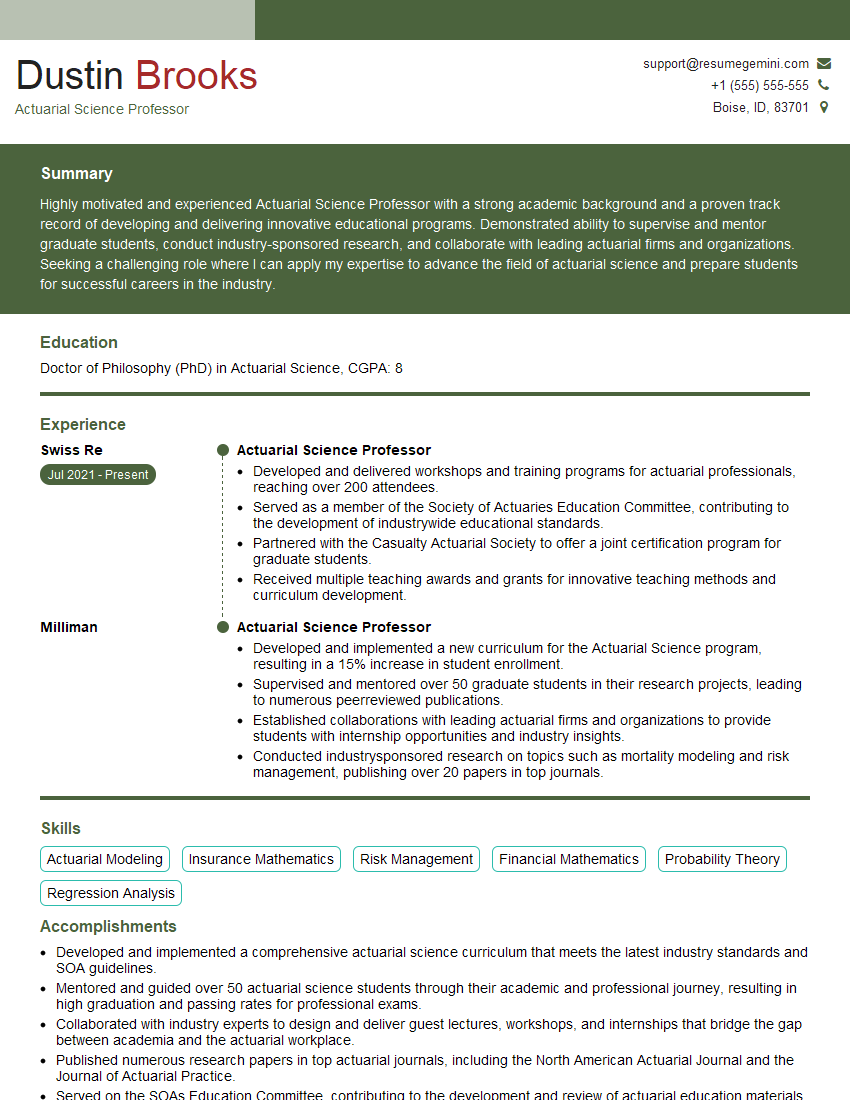
Feeling lost in a sea of interview questions? Landed that dream interview for Actuarial Science Professor but worried you might not have the answers? You’re not alone! This blog is your guide for interview success. We’ll break down the most common Actuarial Science Professor interview questions, providing insightful answers and tips to leave a lasting impression. Plus, we’ll delve into the key responsibilities of this exciting role, so you can walk into your interview feeling confident and prepared.
Acing the interview is crucial, but landing one requires a compelling resume that gets you noticed. Crafting a professional document that highlights your skills and experience is the first step toward interview success. ResumeGemini can help you build a standout resume that gets you called in for that dream job.






Essential Interview Questions For Actuarial Science Professor
1. Explain the concept of actuarial equivalence and its application in calculating present values and future values.
- Actuarial equivalence refers to the mathematical principle that two financial transactions or cash flows are considered equivalent if they have the same present value or future value.
- When calculating present values, actuarial equivalence is used to determine the present value of a future stream of payments or cash flows, taking into account the time value of money and the appropriate discount rate.
- For future values, actuarial equivalence can be applied to determine the future value of a current asset or liability, factoring in the effects of interest or growth rates over a specified period.
2. Describe the different types of mortality tables used in actuarial science and their applications.
Deterministic Tables
- Provide fixed probabilities of death at each age
- Used for simple calculations, such as life expectancies and basic insurance premiums
Stochastic Tables
- Incorporate randomness and uncertainty into mortality rates
- Used for more complex calculations, such as valuing life insurance policies and pension liabilities
Select and Ultimate Tables
- Assumes a higher mortality rate in the early years of a policy or contract
- Used for valuing life insurance policies and health insurance plans
3. Discuss the role of reinsurance in managing risk in the insurance industry.
- Reinsurance involves transferring a portion of an insurance company’s risk to another insurance company (the reinsurer).
- It allows insurance companies to spread their exposure and reduce their financial burden in the event of large claims.
- Types of reinsurance include proportional reinsurance, non-proportional reinsurance, and facultative reinsurance.
4. Explain the difference between prospective and retrospective reserving methods and when each is appropriate.
Prospective Reserving Methods
- Estimate liabilities based on assumptions about future events
- Used when future cash flows are relatively predictable
Retrospective Reserving Methods
- Estimate liabilities based on historical claims data
- Used when future cash flows are highly uncertain
5. Describe the role of stochastic modeling in actuarial science and its applications.
- Stochastic modeling incorporates uncertainty and randomness into actuarial calculations.
- Applications include valuing insurance policies, managing risk portfolios, and simulating future financial outcomes.
- Examples of stochastic models used in actuarial science include Monte Carlo simulations and Markov chains.
6. Discuss the ethical responsibilities of an Actuarial Science Professor.
- Uphold the ethical principles of the actuarial profession
- Maintain confidentiality of student information
- Provide fair and unbiased assessments
- Promote integrity and professionalism in the classroom
- Contribute to the advancement of actuarial knowledge and practice
7. How do you incorporate real-world case studies and practical applications into your actuarial science teaching?
- Use industry data and case studies to illustrate concepts and principles
- Involve students in hands-on projects and simulations
- Invite guest speakers from the actuarial profession
- Encourage students to participate in actuarial competitions and research
8. Explain how you assess student learning and provide feedback to enhance their understanding of actuarial science concepts.
- Use a variety of assessment methods, including exams, assignments, and projects
- Provide detailed feedback on student work, highlighting strengths and areas for improvement
- Offer office hours and extra support to students who need additional assistance
- Conduct regular course evaluations to gauge student learning and make improvements
9. How do you stay up-to-date with the latest developments in actuarial science and incorporate them into your teaching?
- Attend industry conferences and workshops
- Read academic journals and research papers
- Collaborate with actuarial professionals
- Incorporate emerging trends and technologies into course materials
10. Describe your research interests in actuarial science and how they complement your teaching.
- My research focuses on [area of interest], which is relevant to current industry practices.
- Through my research, I stay abreast of the latest developments in the field.
- My research findings enhance my teaching materials and provide students with a deeper understanding of actuarial concepts.
Interviewers often ask about specific skills and experiences. With ResumeGemini‘s customizable templates, you can tailor your resume to showcase the skills most relevant to the position, making a powerful first impression. Also check out Resume Template specially tailored for Actuarial Science Professor.
Career Expert Tips:
- Ace those interviews! Prepare effectively by reviewing the Top 50 Most Common Interview Questions on ResumeGemini.
- Navigate your job search with confidence! Explore a wide range of Career Tips on ResumeGemini. Learn about common challenges and recommendations to overcome them.
- Craft the perfect resume! Master the Art of Resume Writing with ResumeGemini’s guide. Showcase your unique qualifications and achievements effectively.
- Great Savings With New Year Deals and Discounts! In 2025, boost your job search and build your dream resume with ResumeGemini’s ATS optimized templates.
Researching the company and tailoring your answers is essential. Once you have a clear understanding of the Actuarial Science Professor‘s requirements, you can use ResumeGemini to adjust your resume to perfectly match the job description.
Key Job Responsibilities
An Actuarial Science Professor is responsible for teaching and conducting research in the field of actuarial science. They also provide guidance and support to students and collaborate with colleagues in the department and the university community.
1. Teaching and Curriculum Development
This includes developing and teaching courses, preparing syllabi, grading assignments, and providing feedback to students. They also collaborate with colleagues to develop new curricula and programs.
- Develop and deliver lectures, tutorials, and practical exercises to undergraduate and graduate students.
- Design and implement innovative teaching methodologies that enhance student learning outcomes.
2. Research and Scholarship
This includes conducting original research in actuarial science, publishing papers in academic journals, and presenting findings at conferences. They also supervise graduate students and provide mentorship.
- Conduct research in areas such as risk management, insurance, financial mathematics, and machine learning.
- Publish research outcomes in high-impact academic journals and present findings at national and international conferences.
3. Academic Service and Administration
This includes serving on departmental and university committees, participating in faculty development activities, and providing service to the community. They also advise students on career and professional development.
- Participate in departmental and university committees, task forces, and working groups.
- Contribute to the development and implementation of departmental and university policies and procedures.
4. Collaboration and Outreach
This includes working with colleagues in other departments, collaborating with industry professionals, and engaging with the wider community. They also represent the university at various events and activities.
- Collaborate with colleagues in other disciplines to develop interdisciplinary research and teaching initiatives.
- Participate in industry advisory boards, consult with actuarial firms, and provide workshops and seminars to professionals.
Interview Tips
Preparing well for an interview can increase your chances of success. Here are some tips to help you ace your interview for an Actuarial Science Professor position:
1. Research the University and Department
Familiarize yourself with the university’s mission, values, and strategic priorities. Research the department’s faculty, research strengths, and course offerings. This will demonstrate your interest in the position and your knowledge of the institution.
- Visit the university and department websites to gather information.
- Read the faculty profiles and research publications of potential colleagues.
2. Highlight Your Teaching and Research Experience
Emphasize your teaching and research accomplishments in your resume and cover letter. Provide specific examples of how you have developed innovative teaching methods, mentored students, and published high-impact research. Relate your experiences to the key responsibilities of the position.
- Quantify your teaching effectiveness with student evaluations and teaching awards.
- Showcase your research impact through citations, grants, and collaborations.
3. Demonstrate Your Commitment to Service
Highlight your experience in academic service and outreach activities. Explain how you have contributed to departmental governance, participated in university committees, and engaged with the community. This demonstrates your commitment to the profession and your broader responsibilities as a faculty member.
- Provide examples of your involvement in curriculum development, faculty mentoring, and student advising.
- Describe your participation in outreach programs, such as industry partnerships and public lectures.
4. Prepare for Interview Questions
Anticipate common interview questions and prepare thoughtful responses. Practice answering questions about your teaching philosophy, research interests, and collaborative experience. Also, be ready to discuss your strengths, weaknesses, and career goals.
- Use the STAR method (Situation, Task, Action, Result) to structure your answers.
- Tailor your responses to the specific requirements of the position and the university.
5. Ask Informed Questions
Prepare insightful questions to ask the interviewers. This shows your engagement and interest in the position and the institution. Ask questions about the department’s research priorities, faculty development opportunities, and student support services.
- Demonstrate your curiosity and enthusiasm by asking questions about the department’s research direction.
- Inquire about the university’s commitment to faculty development and support for junior faculty.
Next Step:
Armed with this knowledge, you’re now well-equipped to tackle the Actuarial Science Professor interview with confidence. Remember, a well-crafted resume is your first impression. Take the time to tailor your resume to highlight your relevant skills and experiences. And don’t forget to practice your answers to common interview questions. With a little preparation, you’ll be on your way to landing your dream job. So what are you waiting for? Start building your resume and start applying! Build an amazing resume with ResumeGemini.