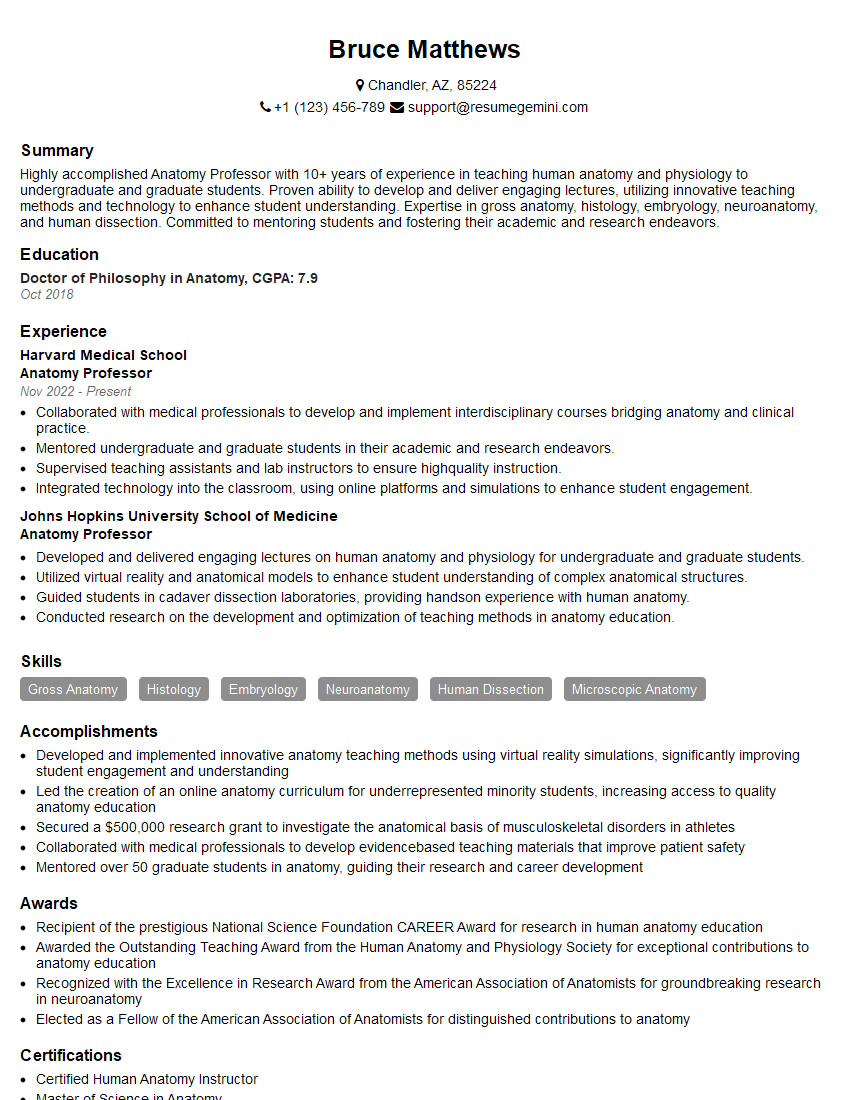
Ever felt underprepared for that crucial job interview? Or perhaps you’ve landed the interview but struggled to articulate your skills and experiences effectively? Fear not! We’ve got you covered. In this blog post, we’re diving deep into the Anatomy Professor interview questions that you’re most likely to encounter. But that’s not all. We’ll also provide expert insights into the key responsibilities of a Anatomy Professor so you can tailor your answers to impress potential employers.
Acing the interview is crucial, but landing one requires a compelling resume that gets you noticed. Crafting a professional document that highlights your skills and experience is the first step toward interview success. ResumeGemini can help you build a standout resume that gets you called in for that dream job.






Essential Interview Questions For Anatomy Professor
1. What specific dissections have you performed as part of your research or teaching experience?
In my research on the innervation of the human hand, I performed detailed dissections of multiple cadaveric hands to identify and map the distribution of peripheral nerves. During my teaching assistantship, I guided medical students through the dissection of cadaveric specimens, providing instruction on anatomical structures and their relationships.
2. Describe your experience in using imaging techniques such as MRI and CT scans in anatomy teaching.
Incorporation in Lectures and Demonstrations
- Embedded MRI and CT scans within lectures to illustrate anatomical structures and their spatial relationships.
- Utilized 3D models generated from scans to enhance visualization and comprehension for students.
Interactive Learning
- Facilitated virtual dissections using medical imaging software, allowing students to explore anatomical structures in a simulated environment.
- Developed case study exercises based on imaging findings, promoting clinical problem-solving skills.
3. How do you stay updated with the latest advancements and research findings in anatomy?
- Attend scientific conferences and workshops on anatomy and related fields.
- Subscribe to peer-reviewed journals and regularly review published research articles.
- Engage in collaborative research projects with colleagues to contribute to the advancement of anatomical knowledge.
4. Describe your approach to teaching complex anatomical concepts to students.
- Emphasize foundational principles and build upon them gradually to create a logical framework for understanding.
- Utilize a variety of teaching methods, including lectures, hands-on dissections, and interactive simulations, to accommodate different learning styles.
- Incorporate clinical examples and case studies to demonstrate the relevance and practical application of anatomical knowledge.
5. How do you foster a positive and inclusive learning environment in your anatomy classes?
- Create a welcoming and respectful atmosphere where all students feel valued and supported.
- Encourage active participation and collaboration among students, promoting a sense of community.
- Provide individualized feedback and support to students with diverse backgrounds and learning needs.
6. What criteria do you use to assess student learning in anatomy?
- Written exams and quizzes to assess factual knowledge and conceptual understanding.
- Practical exams, such as dissections and specimen identification, to evaluate technical skills and spatial reasoning.
- Oral presentations and case study discussions to gauge students’ ability to communicate and apply anatomical concepts.
7. Describe your experience in developing and using educational resources for anatomy teaching.
- Designed and implemented interactive online modules that supplement lectures and provide additional practice for students.
- Created anatomical charts and models to enhance visualization and understanding of complex structures.
- Developed and led workshops to train students on the use of anatomical software and technologies.
8. What is your philosophy on the use of technology in anatomy teaching?
- Believe that technology can be a valuable tool to enhance student learning and engagement.
- Integrate technology into teaching as a complement to traditional methods, not a replacement.
- Ensure that technological tools are used effectively and are aligned with pedagogical goals.
9. How do you incorporate clinical applications into your anatomy teaching?
- Discuss the clinical relevance of anatomical structures and their implications for medical practice.
- Use clinical case studies and examples to illustrate how anatomy knowledge is used in diagnosis and treatment.
- Invite guest lecturers from the medical field to share their experiences and insights.
10. What are your strengths and weaknesses as an anatomy professor?
Strengths
- In-depth knowledge of human anatomy and passion for teaching the subject.
- Exceptional ability to communicate complex anatomical concepts clearly and effectively.
- Experience in developing and utilizing innovative teaching methods and resources.
Weaknesses
- Limited experience in teaching human embryology.
- Working on improving my skills in incorporating active learning strategies into my teaching.
Interviewers often ask about specific skills and experiences. With ResumeGemini‘s customizable templates, you can tailor your resume to showcase the skills most relevant to the position, making a powerful first impression. Also check out Resume Template specially tailored for Anatomy Professor.
Career Expert Tips:
- Ace those interviews! Prepare effectively by reviewing the Top 50 Most Common Interview Questions on ResumeGemini.
- Navigate your job search with confidence! Explore a wide range of Career Tips on ResumeGemini. Learn about common challenges and recommendations to overcome them.
- Craft the perfect resume! Master the Art of Resume Writing with ResumeGemini’s guide. Showcase your unique qualifications and achievements effectively.
- Great Savings With New Year Deals and Discounts! In 2025, boost your job search and build your dream resume with ResumeGemini’s ATS optimized templates.
Researching the company and tailoring your answers is essential. Once you have a clear understanding of the Anatomy Professor‘s requirements, you can use ResumeGemini to adjust your resume to perfectly match the job description.
Key Job Responsibilities
An Anatomy Professor is a highly qualified academic responsible for teaching and researching human anatomy. The key job responsibilities include:
1. Teaching and Instruction
Preparing and delivering lectures, conducting laboratory sessions, and leading discussions on human anatomy to students in undergraduate and graduate programs.
- Developing course materials, including syllabi, presentations, and assignments.
- Assessing student learning through exams, quizzes, and other evaluation methods.
2. Research and Scholarly Activity
Conducting original research on human anatomy, publishing findings in peer-reviewed journals, and presenting at conferences.
- Securing funding for research projects.
- Mentoring and supervising graduate students.
3. Administrative and Service
Participating in departmental and university committees, advising students, and serving on editorial boards.
- Representing the department or university at professional meetings.
- Providing expert testimony or consultation in legal or medical cases involving anatomical issues.
4. Collaboration and Professional Development
Collaborating with colleagues in other departments and institutions, and staying abreast of advances in the field of anatomy.
- Attending conferences, workshops, and seminars to enhance knowledge and skills.
- Engaging in professional development activities to maintain certification and licensure.
Interview Tips
To ace an interview for an Anatomy Professor position, candidates should:
1. Research the University and Department
Demonstrate a thorough understanding of the university’s mission, reputation, and strategic plan, specifically within the context of the anatomy department.
- Review the department website, faculty profiles, and research publications.
- Identify the department’s strengths, areas of research focus, and any unique programs or initiatives.
2. Highlight Teaching and Research Experience
Quantify accomplishments and provide specific examples of effective teaching strategies, research methodologies, and scholarly contributions.
- Discuss teaching evaluations, student feedback, and innovative teaching methods implemented.
- Present research projects, publications, conference presentations, and funding secured.
3. Articulate Research Interests and Goals
Explain the specific areas of anatomy that interest you and how your research aligns with the department’s research priorities.
- Discuss future research plans, including potential collaborations and funding strategies.
- Demonstrate a clear understanding of the ethical implications of research involving human subjects.
4. Emphasize Collaboration and Service
Highlight your experience in collaborative projects, interdisciplinary research, and service to the university and community.
- Provide examples of successful collaborations with colleagues, students, or external organizations.
- Describe contributions to departmental committees, student mentorship programs, or outreach activities.
Next Step:
Now that you’re armed with the knowledge of Anatomy Professor interview questions and responsibilities, it’s time to take the next step. Build or refine your resume to highlight your skills and experiences that align with this role. Don’t be afraid to tailor your resume to each specific job application. Finally, start applying for Anatomy Professor positions with confidence. Remember, preparation is key, and with the right approach, you’ll be well on your way to landing your dream job. Build an amazing resume with ResumeGemini