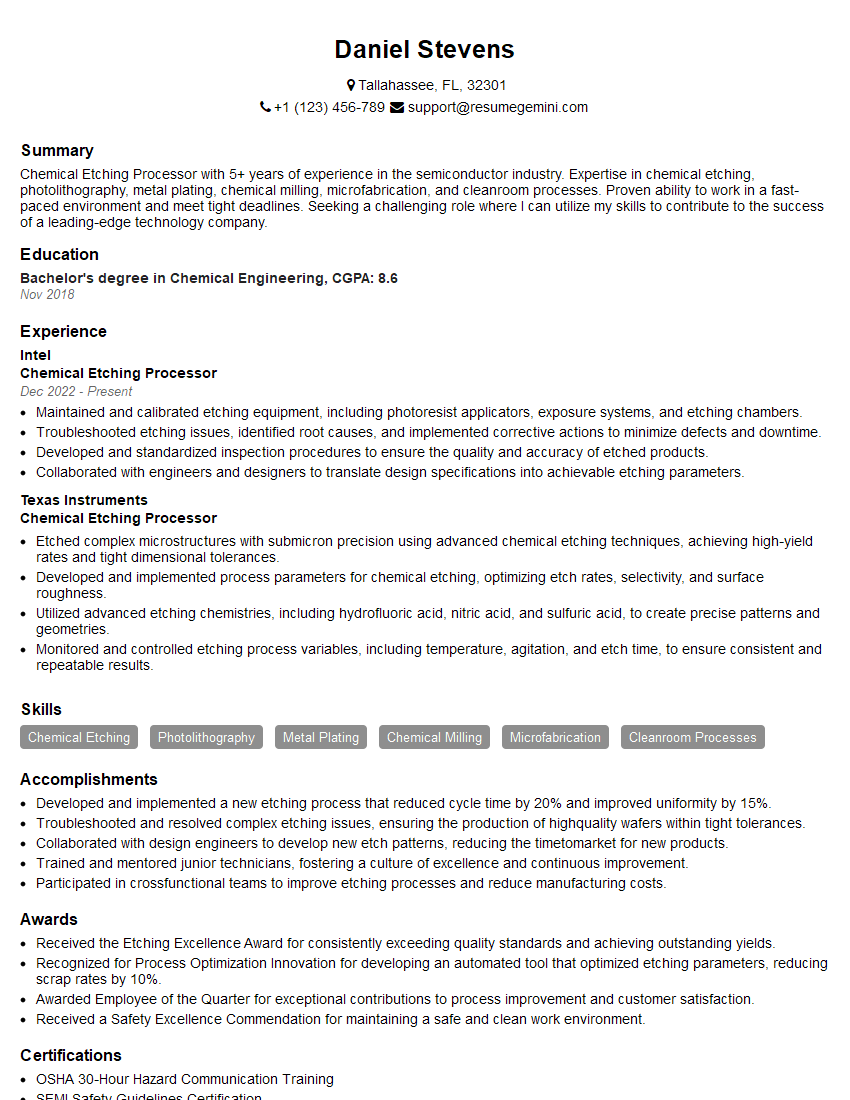
Are you gearing up for a career in Chemical Etching Processor? Feeling nervous about the interview questions that might come your way? Don’t worry, you’re in the right place. In this blog post, we’ll dive deep into the most common interview questions for Chemical Etching Processor and provide you with expert-backed answers. We’ll also explore the key responsibilities of this role so you can tailor your responses to showcase your perfect fit.
Acing the interview is crucial, but landing one requires a compelling resume that gets you noticed. Crafting a professional document that highlights your skills and experience is the first step toward interview success. ResumeGemini can help you build a standout resume that gets you called in for that dream job.






Essential Interview Questions For Chemical Etching Processor
1. What is the role of etchant concentration in chemical etching?
The concentration of the etchant plays a crucial role in chemical etching by influencing the following factors:
- Etch rate: Higher etchant concentrations typically lead to faster etch rates.
- Surface finish: Optimized etchant concentrations can produce smoother and more uniform surfaces.
- Selectivity: The etchant concentration can affect the selectivity of the etching process, influencing the relative etching rates of different materials.
2. Describe the different types of chemical etching techniques and their applications.
Isotropic Etching
- Uniform etching in all directions.
- Used in creating bulk microstructures, releasing structures from substrates.
Anisotropic Etching
- Selective etching along specific crystallographic orientations.
- Applications in microelectronics, MEMS fabrication (e.g., trenches, cantilevers).
3. How do you monitor and control the etching process to ensure consistent results?
To ensure consistent etching results, several monitoring and control measures are employed:
- Etch time and temperature: Precisely controlling these parameters helps achieve desired etch depths and surface finishes.
- Etchant composition: Maintaining the correct etchant concentration and composition is crucial for consistent etching performance.
- Agitation: Adequate agitation ensures uniform etching by preventing mass transport limitations and reducing etch variations.
4. What are the potential hazards associated with chemical etching, and how do you mitigate them?
Chemical etching involves hazardous materials and processes, so it’s essential to prioritize safety:
- Corrosive chemicals: Etchants like acids and bases can cause burns and skin irritation; proper handling, protective gear, and ventilation are crucial.
- Fumes and gases: Etching processes can release harmful fumes and gases; proper ventilation and respiratory protection are necessary.
- Waste disposal: Spent etchants and etched materials require appropriate disposal methods to minimize environmental impact.
5. How do you handle non-uniform etching and how do you correct it?
Non-uniform etching can arise due to several factors. Corrective measures include:
- Optimizing etchant concentration: Adjusting the etchant concentration can improve uniformity.
- Ensuring proper agitation: Enhanced agitation promotes uniform mass transfer and etching.
- Using additives: Surfactants or inhibitors can be added to the etchant to improve uniformity.
6. What are the different techniques used to measure etch depth and how do you choose the appropriate one?
Etch depth measurement techniques:
- Profilometry: Non-destructive method using a stylus or laser to measure surface profiles.
- Ellipsometry: Measures changes in light polarization to determine film thickness and etch depth.
- Cross-sectional SEM: Provides high-resolution images of the etched profile.
- Optical microscopy: Estimates etch depth based on visual inspection and magnification.
- Atomic force microscopy (AFM): Scans the surface to create a three-dimensional image and measure etch depth.
7. What are the factors that affect the selectivity of chemical etching?
Factors influencing etch selectivity:
- Etchant chemistry: The etchant’s composition and properties determine its selectivity for different materials.
- Crystallographic orientation: Anisotropic etching occurs at different rates based on the crystal orientation of the substrate.
- Temperature and agitation: These parameters can influence the selectivity by affecting mass transport and surface reactions.
- Additives: Surfactants or inhibitors can be added to enhance selectivity by modifying the etchant’s behavior.
8. How do you optimize the chemical etching process for a specific material and pattern?
Optimizing the etching process involves:
- Material characterization: Understanding the material’s composition, crystal structure, and etching behavior.
- Etchant selection: Choosing the etchant with the desired selectivity and etch rate for the material.
- Process parameter optimization: Adjusting etchant concentration, temperature, and agitation to achieve desired results.
- Mask design: Designing masks to protect desired areas and define the desired pattern.
9. What are the different types of resists used in chemical etching and how do you select the appropriate one?
Types of resists:
- Positive resists: Exposed areas are removed during development, creating the desired pattern.
- Negative resists: Unexposed areas are removed during development, creating the inverse pattern.
- Dry film resists: Pre-applied thin films that are laminated onto the substrate.
- Liquid resists: Applied as solutions and require a baking process to cure.
Selection criteria:
- Etch resistance: Resist’s ability to withstand the etchant.
- Pattern resolution: Minimum feature size achievable.
- Adhesion: Resist’s ability to adhere to the substrate.
- Cost and availability: Practical considerations for production.
10. Can you describe the role of post-etching treatments in chemical etching?
Post-etching treatments are crucial to:
- Remove residual etchant: Ensure complete removal of any remaining etchant.
- Neutralize the surface: Eliminate any acidic or basic residues to prevent corrosion or contamination.
- Improve surface properties: Enhance adhesion, reduce roughness, or passivate the surface for specific applications.
Interviewers often ask about specific skills and experiences. With ResumeGemini‘s customizable templates, you can tailor your resume to showcase the skills most relevant to the position, making a powerful first impression. Also check out Resume Template specially tailored for Chemical Etching Processor.
Career Expert Tips:
- Ace those interviews! Prepare effectively by reviewing the Top 50 Most Common Interview Questions on ResumeGemini.
- Navigate your job search with confidence! Explore a wide range of Career Tips on ResumeGemini. Learn about common challenges and recommendations to overcome them.
- Craft the perfect resume! Master the Art of Resume Writing with ResumeGemini’s guide. Showcase your unique qualifications and achievements effectively.
- Great Savings With New Year Deals and Discounts! In 2025, boost your job search and build your dream resume with ResumeGemini’s ATS optimized templates.
Researching the company and tailoring your answers is essential. Once you have a clear understanding of the Chemical Etching Processor‘s requirements, you can use ResumeGemini to adjust your resume to perfectly match the job description.
Key Job Responsibilities
The Chemical Etching Processor is responsible for carrying out all aspects of the chemical etching process, from preparing the materials to etching the final product. This role requires a thorough understanding of the chemical etching process, as well as the ability to operate and maintain the equipment used.
1. Preparing the Materials
The first step in the chemical etching process is to prepare the materials. This involves cleaning the materials to remove any contaminants, and then applying a resist to the areas that should not be etched. The resist is a protective coating that will prevent the etching solution from damaging these areas.
2. Etching the Materials
Once the materials have been prepared, they are placed in an etching solution. The etching solution is a corrosive chemical that will dissolve the materials, leaving behind the desired pattern. The etching process is carefully controlled to ensure that the materials are etched to the correct depth and width.
3. Cleaning the Materials
After the materials have been etched, they are cleaned to remove any remaining etching solution. The materials are then inspected to ensure that they meet the required specifications.
4. Maintaining the Equipment
The Chemical Etching Processor is responsible for maintaining the equipment used in the etching process. This includes cleaning, calibrating, and repairing the equipment as needed. The Processor must also be familiar with the safety procedures associated with the use of chemicals and equipment.
Interview Tips
Preparing for an interview can be daunting, but there are a few things you can do to increase your chances of success. Here are a few tips to help you ace your next interview for a Chemical Etching Processor position:
1. Research the company and the position
Before you go into an interview, it is important to do your research. This includes learning about the company, the position you are applying for, and the industry. This will help you to answer questions intelligently and show the interviewer that you are genuinely interested in the position.
2. Practice answering common interview questions
There are a few common interview questions that you are likely to be asked, regardless of the position you are applying for. These questions include:
- Tell me about yourself.
- Why are you interested in this position?
- What are your strengths and weaknesses?
- What are your career goals?
- Why should we hire you?
It is helpful to practice answering these questions in advance so that you can deliver your answers confidently and concisely.
3. Be prepared to talk about your experience
The interviewer will want to know about your experience in the chemical etching industry. Be prepared to talk about your skills and knowledge, and how they relate to the position you are applying for.
4. Ask questions
At the end of the interview, it is important to ask the interviewer questions. This shows that you are interested in the position and the company, and that you are taking the interview seriously.
5. Follow up
After the interview, it is important to follow up with the interviewer. This can be done by sending a thank-you note or email. This shows the interviewer that you are still interested in the position and that you appreciate their time.
Next Step:
Now that you’re armed with interview-winning answers and a deeper understanding of the Chemical Etching Processor role, it’s time to take action! Does your resume accurately reflect your skills and experience for this position? If not, head over to ResumeGemini. Here, you’ll find all the tools and tips to craft a resume that gets noticed. Don’t let a weak resume hold you back from landing your dream job. Polish your resume, hit the “Build Your Resume” button, and watch your career take off! Remember, preparation is key, and ResumeGemini is your partner in interview success.