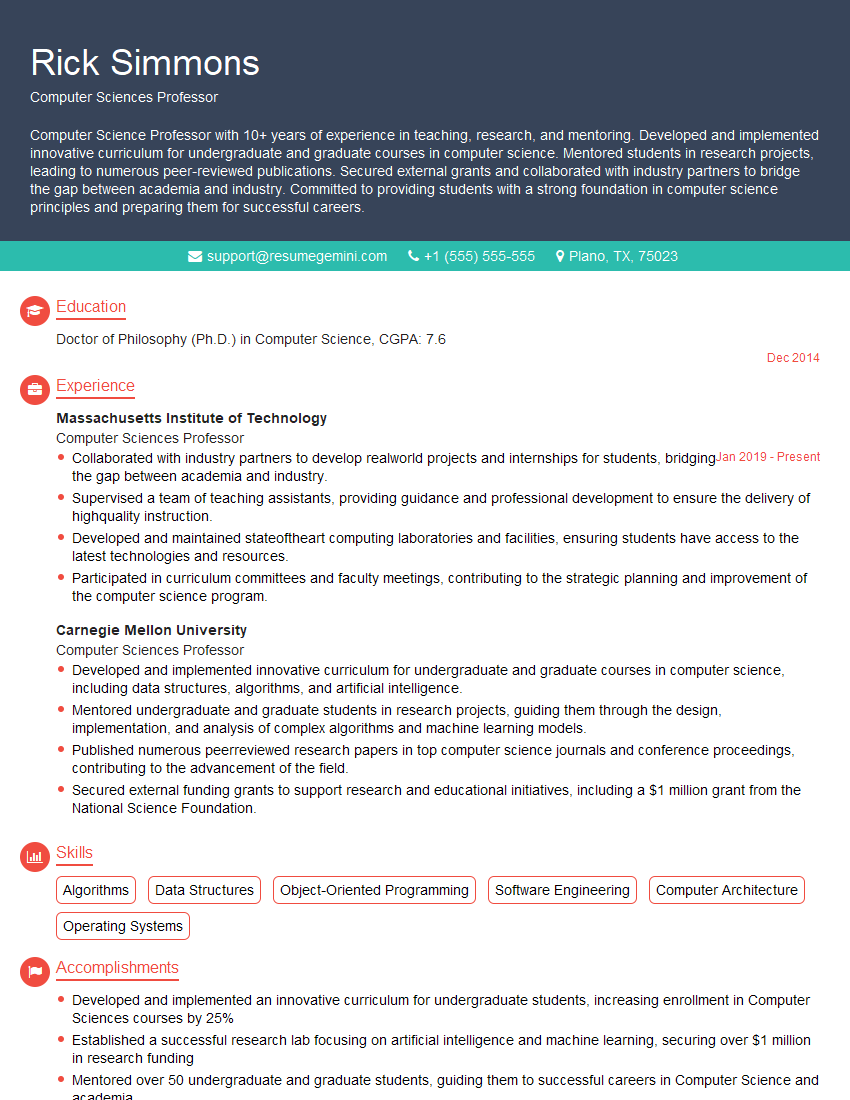
Are you gearing up for an interview for a Computer Sciences Professor position? Whether you’re a seasoned professional or just stepping into the role, understanding what’s expected can make all the difference. In this blog, we dive deep into the essential interview questions for Computer Sciences Professor and break down the key responsibilities of the role. By exploring these insights, you’ll gain a clearer picture of what employers are looking for and how you can stand out. Read on to equip yourself with the knowledge and confidence needed to ace your next interview and land your dream job!
Acing the interview is crucial, but landing one requires a compelling resume that gets you noticed. Crafting a professional document that highlights your skills and experience is the first step toward interview success. ResumeGemini can help you build a standout resume that gets you called in for that dream job.






Essential Interview Questions For Computer Sciences Professor
1. Describe the key differences between supervised and unsupervised learning.
- Supervised learning involves training a model on a dataset with labeled data. The model learns to map input features to output labels. Examples include regression and classification.
- Unsupervised learning involves training a model on a dataset with unlabeled data. The model learns to find patterns and structures in the data without explicit guidance. Examples include clustering and dimensionality reduction.
2. Discuss the advantages and disadvantages of using decision trees for classification tasks.
Advantages
- Easy to interpret and visualize
- Handle both numerical and categorical features
- Robust to noisy data
Disadvantages
- Can overfit data if not properly pruned
- Can be sensitive to changes in the training data
- Not suitable for high-dimensional data
3. Explain the concept of regularization and discuss its benefits in machine learning models.
- Regularization adds a penalty term to the loss function that encourages simpler models.
- Benefits include reducing overfitting, improving generalization performance, and enhancing the robustness of models.
4. Discuss the ethical considerations involved in the development and deployment of artificial intelligence systems.
- Algorithmic bias
- Privacy and data security
- Accountability and transparency
- Impact on employment and society
5. Describe the role of cloud computing in modern software development.
- Scalability and flexibility
- Reduced infrastructure costs
- Improved collaboration and efficiency
- Access to specialized services and tools
6. Explain the principles of agile software development and discuss its benefits.
- Iterative and incremental approach
- Focus on customer collaboration
- Flexible and adaptable processes
- Improved software quality and faster delivery times
7. Discuss the challenges of teaching computer science to students with diverse backgrounds and learning styles.
- Varying levels of prior knowledge
- Different learning preferences and styles
- Motivating students with diverse interests
- Addressing equity and inclusion
8. Describe your approach to mentoring and supporting graduate students in their research.
- Provide regular guidance and feedback
- Foster a collaborative and supportive environment
- Encourage students to present their work at conferences
- Connect students with potential collaborators and industry partners
9. Discuss the importance of research in computer science and its impact on society.
- Advancing fundamental knowledge
- Developing new technologies and applications
- Addressing societal challenges
- Educating the next generation of computer scientists
10. How do you stay up-to-date with the latest advancements in computer science?
- Attending conferences and workshops
- Reading research papers and industry publications
- Participating in online forums and discussions
- Collaborating with researchers in industry and academia
Interviewers often ask about specific skills and experiences. With ResumeGemini‘s customizable templates, you can tailor your resume to showcase the skills most relevant to the position, making a powerful first impression. Also check out Resume Template specially tailored for Computer Sciences Professor.
Career Expert Tips:
- Ace those interviews! Prepare effectively by reviewing the Top 50 Most Common Interview Questions on ResumeGemini.
- Navigate your job search with confidence! Explore a wide range of Career Tips on ResumeGemini. Learn about common challenges and recommendations to overcome them.
- Craft the perfect resume! Master the Art of Resume Writing with ResumeGemini’s guide. Showcase your unique qualifications and achievements effectively.
- Great Savings With New Year Deals and Discounts! In 2025, boost your job search and build your dream resume with ResumeGemini’s ATS optimized templates.
Researching the company and tailoring your answers is essential. Once you have a clear understanding of the Computer Sciences Professor‘s requirements, you can use ResumeGemini to adjust your resume to perfectly match the job description.
Key Job Responsibilities
Computer Sciences Professors are responsible for teaching undergraduate and graduate students in the field of computer science. They also conduct research in their areas of expertise and publish their findings in academic journals. In addition, they may serve on departmental committees and advise students on their academic and career goals.
1. Teaching
Computer Sciences Professors are responsible for teaching a variety of courses in the field of computer science. These courses may cover topics such as programming, data structures, algorithms, computer architecture, and software engineering. Professors must be able to effectively communicate complex technical concepts to students and create a positive and engaging learning environment.
- Develop and deliver course materials, including lectures, assignments, and exams
- Grade student work and provide feedback
- Meet with students outside of class to provide additional support
2. Research
Computer Sciences Professors are expected to conduct research in their areas of expertise. This research may lead to the publication of papers in academic journals, conference presentations, and patents. Professors must be able to identify and pursue research questions that are both innovative and significant.
- Identify and pursue research questions
- Design and conduct research studies
- Publish research findings in academic journals and conference proceedings
3. Service
Computer Sciences Professors are expected to serve on departmental committees and advise students on their academic and career goals. They may also participate in outreach activities such as giving public lectures or volunteering at local schools.
- Serve on departmental committees
- Advise students on their academic and career goals
- Participate in outreach activities
Interview Tips
Preparing for an interview for a Computer Sciences Professor position can be a daunting task. However, by following a few simple tips, you can increase your chances of success.
1. Research the Position and the Department
Before you go on an interview, it is important to do your research. This includes learning about the specific position you are applying for, as well as the department and the university. This will help you to tailor your answers to the interviewer’s questions and demonstrate your interest in the position.
- Read the job posting carefully
- Visit the department’s website
- Talk to people who know about the department and the position
2. Prepare Your Answers to Common Interview Questions
There are a few common interview questions that you are likely to be asked, such as “Why are you interested in this position?” and “What are your research interests?”. It is important to prepare your answers to these questions in advance so that you can deliver them confidently and concisely.
- Practice your answers to common interview questions
- Be prepared to talk about your teaching experience and research interests
- Be prepared to discuss your service experience
3. Dress Professionally and Arrive on Time
First impressions matter, so it is important to dress professionally and arrive on time for your interview. This will show the interviewer that you are serious about the position and that you respect their time.
- Dress in a suit or business casual attire
- Be on time for your interview
- Be polite and respectful to everyone you meet
4. Be Yourself
The most important thing is to be yourself during your interview. The interviewer wants to get to know the real you, so don’t try to be someone you’re not. Just relax, be confident, and let your personality shine through.
- Be honest and authentic
- Share your passion for teaching and research
- Be yourself and let your personality shine through
Next Step:
Now that you’re armed with interview-winning answers and a deeper understanding of the Computer Sciences Professor role, it’s time to take action! Does your resume accurately reflect your skills and experience for this position? If not, head over to ResumeGemini. Here, you’ll find all the tools and tips to craft a resume that gets noticed. Don’t let a weak resume hold you back from landing your dream job. Polish your resume, hit the “Build Your Resume” button, and watch your career take off! Remember, preparation is key, and ResumeGemini is your partner in interview success.