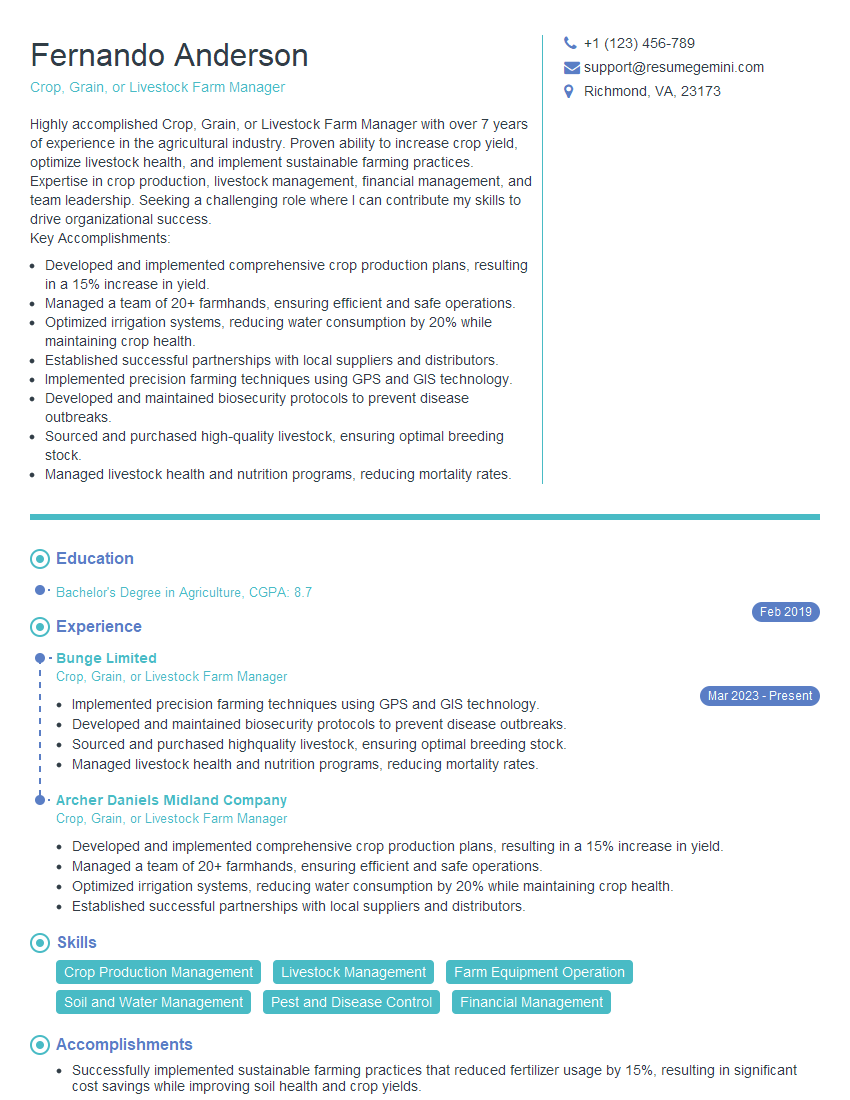
Ever felt underprepared for that crucial job interview? Or perhaps you’ve landed the interview but struggled to articulate your skills and experiences effectively? Fear not! We’ve got you covered. In this blog post, we’re diving deep into the Crop, Grain, or Livestock Farm Manager interview questions that you’re most likely to encounter. But that’s not all. We’ll also provide expert insights into the key responsibilities of a Crop, Grain, or Livestock Farm Manager so you can tailor your answers to impress potential employers.
Acing the interview is crucial, but landing one requires a compelling resume that gets you noticed. Crafting a professional document that highlights your skills and experience is the first step toward interview success. ResumeGemini can help you build a standout resume that gets you called in for that dream job.






Essential Interview Questions For Crop, Grain, or Livestock Farm Manager
1. What are the key performance indicators (KPIs) you would track to measure the success of a farming operation?
- Crop yield (bushels/acre, tons/acre, etc.)
- Livestock production (pounds of meat, gallons of milk, etc.)
- Profit margin
- Return on investment
- Employee productivity
- Customer satisfaction
- Environmental sustainability
2. Describe your experience with developing and implementing crop or livestock production plans.
subheading of the answer
- Developed and implemented a crop rotation plan that increased soil health and crop yields.
- Developed and implemented a livestock grazing plan that improved pasture utilization and animal health.
- Conducted research and trialled new crop varieties and livestock breeds to improve productivity.
subheading of the answer
- Experience with using precision agriculture technologies (GPS, variable rate technology, etc.) to improve production efficiency.
3. What are your strategies for managing risk in a farming operation?
- Diversify crops and livestock to reduce dependence on a single commodity.
- Develop and implement a crop insurance plan.
- Invest in risk management tools such as futures and options contracts.
- Build relationships with lenders and other financial institutions to access capital in case of an emergency.
- Develop and implement a disaster preparedness plan.
4. How do you stay up-to-date on the latest farming technologies and best practices?
- Attend industry conferences and workshops.
- Read trade publications and online resources.
- Network with other farmers and agricultural professionals.
- Conduct research and trial new technologies and practices on my own farm.
5. What is your experience with managing a team of employees?
- Supervised a team of 10 employees on a 1,000-acre crop farm.
- Developed and implemented employee training programs.
- Evaluated employee performance and provided feedback.
- Motivated and rewarded employees to achieve goals.
6. How do you manage the financial aspects of a farming operation?
- Developed and implemented a financial plan and budget.
- Tracked income and expenses.
- Prepared financial statements.
- Negotiated with lenders and other financial institutions.
- Experience with using financial software and tools.
7. What is your experience with marketing and selling agricultural products?
- Developed and implemented a marketing plan.
- Negotiated contracts with buyers.
- Promoted products through advertising and public relations.
- Developed and maintained relationships with customers.
8. What are your long-term goals as a Crop, Grain, or Livestock Farm Manager?
- To increase the productivity and profitability of the farm.
- To develop and implement sustainable farming practices.
- To create a positive and supportive work environment for employees.
- To be a leader in the agricultural industry.
9. Why are you interested in this position with our company?
- I am passionate about agriculture and have a proven track record of success in managing farming operations.
- I am impressed with your company’s commitment to sustainability and innovation.
- I believe that my skills and experience would be a valuable asset to your team.
10. What are your salary expectations?
- My salary expectations are commensurate with my experience and qualifications.
- I am open to discussing a salary range that is competitive within the industry.
- I am more interested in finding the right fit for my skills and experience than in maximizing my salary.
Interviewers often ask about specific skills and experiences. With ResumeGemini‘s customizable templates, you can tailor your resume to showcase the skills most relevant to the position, making a powerful first impression. Also check out Resume Template specially tailored for Crop, Grain, or Livestock Farm Manager.
Career Expert Tips:
- Ace those interviews! Prepare effectively by reviewing the Top 50 Most Common Interview Questions on ResumeGemini.
- Navigate your job search with confidence! Explore a wide range of Career Tips on ResumeGemini. Learn about common challenges and recommendations to overcome them.
- Craft the perfect resume! Master the Art of Resume Writing with ResumeGemini’s guide. Showcase your unique qualifications and achievements effectively.
- Great Savings With New Year Deals and Discounts! In 2025, boost your job search and build your dream resume with ResumeGemini’s ATS optimized templates.
Researching the company and tailoring your answers is essential. Once you have a clear understanding of the Crop, Grain, or Livestock Farm Manager‘s requirements, you can use ResumeGemini to adjust your resume to perfectly match the job description.
Key Job Responsibilities
Crop, Grain, or Livestock Farm Managers are responsible for the day-to-day operations of a farm. They oversee all aspects of the farm, from planting and harvesting crops to raising and caring for livestock. These managers must have a deep understanding of agricultural practices and a proven track record of success in the field.
1. Planning and Execution of Farm Operations
Managers develop and implement plans for all aspects of the farm’s operations, including crop production, livestock management, and financial planning.
- Develop and implement crop rotation plans to maintain soil health and maximize yields.
- Select and purchase livestock breeds that are well-suited to the farm’s climate and market demand.
2. Resource Management
Managers are responsible for managing the farm’s resources, including land, water, labor, and equipment.
- Monitor soil and water quality and implement conservation practices to protect natural resources.
- Recruit, train, and supervise a team of farm workers to ensure efficient operations.
3. Financial Management
Managers are responsible for the farm’s financial health, including budgeting, record-keeping, and tax compliance.
- Develop and manage the farm’s budget to ensure financial stability.
- Maintain accurate financial records and file taxes in a timely manner.
4. Marketing and Sales
Managers are responsible for marketing and selling the farm’s products, including crops, livestock, and value-added products.
- Identify and develop new markets for the farm’s products.
- Negotiate prices and contracts with buyers, processors, and distributors.
Interview Tips
Preparing for an interview for a Crop, Grain, or Livestock Farm Manager position requires thorough research and thoughtful consideration of your skills and experience. Here are some tips to help you ace the interview:
1. Research the Company and Position
Before the interview, take time to learn about the company and the specific position you are applying for. Visit the company’s website, read industry news, and connect with current or former employees to gain insights into the company culture and the role’s expectations.
- Review the job description thoroughly and identify the key responsibilities and qualifications required for the position.
- Research the company’s history, mission, values, and recent news to demonstrate your understanding of their business.
2. Highlight Your Relevant Experience and Skills
During the interview, focus on showcasing your relevant experience and skills that align with the job requirements. Use specific examples to illustrate your abilities and accomplishments.
- Quantify your accomplishments whenever possible, using metrics that demonstrate the impact of your work.
- Be prepared to discuss your knowledge of agricultural practices, livestock management, and financial planning.
3. Prepare Questions to Ask
Asking thoughtful questions during the interview shows that you are engaged and interested in the position. Prepare a few questions that demonstrate your curiosity and understanding of the industry.
- Ask about the company’s growth plans, sustainability initiatives, and employee development opportunities.
- Inquire about the farm’s production methods, market strategies, and plans for innovation.
4. Demonstrate Your Passion for Agriculture
Farming is a demanding profession that requires passion and dedication. Throughout the interview, convey your enthusiasm for agriculture and your commitment to the industry.
- Share your personal experiences or interests related to farming, such as growing up on a farm or engaging in agricultural clubs.
- Discuss your long-term career goals and how this position aligns with your aspirations in the field.
Next Step:
Armed with this knowledge, you’re now well-equipped to tackle the Crop, Grain, or Livestock Farm Manager interview with confidence. Remember, a well-crafted resume is your first impression. Take the time to tailor your resume to highlight your relevant skills and experiences. And don’t forget to practice your answers to common interview questions. With a little preparation, you’ll be on your way to landing your dream job. So what are you waiting for? Start building your resume and start applying! Build an amazing resume with ResumeGemini.