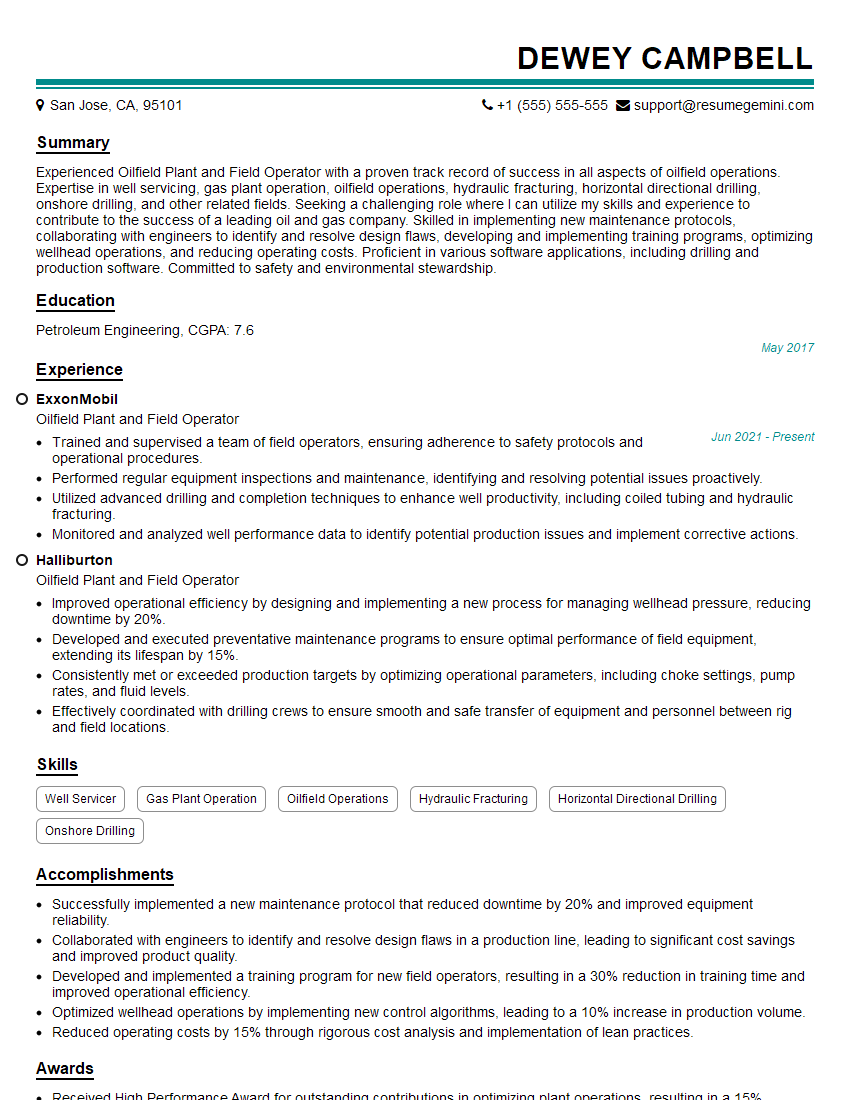
Are you gearing up for a career in Oilfield Plant and Field Operator? Feeling nervous about the interview questions that might come your way? Don’t worry, you’re in the right place. In this blog post, we’ll dive deep into the most common interview questions for Oilfield Plant and Field Operator and provide you with expert-backed answers. We’ll also explore the key responsibilities of this role so you can tailor your responses to showcase your perfect fit.
Acing the interview is crucial, but landing one requires a compelling resume that gets you noticed. Crafting a professional document that highlights your skills and experience is the first step toward interview success. ResumeGemini can help you build a standout resume that gets you called in for that dream job.






Essential Interview Questions For Oilfield Plant and Field Operator
1. Describe the process of starting up a gas turbine.
The process of starting up a gas turbine involves several steps:
- Pre-start checks: Ensure that all systems are ready for operation, including fuel supply, lubrication, and electrical systems.
- Fuel on and ignition: Open the fuel valve and initiate ignition to start the combustion process.
- Acceleration: Gradually increase the fuel flow to accelerate the turbine to its operating speed.
- Synchronization: If the turbine is connected to the grid, synchronize its speed and frequency with the network.
- Load application: Gradually increase the load on the turbine until it reaches the desired output.
2. What are the key components of a reciprocating compressor?
- Cylinders and pistons: Compress the gas using a reciprocating motion.
- Valves: Control the flow of gas in and out of the cylinders.
- Crosshead and connecting rod: Convert the reciprocating motion of the piston to rotary motion.
- Crankshaft: Transmits the rotary motion to the output shaft.
- Lubrication system: Provides lubrication to reduce friction and wear.
- Cooling system: Regulates the temperature of the compressor.
3. Explain the operation of a positive displacement pump.
Positive displacement pumps move a fixed volume of fluid per revolution:
- Rotary positive displacement pumps: Use rotating components to trap and move fluid, such as gear pumps and screw pumps.
- Reciprocating positive displacement pumps: Use a piston or diaphragm to create a positive displacement, such as reciprocating pumps and plunger pumps.
4. What are the different types of heat exchangers used in oil and gas processing?
- Shell and tube heat exchangers: Consist of a series of tubes enclosed in a shell, with fluid flowing through both sides.
- Plate and frame heat exchangers: Use a series of corrugated plates to create channels for fluid flow.
- Air coolers: Transfer heat from a process fluid to the surrounding air.
- Condenser: Condenses a gas into a liquid by removing heat.
- Evaporator: Vaporizes a liquid into a gas by adding heat.
5. Describe the role of a control valve in an oil and gas processing plant.
- Regulate flow: Control the flow of fluid through a pipeline or process equipment.
- Maintain pressure: Control the pressure in a system by adjusting the flow of fluid.
- Control temperature: Control the temperature of a process fluid by adjusting the flow of cooling or heating medium.
- Protect equipment: Prevent overpressure or underpressure in equipment by regulating flow.
6. What are the different types of pipelines used for oil and gas transportation?
- Gathering lines: Collect oil or gas from production facilities.
- Transportation lines: Transport oil or gas over long distances.
- Distribution lines: Deliver oil or gas to end-users.
- Subsea pipelines: Transport oil or gas underwater.
- Flowlines: Connect production facilities to processing plants.
7. What are the safety precautions that should be taken when working on a live electrical system?
- Lockout/tagout: Isolate the system from power sources to prevent accidental energization.
- Grounding: Connect the system to the ground to discharge static electricity and prevent electrical shocks.
- Test for voltage: Use a voltmeter to ensure that the system is de-energized before working on it.
- Wear proper PPE: Wear insulated gloves, safety glasses, and non-conductive clothing.
- Follow proper procedures: Adhere to established safety guidelines and protocols.
8. What are the different types of corrosion that can occur in oil and gas pipelines?
- Internal corrosion: Occurs on the inside of the pipeline due to contact with corrosive fluids, such as hydrogen sulfide or carbon dioxide.
- External corrosion: Occurs on the outside of the pipeline due to contact with corrosive soil or water.
- Microbiologically induced corrosion (MIC): Caused by bacteria or other microorganisms that produce corrosive substances.
- Stress corrosion cracking (SCC): Occurs when a pipeline is subjected to a combination of tensile stress and a corrosive environment.
9. What are the different methods used to detect and monitor corrosion in pipelines?
- Visual inspection: Inspecting the pipeline for signs of corrosion, such as pitting or rust.
- Ultrasonic testing: Using sound waves to detect corrosion beneath the surface of the pipeline.
- Radiography: Using X-rays or gamma rays to detect corrosion in the pipeline.
- Magnetic flux leakage (MFL): Using a magnetic field to detect corrosion in the pipeline.
- Corrosion coupons: Placing metal coupons in the pipeline to monitor corrosion rates.
10. What are the different types of maintenance performed on oil and gas pipelines?
- Preventive maintenance: Regular inspections and maintenance tasks to prevent corrosion and other problems.
- Predictive maintenance: Using monitoring systems to detect potential problems before they occur.
- Corrective maintenance: Repairing or replacing damaged or corroded sections of the pipeline.
- Emergency maintenance: Immediate repairs to address leaks or other critical issues.
Interviewers often ask about specific skills and experiences. With ResumeGemini‘s customizable templates, you can tailor your resume to showcase the skills most relevant to the position, making a powerful first impression. Also check out Resume Template specially tailored for Oilfield Plant and Field Operator.
Career Expert Tips:
- Ace those interviews! Prepare effectively by reviewing the Top 50 Most Common Interview Questions on ResumeGemini.
- Navigate your job search with confidence! Explore a wide range of Career Tips on ResumeGemini. Learn about common challenges and recommendations to overcome them.
- Craft the perfect resume! Master the Art of Resume Writing with ResumeGemini’s guide. Showcase your unique qualifications and achievements effectively.
- Great Savings With New Year Deals and Discounts! In 2025, boost your job search and build your dream resume with ResumeGemini’s ATS optimized templates.
Researching the company and tailoring your answers is essential. Once you have a clear understanding of the Oilfield Plant and Field Operator‘s requirements, you can use ResumeGemini to adjust your resume to perfectly match the job description.
Key Job Responsibilities
An Oilfield Plant and Field Operator is responsible for a variety of tasks related to the operation and maintenance of oilfield equipment. These responsibilities may vary depending on the specific job title and the size and type of oilfield operation, but some common key responsibilities include:
1. Equipment Operation
Operators are responsible for the safe and efficient operation of a variety of oilfield equipment, including pumps, compressors, generators, and other machinery. They must be able to monitor equipment performance, identify and troubleshoot problems, and make necessary repairs.
- Operate and maintain oil and gas production equipment, including pumps, compressors, and separators.
- Monitor and control production processes to ensure optimal performance and safety.
2. Field Maintenance
Operators are also responsible for performing routine maintenance on oilfield equipment. This may include tasks such as lubricating moving parts, changing filters, and inspecting equipment for signs of wear or damage.
- Inspect and maintain oilfield equipment, such as pipelines, valves, and tanks.
- Conduct preventive maintenance and repairs to minimize downtime and ensure equipment reliability.
3. Safety and Compliance
Oilfield Plant and Field Operators must always work in a safe manner and comply with all applicable safety regulations. They must be familiar with the potential hazards of working in an oilfield environment and must take steps to protect themselves and others from injury.
- Adhere to strict safety protocols and regulations to ensure a safe working environment.
- Wear appropriate personal protective equipment (PPE) and follow established safety procedures.
4. Communication and Teamwork
Operators must be able to communicate effectively with other members of the oilfield team, including supervisors, engineers, and other operators. They must also be able to work well as part of a team to achieve common goals.
- Communicate effectively with colleagues, supervisors, and clients.
- Collaborate with other team members to solve problems and optimize operations.
Interview Tips
To ace an interview for an Oilfield Plant and Field Operator position, it is important to be prepared and to demonstrate your skills and experience in the following areas:
1. Technical Skills
Interviewers will be looking for candidates who have a strong understanding of the technical aspects of oilfield operations. This includes knowledge of equipment operation, maintenance, and safety procedures.
- Highlight your technical expertise in operating and maintaining oil and gas production equipment.
- Provide examples of your troubleshooting and problem-solving abilities in a plant or field environment.
2. Safety and Compliance
Safety is paramount in the oilfield industry. Interviewers will want to know that you are committed to working safely and that you are familiar with all applicable safety regulations.
- Emphasize your commitment to safety and your understanding of oilfield safety protocols.
- Explain your experience in following safety procedures and using personal protective equipment (PPE).
3. Communication and Teamwork
Oilfield Plant and Field Operators must be able to work effectively as part of a team. Interviewers will be looking for candidates who have strong communication skills and who can demonstrate their ability to work well with others.
- Showcase your communication and interpersonal skills by providing examples of how you have worked effectively in a team environment.
- Highlight your ability to build relationships and collaborate with colleagues.
4. Problem-Solving
Oilfield Plant and Field Operators must be able to identify and solve problems quickly and efficiently. Interviewers will want to know that you have the ability to think critically and to come up with innovative solutions.
- Describe your problem-solving process and provide examples of how you have successfully resolved issues in an oilfield setting.
- Explain how you stay up-to-date on the latest industry best practices and technologies.
Next Step:
Armed with this knowledge, you’re now well-equipped to tackle the Oilfield Plant and Field Operator interview with confidence. Remember, preparation is key. So, start crafting your resume, highlighting your relevant skills and experiences. Don’t be afraid to tailor your application to each specific job posting. With the right approach and a bit of practice, you’ll be well on your way to landing your dream job. Build your resume now from scratch or optimize your existing resume with ResumeGemini. Wish you luck in your career journey!