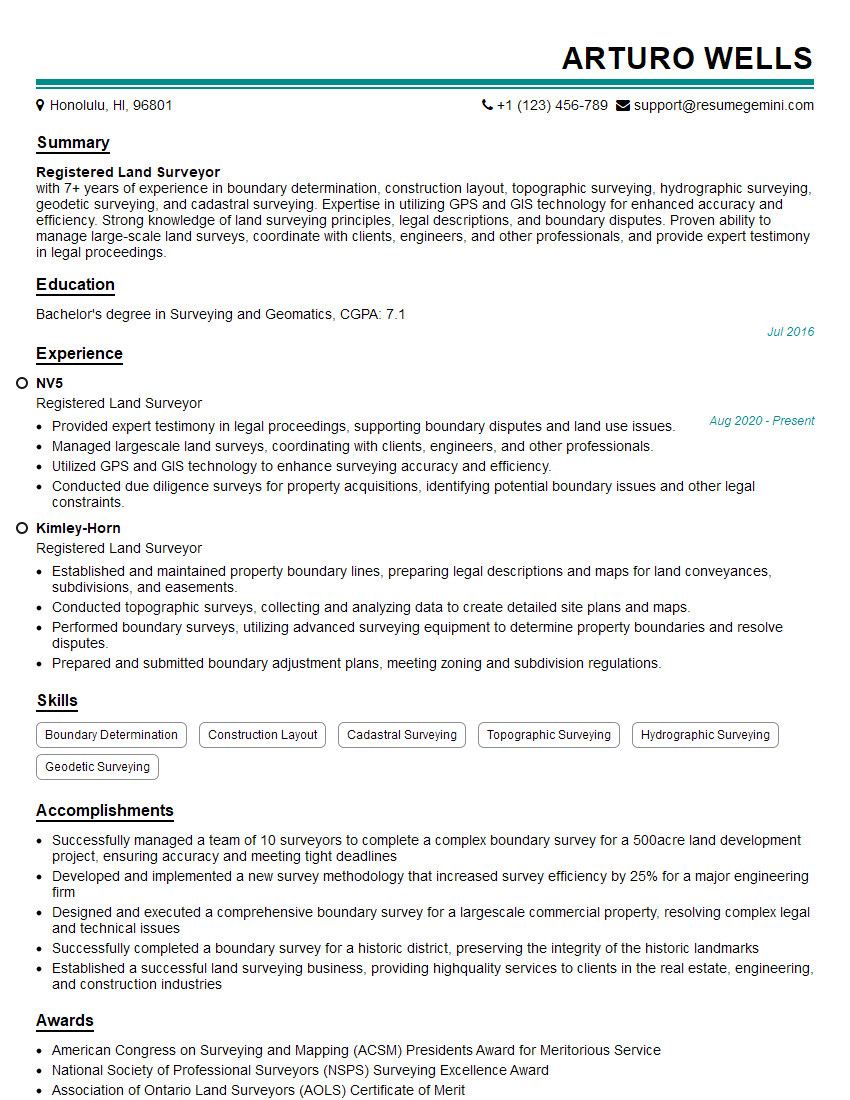
Are you gearing up for a career in Registered Land Surveyor? Feeling nervous about the interview questions that might come your way? Don’t worry, you’re in the right place. In this blog post, we’ll dive deep into the most common interview questions for Registered Land Surveyor and provide you with expert-backed answers. We’ll also explore the key responsibilities of this role so you can tailor your responses to showcase your perfect fit.
Acing the interview is crucial, but landing one requires a compelling resume that gets you noticed. Crafting a professional document that highlights your skills and experience is the first step toward interview success. ResumeGemini can help you build a standout resume that gets you called in for that dream job.






Essential Interview Questions For Registered Land Surveyor
1. Can you describe the different types of surveys that a Registered Land Surveyor performs? Explain the purpose of each type of survey.
- Boundary Survey: Determines the boundaries of a property and creates a legal description of the land.
- Topographic Survey: Maps the physical features of a property, including elevation, contours, and natural features.
- Construction Survey: Provides control points and measurements for construction projects, ensuring the accuracy of building placement and infrastructure.
- ALTA/ACSM Land Title Survey: A comprehensive survey that meets the requirements of the American Land Title Association and American Congress on Surveying and Mapping, providing legal descriptions, boundary lines, and title information.
- Subdivision Survey: Divides a larger parcel of land into smaller lots, creating boundaries and legal descriptions for each new parcel.
2. Explain the role of a Registered Land Surveyor in the legal process of land ownership.
Registered Land Surveyors play a crucial role in the legal process of land ownership:
Accurate Property Boundaries
- Identify and establish the legal boundaries of a property, ensuring clear ownership.
- Resolve boundary disputes by identifying errors or overlaps in property descriptions.
Legal Descriptions and Deeds
- Create legal descriptions that define the dimensions and boundaries of a property.
- Prepare deeds, which are legal documents that transfer ownership or create easements.
Title Insurance
- Provide surveys for title insurance companies, verifying property ownership and boundaries.
- Identify potential title issues or encumbrances that may affect property rights.
3. Describe the use of technology in the field of land surveying. How has technology improved the efficiency and accuracy of surveys?
Technology has revolutionized the field of land surveying, enhancing efficiency and accuracy:
- GPS (Global Positioning Systems): Provide highly precise location data, allowing for accurate measurement and mapping.
- Total Stations: Measure distances, angles, and elevations with great accuracy, reducing the need for manual calculations.
- Digital Leveling: Automates leveling tasks, providing accurate elevation data and reducing time spent on manual leveling.
- CAD (Computer-Aided Design) Software: Creates digital maps and plans, reducing human error and improving data visualization.
- Aerial Imagery and Photogrammetry: Provides detailed aerial images and 3D models, allowing for cost-effective mapping and terrain analysis.
4. How do you stay up-to-date with the latest advancements in surveying techniques and technology?
- Attend industry conferences and workshops.
- Read professional journals and publications.
- Participate in online forums and webinars.
- Undertake continuing education courses.
- Collaborate with other surveyors and experts.
5. What are some of the challenges that you have faced in your career as a Registered Land Surveyor? How did you overcome these challenges?
Challenge: Resolving Boundary Disputes
Solution: Conducting thorough research, reviewing historical records, and collaborating with adjacent landowners to find mutually acceptable solutions.
Challenge: Dealing with Difficult Terrain
Solution: Utilizing specialized equipment, such as high-precision GPS and laser scanners, to collect data in challenging environments.
Challenge: Coordinating with Multiple Stakeholders
Solution: Establishing clear communication channels, effectively managing expectations, and fostering collaboration to ensure timely project completion.
6. Can you explain the concept of “Least Squares Adjustment” as it pertains to land surveying?
Least Squares Adjustment is a mathematical technique used in land surveying to minimize errors in measurements and calculations.
- Adjusts measurements from multiple observations or readings.
- Uses statistical principles to determine the most probable values of coordinate positions.
- Reduces the impact of random errors and outliers, resulting in more accurate survey results.
7. How do you handle situations where there are discrepancies between existing property boundaries and survey measurements?
- Analyze historical records and property deeds to understand the legal basis of the boundaries.
- Re-establish original boundary markers based on the recorded descriptions.
- Negotiate with affected parties to reach mutually acceptable boundary adjustments.
- If necessary, file legal descriptions or surveys to update property records.
8. What are the legal responsibilities of a Registered Land Surveyor?
- Ensure the accuracy and reliability of survey measurements and calculations.
- Adhere to professional standards and ethics, including confidentiality and unbiased reporting.
- Comply with state licensing requirements and applicable laws.
- Maintain professional liability insurance to protect clients and the public.
- Provide clear and detailed survey reports that meet legal requirements.
9. Can you describe the process of preparing a legal description of a property?
- Determine the legal basis of the property, such as a deed or patent.
- Analyze existing survey data, including boundary measurements and descriptions.
- Write a legal description that follows the accepted format and includes all required elements.
- Review the legal description with an attorney to ensure its accuracy and legal sufficiency.
- File the legal description with the appropriate government agency for recording.
10. How do you determine the elevation of a property? What methods and equipment do you use?
- Differential Leveling: Using a level and leveling rod to measure altitude differences between known and unknown points.
- Trigonometric Leveling: Employing a theodolite to measure vertical angles and calculate elevations.
- GPS Elevation Data: Utilizing GPS receivers to obtain elevation information from satellites.
- Light Detection and Ranging (LiDAR): Using laser technology to create precise elevation models.
- Photogrammetry: Deriving elevation data from aerial imagery and digital elevation models.
Interviewers often ask about specific skills and experiences. With ResumeGemini‘s customizable templates, you can tailor your resume to showcase the skills most relevant to the position, making a powerful first impression. Also check out Resume Template specially tailored for Registered Land Surveyor.
Career Expert Tips:
- Ace those interviews! Prepare effectively by reviewing the Top 50 Most Common Interview Questions on ResumeGemini.
- Navigate your job search with confidence! Explore a wide range of Career Tips on ResumeGemini. Learn about common challenges and recommendations to overcome them.
- Craft the perfect resume! Master the Art of Resume Writing with ResumeGemini’s guide. Showcase your unique qualifications and achievements effectively.
- Great Savings With New Year Deals and Discounts! In 2025, boost your job search and build your dream resume with ResumeGemini’s ATS optimized templates.
Researching the company and tailoring your answers is essential. Once you have a clear understanding of the Registered Land Surveyor‘s requirements, you can use ResumeGemini to adjust your resume to perfectly match the job description.
Key Job Responsibilities
A Registered Land Surveyor is responsible for establishing or re-establishing property boundaries, preparing legal descriptions of properties, and creating maps and plans.
1. Conducting Surveys
Registered Land Surveyors conduct surveys to determine the location of property lines and boundaries. They use a variety of equipment, including surveying instruments, GPS receivers, and total stations.
- Conduct boundary surveys to establish or re-establish property lines.
- Perform topographic surveys to map the physical features of a property.
- Conduct construction surveys to assist with the planning and construction of buildings and other structures.
2. Preparing Legal Descriptions
Registered Land Surveyors prepare legal descriptions of properties. These descriptions are used in deeds, mortgages, and other legal documents.
- Create legal descriptions of properties for deeds, mortgages, and other legal documents.
- Review and interpret legal descriptions to identify property boundaries.
3. Creating Maps and Plans
Registered Land Surveyors create maps and plans that show the location of property lines, boundaries, and other features.
- Create maps and plans that show the location of property lines, boundaries, and other features.
- Use computer-aided drafting (CAD) software to create accurate and detailed maps and plans.
4. Testifying in Court
Registered Land Surveyors may be called upon to testify in court about their surveys and findings.
- Testify in court about their surveys and findings.
- Provide expert testimony on matters related to land surveying.
Interview Tips
To ace an interview for a Registered Land Surveyor position, it is important to be well-prepared. Here are some tips:
1. Research the Company and Position
Before the interview, research the company and the specific position you are applying for. This will help you to understand the company’s culture and the specific requirements of the job.
- Visit the company’s website.
- Read articles about the company and its industry.
- Talk to people who work at the company.
2. Practice Answering Common Interview Questions
There are a number of common interview questions that you may be asked, such as “Why are you interested in this position?” and “What are your strengths and weaknesses?”. It is helpful to practice answering these questions beforehand so that you can give confident and well-thought-out responses.
- Make a list of potential interview questions.
- Practice answering the questions out loud.
- Get feedback from a friend or family member.
3. Prepare Questions for the Interviewer
Asking questions at the end of the interview shows that you are interested in the position and that you have taken the time to prepare. It also gives you an opportunity to learn more about the company and the job.
- Prepare a list of questions to ask the interviewer.
- Ask questions about the company, the position, and the team.
- Avoid asking questions about salary or benefits.
4. Dress Professionally
First impressions matter, so it is important to dress professionally for your interview. This means wearing a suit or dress pants and a button-down shirt or blouse. You should also make sure your clothes are clean and pressed.
- Choose clothing that is appropriate for the job and the company culture.
- Make sure your clothes are clean and pressed.
- Avoid wearing clothing that is too revealing or too casual.
5. Be Confident and Enthusiastic
Confidence and enthusiasm are contagious, so make sure you project these qualities during your interview. This will help to make a positive impression on the interviewer and show that you are excited about the opportunity.
- Make eye contact with the interviewer.
- Smile and be friendly.
- Speak clearly and confidently.
Next Step:
Now that you’re armed with a solid understanding of what it takes to succeed as a Registered Land Surveyor, it’s time to turn that knowledge into action. Take a moment to revisit your resume, ensuring it highlights your relevant skills and experiences. Tailor it to reflect the insights you’ve gained from this blog and make it shine with your unique qualifications. Don’t wait for opportunities to come to you—start applying for Registered Land Surveyor positions today and take the first step towards your next career milestone. Your dream job is within reach, and with a polished resume and targeted applications, you’ll be well on your way to achieving your career goals! Build your resume now with ResumeGemini.