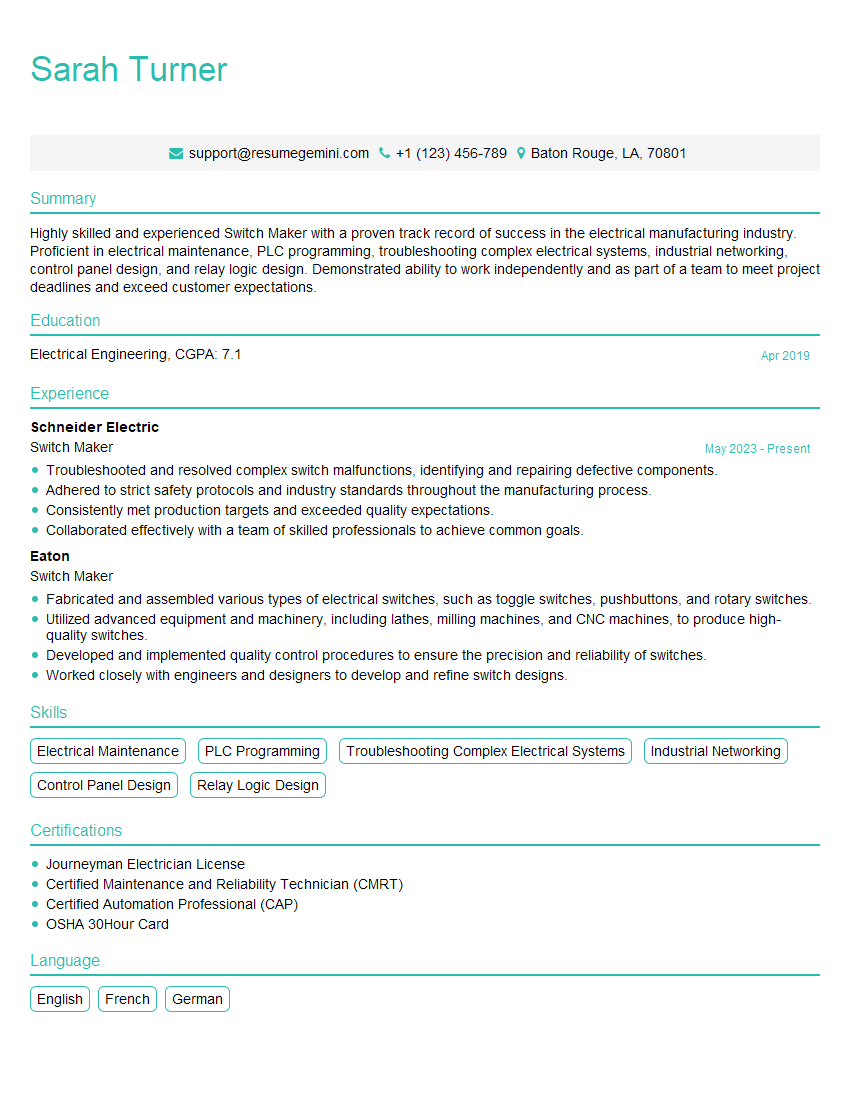
Are you gearing up for a career shift or aiming to ace your next interview? Look no further! We’ve curated a comprehensive guide to help you crack the interview for the coveted Switch Maker position. From understanding the key responsibilities to mastering the most commonly asked questions, this blog has you covered. So, buckle up and let’s embark on this journey together.
Acing the interview is crucial, but landing one requires a compelling resume that gets you noticed. Crafting a professional document that highlights your skills and experience is the first step toward interview success. ResumeGemini can help you build a standout resume that gets you called in for that dream job.






Essential Interview Questions For Switch Maker
1. What are the different types of switches used in electrical circuits and describe their functions?
There are various types of switches utilized in electrical circuits, each serving specific functions:
- Toggle Switch: A double-throw switch that alternates between two circuits, commonly employed in lighting systems.
- Push Button Switch: A momentary switch that activates a circuit while the button is pressed, often used in control panels.
- Rotary Switch: A multi-position switch that selects among multiple circuits, typically found in fan speed controllers.
- Limit Switch: A switch designed to detect the presence or absence of an object, widely used in industrial automation.
- Float Switch: A switch that triggers based on the liquid level, commonly employed in pumping systems to prevent overflows.
- Pressure Switch: A switch that responds to changes in pressure, frequently utilized in hydraulic and pneumatic systems.
- Temperature Switch: A switch that activates or deactivates a circuit based on temperature variations, commonly found in heating and cooling systems.
2. Explain the working principle of a solid-state relay (SSR)?
- Isolation: SSRs provide electrical isolation between the control and load circuits, eliminating the risk of electrical shock or interference.
- Zero-Voltage Switching: SSRs switch the load current at zero voltage crossings, reducing electromagnetic interference (EMI) and extending the lifespan of the load.
- High Efficiency: SSRs have low power dissipation, resulting in improved energy efficiency compared to traditional electromechanical relays.
- Compact Size: SSRs are typically smaller in size than electromechanical relays, allowing for space-saving in electrical enclosures.
- Long Life Span: SSRs have a longer lifespan due to the absence of moving parts, reducing maintenance and replacement costs.
3. What are the advantages and disadvantages of using push-button switches in control circuits?
Advantages:
- Simplicity: Push-button switches are straightforward to operate, requiring only a simple push action.
- Durability: They are robust and can withstand frequent use, making them suitable for industrial applications.
- Compact Size: Push-button switches are compact, enabling installation in tight spaces.
- Variety of Options: They come in various shapes, sizes, and colors, providing design flexibility.
Disadvantages:
- Limited Switching Capacity: Push-button switches have a limited current-carrying capacity, making them unsuitable for high-power applications.
- Momentary Operation: Some push-button switches are momentary, meaning they only maintain the circuit while the button is pressed.
4. Explain the purpose of using a capacitor in parallel with a switch in an electrical circuit?
- Arc Suppression: When an inductive load is switched off, it can generate a high voltage arc across the switch contacts. The capacitor provides a low impedance path for the arc current, reducing its magnitude and duration.
- EMI Reduction: The capacitor absorbs high-frequency transients generated by the arc, mitigating electromagnetic interference (EMI) that can disrupt other electronic components.
- Voltage Snubbing: The capacitor helps to suppress voltage spikes that occur during switching, protecting the switch and other circuit components.
5. Describe the different wiring methods used for connecting switches in an electrical installation?
- Single-Pole, Single-Throw (SPST): A simple switch with two terminals, connecting or disconnecting a single circuit.
- Single-Pole, Double-Throw (SPDT): A switch with three terminals, connecting one terminal to either of the other two.
- Double-Pole, Single-Throw (DPST): A switch with two sets of two terminals, simultaneously switching two circuits.
- Double-Pole, Double-Throw (DPDT): A switch with two sets of three terminals, allowing each set to be connected independently.
6. What are the factors to consider when selecting a switch for a specific application?
- Load Current: The switch must be rated for the maximum current drawn by the load.
- Voltage Rating: The switch must be rated for the voltage of the circuit in which it is used.
- Switch Type: The type of switch (e.g., toggle, push-button, rotary) should suit the application’s requirements.
- Operating Environment: The switch should be suitable for the temperature, humidity, and other environmental factors.
- Safety Certifications: The switch should meet relevant safety standards and certifications.
7. Explain the difference between a normally open (NO) and normally closed (NC) switch?
- Normally Open (NO): In its normal state, the switch is open, meaning no current flows through it.
- Normally Closed (NC): In its normal state, the switch is closed, meaning current flows through it.
8. Describe the principles of electromagnetic interference (EMI) and how it can affect switch performance?
- Sources of EMI: Electromagnetic interference can be generated by electrical devices, motors, and other sources, causing unwanted electrical noise.
- Effects on Switches: EMI can interfere with switch operation, causing false triggering or malfunctioning.
- Mitigation Techniques: EMI can be mitigated using shielding, filtering, and proper grounding practices.
9. Explain the concept of switch debouncing and its importance in digital circuits?
- Switch Bounce: When a mechanical switch is closed or opened, it can experience momentary bouncing of its contacts, causing multiple on/off transitions.
- Debouncing: Debouncing techniques eliminate these unwanted transitions, ensuring clean and reliable switch operation.
10. Describe the role of a switch matrix in complex electrical systems?
- Signal Routing: A switch matrix allows for flexible routing of signals between multiple input and output channels.
- Multiplexing: Switch matrices enable multiple signals to share a common transmission path, optimizing bandwidth utilization.
- Routing Control: A controller or software manages the switch matrix to establish and modify signal connections.
Interviewers often ask about specific skills and experiences. With ResumeGemini‘s customizable templates, you can tailor your resume to showcase the skills most relevant to the position, making a powerful first impression. Also check out Resume Template specially tailored for Switch Maker.
Career Expert Tips:
- Ace those interviews! Prepare effectively by reviewing the Top 50 Most Common Interview Questions on ResumeGemini.
- Navigate your job search with confidence! Explore a wide range of Career Tips on ResumeGemini. Learn about common challenges and recommendations to overcome them.
- Craft the perfect resume! Master the Art of Resume Writing with ResumeGemini’s guide. Showcase your unique qualifications and achievements effectively.
- Great Savings With New Year Deals and Discounts! In 2025, boost your job search and build your dream resume with ResumeGemini’s ATS optimized templates.
Researching the company and tailoring your answers is essential. Once you have a clear understanding of the Switch Maker‘s requirements, you can use ResumeGemini to adjust your resume to perfectly match the job description.
Key Job Responsibilities
Switch makers play a crucial role in the manufacturing industry, specializing in the fabrication and assembly of electrical switches. They are responsible for various processes, including designing, building, and testing switches to meet specific requirements. These switches are essential components in electrical circuits and find applications in a wide range of consumer and industrial products.
1. Design and Engineering
Switch makers collaborate with engineers and designers to develop new switch designs or improve existing ones. They analyze customer requirements, consider factors like electrical specifications, environmental conditions, and cost, and create detailed technical drawings using CAD software. This process involves determining the switch’s size, shape, materials, and manufacturing methods.
2. Fabrication and Assembly
Once the design is finalized, switch makers are responsible for fabricating and assembling the switches. They use precision machinery and tools to cut, shape, and form metal components, ensuring dimensional accuracy and surface finish. They assemble these components together, following specific procedures and quality standards.
3. Testing and Quality Control
Switch makers conduct rigorous testing on the manufactured switches to verify their performance and reliability. They use specialized equipment to test electrical parameters, such as voltage, current, and resistance. Switches are also subjected to environmental testing, including temperature extremes, humidity, and vibration, to ensure they meet specifications.
4. Production Management
Switch makers may also be involved in production management tasks, such as scheduling production activities, optimizing production processes, and managing inventory. They work closely with production teams to ensure efficient and timely delivery of switches, meeting customer requirements and production targets.
5. Troubleshooting and Maintenance
Switch makers are responsible for troubleshooting and maintaining switch-related issues in the production process. They analyze potential problems, identify root causes, and implement corrective actions to restore switch functionality and prevent future failures. They also perform preventive maintenance tasks to ensure the longevity and reliability of the switches.
Interview Tips
Preparing for a switch maker interview requires a solid understanding of the role’s responsibilities and the industry. Here are some key tips to help you ace the interview:
1. Research the Company and the Role
Thoroughly research the company’s profile, products, and values to demonstrate your interest and knowledge about their operations. Explore the specific role you are applying for and understand its key responsibilities and expectations.
2. Highlight Relevant Skills and Experience
Emphasize your technical skills and experience in switch design, fabrication, testing, and troubleshooting. Showcase your proficiency in using CAD software, manufacturing equipment, and testing instruments. Quantify your accomplishments and provide specific examples of your contributions.
3. Prepare for Technical Questions
Anticipate technical questions related to switch design, electrical properties, testing procedures, and quality control standards. Review basic electrical engineering concepts, switch construction principles, and industry best practices to confidently answer these questions.
4. Showcase Problem-Solving Abilities
Interviewers often ask hypothetical questions to assess your problem-solving skills. Prepare for scenarios involving switch failures or production issues. Explain your approach to troubleshooting, identifying potential causes, and implementing solutions to resolve these problems.
5. Be Professional and Enthusiastic
Dress professionally, arrive on time for the interview, and maintain a positive and enthusiastic demeanor throughout the process. Show interest in the company and the role, asking thoughtful questions to demonstrate your engagement and eagerness to learn.
Next Step:
Now that you’re armed with a solid understanding of what it takes to succeed as a Switch Maker, it’s time to turn that knowledge into action. Take a moment to revisit your resume, ensuring it highlights your relevant skills and experiences. Tailor it to reflect the insights you’ve gained from this blog and make it shine with your unique qualifications. Don’t wait for opportunities to come to you—start applying for Switch Maker positions today and take the first step towards your next career milestone. Your dream job is within reach, and with a polished resume and targeted applications, you’ll be well on your way to achieving your career goals! Build your resume now with ResumeGemini.