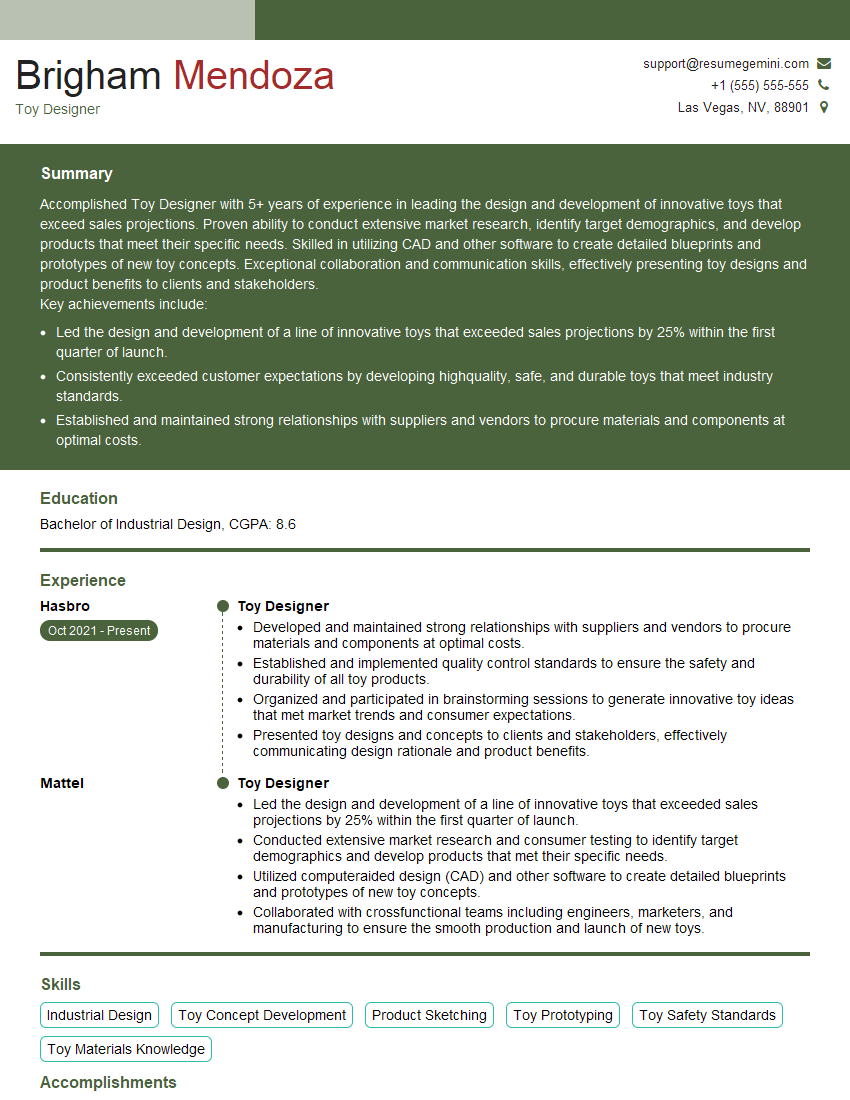
Ever felt underprepared for that crucial job interview? Or perhaps you’ve landed the interview but struggled to articulate your skills and experiences effectively? Fear not! We’ve got you covered. In this blog post, we’re diving deep into the Toy Designer interview questions that you’re most likely to encounter. But that’s not all. We’ll also provide expert insights into the key responsibilities of a Toy Designer so you can tailor your answers to impress potential employers.
Acing the interview is crucial, but landing one requires a compelling resume that gets you noticed. Crafting a professional document that highlights your skills and experience is the first step toward interview success. ResumeGemini can help you build a standout resume that gets you called in for that dream job.






Essential Interview Questions For Toy Designer
1. Can you provide two examples of highly successful toys that you helped design, and explain your role in the design process?
- Example Toy 1: I co-designed a plush toy for a major toy company that became one of their best-sellers. I was responsible for developing the overall concept, sketching out the design, and creating the prototypes.
- Example Toy 2: I was the lead designer on a line of action figures for a popular movie franchise. I was involved in every aspect of the design process, from concept development to final production.
2. What are the key factors you consider when designing a new toy?
- Target audience: I always start by considering the target audience for the toy. What age group is it for? What are their interests?
- Play value: I want to make sure that the toy is fun and engaging to play with. I consider things like the toy’s function, durability, and safety.
- Aesthetics: I also want to make sure that the toy is visually appealing. I consider the toy’s shape, color, and texture.
- Cost: I need to make sure that the toy can be manufactured at a cost that makes it affordable for our target audience.
3. What are some of the latest trends in toy design?
- Interactive toys: Toys that interact with children in some way, such as by talking, singing, or moving, are becoming increasingly popular.
- STEM toys: Toys that teach children about science, technology, engineering, and math are also on the rise.
- Sustainable toys: Toys that are made from sustainable materials or that promote environmental awareness are becoming more popular.
- Personalized toys: Toys that can be personalized with a child’s name or other unique features are also becoming more popular.
4. What is the most challenging part of being a toy designer?
- Balancing creativity with commercial viability: I need to come up with ideas that are both creative and appealing to our target audience. I also need to make sure that the toys can be manufactured at a cost that makes them affordable.
- Meeting deadlines: The toy industry is a fast-paced one, and I often have to meet tight deadlines. This can be challenging, but I find it helps to stay organized and to set realistic goals.
- Staying up-to-date on the latest trends: The toy industry is constantly changing, so I need to stay up-to-date on the latest trends. I read industry publications, attend trade shows, and network with other toy designers.
- Dealing with rejection: Not all of my designs are successful. Sometimes, my ideas get rejected by clients or by our manufacturing partners. This can be frustrating, but I try to learn from my mistakes and move on.
5. What is your favorite part of being a toy designer?
- Seeing my designs come to life: There is nothing quite like seeing a toy that I designed on store shelves. It’s an amazing feeling to know that I helped create something that children will enjoy.
- Making a difference in children’s lives: I believe that toys can play a positive role in children’s lives. They can help children learn, grow, and develop their imaginations. I am proud to be a part of that.
- Working with a team of talented people: I am fortunate to work with a team of talented and passionate toy designers. We all share a love of toys, and we are always pushing each other to come up with new and innovative ideas.
6. What are your strengths as a toy designer?
- Creativity: I am a creative person with a strong imagination. I am always coming up with new ideas for toys.
- Technical skills: I have a strong understanding of the technical aspects of toy design. I am proficient in 3D modeling, sketching, and prototyping.
- Communication skills: I am able to communicate my ideas clearly and effectively to both clients and colleagues.
- Teamwork skills: I am a team player who is able to work effectively with others to achieve a common goal.
7. What are your weaknesses as a toy designer?
- Sometimes I can be too perfectionistic. I want my designs to be perfect, and sometimes I spend too much time on the details. I am working on becoming more efficient so that I can meet deadlines without sacrificing quality.
- I am not always good at taking criticism. When I get feedback on my designs, I sometimes take it personally. I am working on developing a thicker skin and learning to see criticism as an opportunity to improve my work.
8. What are your salary expectations?
My salary expectations are in line with the industry average for toy designers with my experience and skills. I am confident that I can bring value to your company and I am willing to negotiate a salary that is fair for both of us.
9. Why are you interested in working for our company?
I am interested in working for your company because I am impressed by your commitment to innovation and quality. I believe that my skills and experience would be a valuable asset to your team, and I am eager to contribute to the success of your company.
10. What are your career goals?
My career goals are to become a lead toy designer and eventually start my own toy company. I believe that I have the skills and experience to achieve these goals, and I am confident that I can make a significant contribution to the toy industry.
Interviewers often ask about specific skills and experiences. With ResumeGemini‘s customizable templates, you can tailor your resume to showcase the skills most relevant to the position, making a powerful first impression. Also check out Resume Template specially tailored for Toy Designer.
Career Expert Tips:
- Ace those interviews! Prepare effectively by reviewing the Top 50 Most Common Interview Questions on ResumeGemini.
- Navigate your job search with confidence! Explore a wide range of Career Tips on ResumeGemini. Learn about common challenges and recommendations to overcome them.
- Craft the perfect resume! Master the Art of Resume Writing with ResumeGemini’s guide. Showcase your unique qualifications and achievements effectively.
- Great Savings With New Year Deals and Discounts! In 2025, boost your job search and build your dream resume with ResumeGemini’s ATS optimized templates.
Researching the company and tailoring your answers is essential. Once you have a clear understanding of the Toy Designer‘s requirements, you can use ResumeGemini to adjust your resume to perfectly match the job description.
Key Job Responsibilities
Toy Designers are responsible for conceptualising, designing, and developing toys. They work closely with product managers, engineers, and manufacturers to bring their ideas to life.
1. Conceptualising and Designing Toys
Toy Designers start by brainstorming ideas for new toys. They consider the target audience, the latest trends, and the company’s brand identity. Once they have a few ideas, they begin to sketch out their designs.
- Conduct market research to identify trends and target audience
- Conceptualise and sketch out toy designs based on research
2. Developing and Prototyping Toys
Once the designs are finalised, Toy Designers work with engineers to develop prototypes. Prototypes are early versions of the toy that are used to test the design and functionality. Once the prototypes are approved, Toy Designers work with manufacturers to produce the final product.
- Collaborate with engineers to develop and refine toy designs
- Create physical prototypes using 3D modelling or other techniques
3. Testing and Evaluating Toys
Toy Designers test and evaluate toys to ensure that they meet safety and performance standards. They also conduct user testing to get feedback from children on the toy’s design and functionality.
- Conduct safety and performance testing to ensure compliance with standards
- Perform user testing with children to gather feedback and improve design
4. Managing Projects
Toy Designers often manage projects from start to finish. They work with a team of designers, engineers, and manufacturers to ensure that the toy is developed on time and within budget.
- Manage project timelines and budgets
- Coordinate with team members and stakeholders to ensure smooth development
Interview Tips
Preparing thoroughly for an interview can significantly increase your chances of success. Here are some tips to help you ace your Toy Designer interview:
1. Research the company and the position
Before the interview, take the time to research the company and the specific Toy Designer position you are applying for. This will help you understand the company’s culture, values, and what they are looking for in a Toy Designer.
- Visit the company’s website and social media pages
- Read articles and news about the company
- Check out the company’s product line and identify any trends
2. Prepare your portfolio
Your portfolio is one of the most important things you can bring to an interview. It should showcase your best work and demonstrate your skills and creativity. Make sure your portfolio is well-organised and easy to navigate.
- Include a variety of projects that demonstrate your range of skills
- Highlight projects that are relevant to the position you are applying for
- Get feedback on your portfolio from a mentor or peer
3. Practice your answers to common interview questions
There are a number of common interview questions that you are likely to be asked in a Toy Designer interview. It is helpful to practice your answers to these questions in advance so that you can deliver them confidently and clearly.
- Tell me about yourself and your experience
- Why are you interested in this position?
- What are your strengths and weaknesses?
- What are your design inspirations?
4. Be enthusiastic and passionate
Toy Designers are passionate about their work and love to talk about toys. Be sure to convey your enthusiasm and passion in your interview. This will show the interviewer that you are genuinely interested in the position and that you would be a valuable asset to their team.
- Share your favourite toys and explain why you love them
- Discuss your favourite toy design trends
- Express your excitement about the opportunity to work on a team of talented Toy Designers
Next Step:
Now that you’re armed with interview-winning answers and a deeper understanding of the Toy Designer role, it’s time to take action! Does your resume accurately reflect your skills and experience for this position? If not, head over to ResumeGemini. Here, you’ll find all the tools and tips to craft a resume that gets noticed. Don’t let a weak resume hold you back from landing your dream job. Polish your resume, hit the “Build Your Resume” button, and watch your career take off! Remember, preparation is key, and ResumeGemini is your partner in interview success.