Are you a seasoned Biologist seeking a new career path? Discover our professionally built Biologist Resume Template. This time-saving tool provides a solid foundation for your job search. Simply click “Edit Resume” to customize it with your unique experiences and achievements. Customize fonts and colors to match your personal style and increase your chances of landing your dream job. Explore more Resume Templates for additional options.






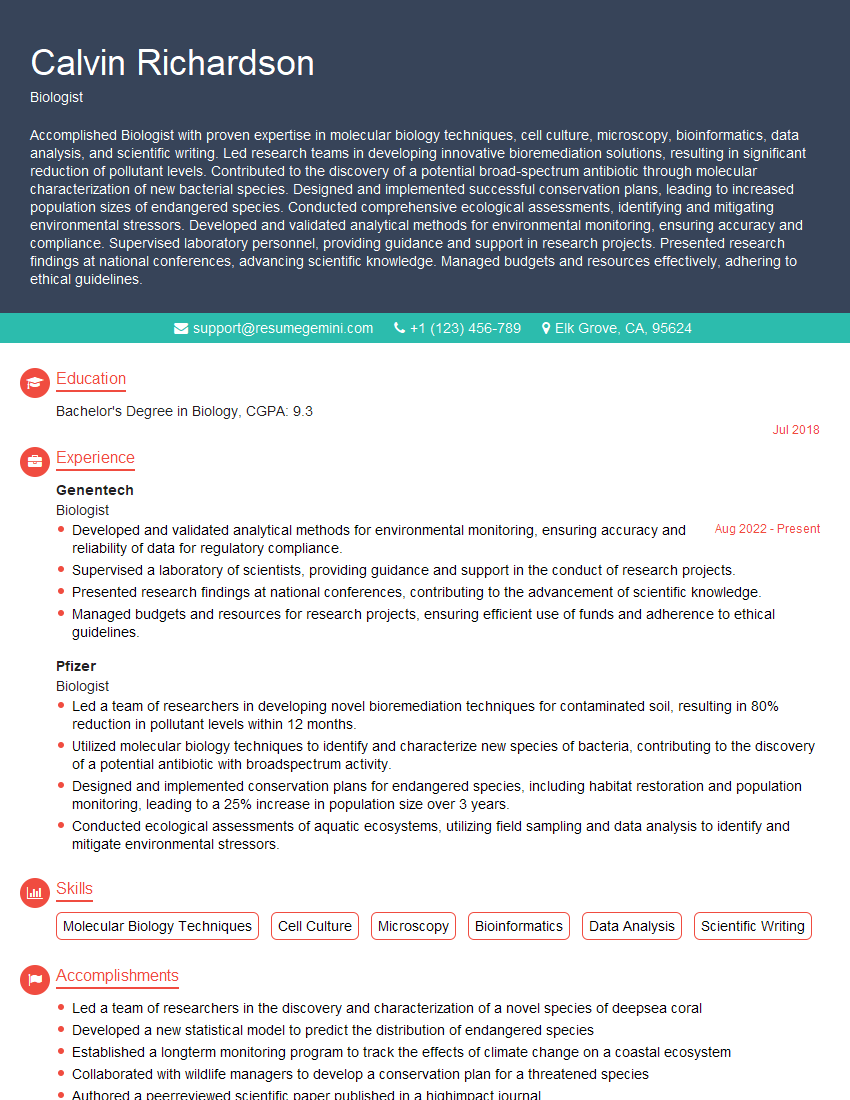
Calvin Richardson
Biologist
Summary
Accomplished Biologist with proven expertise in molecular biology techniques, cell culture, microscopy, bioinformatics, data analysis, and scientific writing. Led research teams in developing innovative bioremediation solutions, resulting in significant reduction of pollutant levels. Contributed to the discovery of a potential broad-spectrum antibiotic through molecular characterization of new bacterial species. Designed and implemented successful conservation plans, leading to increased population sizes of endangered species. Conducted comprehensive ecological assessments, identifying and mitigating environmental stressors. Developed and validated analytical methods for environmental monitoring, ensuring accuracy and compliance. Supervised laboratory personnel, providing guidance and support in research projects. Presented research findings at national conferences, advancing scientific knowledge. Managed budgets and resources effectively, adhering to ethical guidelines.
Education
Bachelor’s Degree in Biology
July 2018
Skills
- Molecular Biology Techniques
- Cell Culture
- Microscopy
- Bioinformatics
- Data Analysis
- Scientific Writing
Work Experience
Biologist
- Developed and validated analytical methods for environmental monitoring, ensuring accuracy and reliability of data for regulatory compliance.
- Supervised a laboratory of scientists, providing guidance and support in the conduct of research projects.
- Presented research findings at national conferences, contributing to the advancement of scientific knowledge.
- Managed budgets and resources for research projects, ensuring efficient use of funds and adherence to ethical guidelines.
Biologist
- Led a team of researchers in developing novel bioremediation techniques for contaminated soil, resulting in 80% reduction in pollutant levels within 12 months.
- Utilized molecular biology techniques to identify and characterize new species of bacteria, contributing to the discovery of a potential antibiotic with broadspectrum activity.
- Designed and implemented conservation plans for endangered species, including habitat restoration and population monitoring, leading to a 25% increase in population size over 3 years.
- Conducted ecological assessments of aquatic ecosystems, utilizing field sampling and data analysis to identify and mitigate environmental stressors.
Accomplishments
- Led a team of researchers in the discovery and characterization of a novel species of deepsea coral
- Developed a new statistical model to predict the distribution of endangered species
- Established a longterm monitoring program to track the effects of climate change on a coastal ecosystem
- Collaborated with wildlife managers to develop a conservation plan for a threatened species
- Authored a peerreviewed scientific paper published in a highimpact journal
Awards
- Recipient of the National Science Foundation Graduate Research Fellowship
- Winner of the American Society of Naturalists Presidents Prize for Best Student Paper
- Awarded the National Institutes of Health Postdoctoral Fellowship
- Recognized with the Society for Conservation Biologys Early Career Conservationist Award
Certificates
- Certified Biologist (CB)
- Associate Biologist (AB)
- Society for Conservation Biology (SCB) Member
- Ecological Society of America (ESA) Member
Career Expert Tips:
- Select the ideal resume template to showcase your professional experience effectively.
- Master the art of resume writing to highlight your unique qualifications and achievements.
- Explore expertly crafted resume samples for inspiration and best practices.
- Build your best resume for free this new year with ResumeGemini. Enjoy exclusive discounts on ATS optimized resume templates.
How To Write Resume For Biologist
- Highlight your expertise in specific biological techniques and methodologies, such as molecular biology, cell culture, or bioinformatics.
- Quantify your accomplishments with specific metrics and data whenever possible.
- Showcase your ability to work both independently and as part of a team.
- Demonstrate your commitment to ethical research practices and environmental conservation.
- Tailor your resume to the specific requirements of each job you apply for, highlighting the skills and experience that are most relevant to the position.
Essential Experience Highlights for a Strong Biologist Resume
- Led research teams in developing novel bioremediation techniques, resulting in significant reduction of pollutant levels.
- Utilized molecular biology techniques to identify and characterize new species of bacteria, contributing to the discovery of a potential broad-spectrum antibiotic.
- Designed and implemented conservation plans for endangered species, leading to increased population sizes.
- Conducted ecological assessments of aquatic ecosystems, identifying and mitigating environmental stressors.
- Developed and validated analytical methods for environmental monitoring, ensuring accuracy and compliance.
- Supervised a laboratory of scientists, providing guidance and support in the conduct of research projects.
- Presented research findings at national conferences, contributing to the advancement of scientific knowledge.
Frequently Asked Questions (FAQ’s) For Biologist
What are the primary responsibilities of a Biologist?
Biologists primarily conduct research, analyze data, and develop solutions to biological problems. They may specialize in a particular area of biology, such as ecology, genetics, or microbiology. Their responsibilities often include designing and conducting experiments, collecting and analyzing data, writing scientific reports, and presenting their findings at conferences or in peer-reviewed journals.
What are the educational requirements to become a Biologist?
Most Biologists hold at least a Bachelor’s degree in Biology, although some positions may require a Master’s degree or PhD. Coursework typically includes biology, chemistry, physics, and mathematics. Additionally, many Biologists pursue specialized training in areas such as bioinformatics, cell biology, or ecology.
What are the key skills and abilities required for a successful Biologist?
Successful Biologists possess strong analytical and problem-solving skills, as well as the ability to design and conduct experiments. They are also proficient in data analysis and interpretation, and have excellent communication and writing skills. Additionally, Biologists should be detail-oriented, organized, and have a strong work ethic.
What are the career prospects for Biologists?
Biologists are employed in a variety of settings, including academia, industry, and government. They may work as research scientists, educators, environmental consultants, or policy analysts. With the increasing emphasis on biotechnology and healthcare, the demand for Biologists is expected to grow in the coming years.
What are the typical salary expectations for Biologists?
Salaries for Biologists vary depending on their education, experience, and area of specialization. According to the U.S. Bureau of Labor Statistics, the median annual salary for Biologists was $82,270 in May 2021. However, salaries can range from $40,000 to over $120,000 per year.
What are some of the challenges faced by Biologists?
Biologists face a number of challenges, including the need to stay abreast of rapidly advancing scientific knowledge, the availability of funding for research, and the increasing complexity of biological systems. Additionally, Biologists may face ethical challenges, such as the use of animals in research or the potential misuse of biotechnology.
What are some of the emerging trends in the field of Biology?
Emerging trends in Biology include the use of artificial intelligence and machine learning in data analysis, the development of new gene-editing technologies, and the increasing focus on personalized medicine. Additionally, there is growing interest in the intersection of biology with other fields, such as computer science and engineering.
What are some tips for writing a standout Biologist resume?
To write a standout Biologist resume, highlight your skills and experience in specific biological techniques and methodologies, quantify your accomplishments with specific metrics and data whenever possible, showcase your ability to work both independently and as part of a team, demonstrate your commitment to ethical research practices and environmental conservation, and tailor your resume to the specific requirements of each job you apply for.