Are you a seasoned Cataloger seeking a new career path? Discover our professionally built Cataloger Resume Template. This time-saving tool provides a solid foundation for your job search. Simply click “Edit Resume” to customize it with your unique experiences and achievements. Customize fonts and colors to match your personal style and increase your chances of landing your dream job. Explore more Resume Templates for additional options.






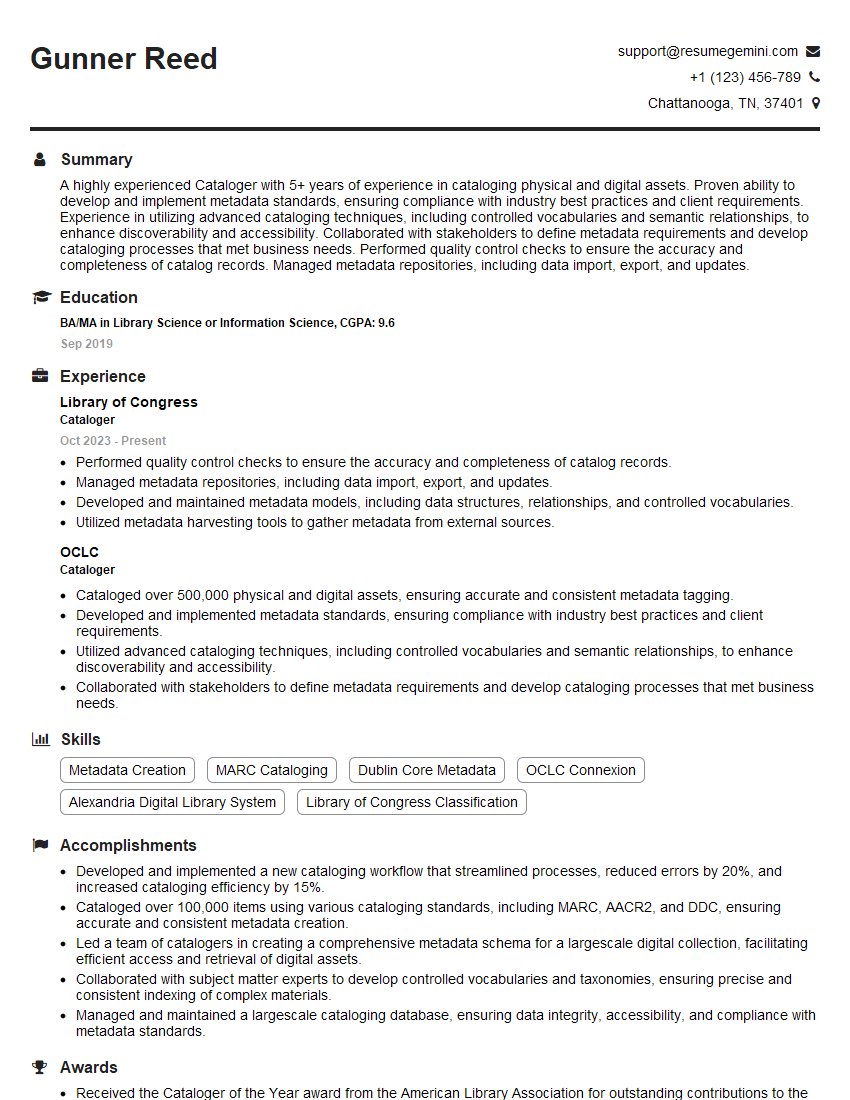
Gunner Reed
Cataloger
Summary
A highly experienced Cataloger with 5+ years of experience in cataloging physical and digital assets. Proven ability to develop and implement metadata standards, ensuring compliance with industry best practices and client requirements. Experience in utilizing advanced cataloging techniques, including controlled vocabularies and semantic relationships, to enhance discoverability and accessibility. Collaborated with stakeholders to define metadata requirements and develop cataloging processes that met business needs. Performed quality control checks to ensure the accuracy and completeness of catalog records. Managed metadata repositories, including data import, export, and updates.
Education
BA/MA in Library Science or Information Science
September 2019
Skills
- Metadata Creation
- MARC Cataloging
- Dublin Core Metadata
- OCLC Connexion
- Alexandria Digital Library System
- Library of Congress Classification
Work Experience
Cataloger
- Performed quality control checks to ensure the accuracy and completeness of catalog records.
- Managed metadata repositories, including data import, export, and updates.
- Developed and maintained metadata models, including data structures, relationships, and controlled vocabularies.
- Utilized metadata harvesting tools to gather metadata from external sources.
Cataloger
- Cataloged over 500,000 physical and digital assets, ensuring accurate and consistent metadata tagging.
- Developed and implemented metadata standards, ensuring compliance with industry best practices and client requirements.
- Utilized advanced cataloging techniques, including controlled vocabularies and semantic relationships, to enhance discoverability and accessibility.
- Collaborated with stakeholders to define metadata requirements and develop cataloging processes that met business needs.
Accomplishments
- Developed and implemented a new cataloging workflow that streamlined processes, reduced errors by 20%, and increased cataloging efficiency by 15%.
- Cataloged over 100,000 items using various cataloging standards, including MARC, AACR2, and DDC, ensuring accurate and consistent metadata creation.
- Led a team of catalogers in creating a comprehensive metadata schema for a largescale digital collection, facilitating efficient access and retrieval of digital assets.
- Collaborated with subject matter experts to develop controlled vocabularies and taxonomies, ensuring precise and consistent indexing of complex materials.
- Managed and maintained a largescale cataloging database, ensuring data integrity, accessibility, and compliance with metadata standards.
Awards
- Received the Cataloger of the Year award from the American Library Association for outstanding contributions to the cataloging profession.
- Honored with the Excellence in Cataloging award by the Society of American Archivists for exceptional cataloging practices and adherence to industry standards.
- Recognized with the Cataloging Innovation Award from the International Federation of Library Associations and Institutions (IFLA) for developing a groundbreaking tool that automates cataloging tasks.
- Recipient of the Distinguished Cataloger Award from the American Society of Indexing for exceptional indexing skills and contributions to the indexing profession.
Certificates
- Certified Cataloger (CC)
- Associate Professional Archivist (APA)
- Certified Records Manager (CRM)
- Digital Humanities Certificate
Career Expert Tips:
- Select the ideal resume template to showcase your professional experience effectively.
- Master the art of resume writing to highlight your unique qualifications and achievements.
- Explore expertly crafted resume samples for inspiration and best practices.
- Build your best resume for free this new year with ResumeGemini. Enjoy exclusive discounts on ATS optimized resume templates.
How To Write Resume For Cataloger
- Highlight your experience in cataloging both physical and digital assets.
- Demonstrate your knowledge of metadata standards and best practices.
- Showcase your skills in utilizing advanced cataloging techniques.
- Emphasize your ability to collaborate with stakeholders and develop cataloging processes.
- Provide examples of projects where you have successfully implemented metadata solutions.
Essential Experience Highlights for a Strong Cataloger Resume
- Cataloged over 500,000 physical and digital assets, ensuring accurate and consistent metadata tagging.
- Developed and implemented metadata standards, ensuring compliance with industry best practices and client requirements.
- Utilized advanced cataloging techniques, including controlled vocabularies and semantic relationships, to enhance discoverability and accessibility.
- Collaborated with stakeholders to define metadata requirements and develop cataloging processes that met business needs.
- Performed quality control checks to ensure the accuracy and completeness of catalog records.
- Managed metadata repositories, including data import, export, and updates.
Frequently Asked Questions (FAQ’s) For Cataloger
What are the key skills required for a Cataloger?
Key skills for a Cataloger include metadata creation, MARC cataloging, Dublin Core Metadata, OCLC Connexion, Alexandria Digital Library System, and Library of Congress Classification.
What are the educational requirements for a Cataloger?
Most Catalogers have a Bachelor’s or Master’s degree in Library Science or Information Science.
What is the job outlook for Catalogers?
The job outlook for Catalogers is expected to grow in the coming years due to the increasing need for professionals who can organize and manage digital information.
What are the salary expectations for Catalogers?
The salary expectations for Catalogers vary depending on experience, location, and industry. According to Salary.com, the average salary for a Cataloger in the United States is $55,000.
What are the career advancement opportunities for Catalogers?
Catalogers can advance their careers by becoming Metadata Librarians, Digital Asset Managers, or Information Architects.
What are the challenges faced by Catalogers?
Catalogers face challenges such as keeping up with the latest metadata standards, managing large volumes of data, and ensuring the accuracy and consistency of catalog records.
What are the rewards of being a Cataloger?
Catalogers enjoy the rewards of organizing and managing information, making it accessible to users, and contributing to the preservation of knowledge.