Are you a seasoned Certified Medication Aide (CMA) seeking a new career path? Discover our professionally built Certified Medication Aide (CMA) Resume Template. This time-saving tool provides a solid foundation for your job search. Simply click “Edit Resume” to customize it with your unique experiences and achievements. Customize fonts and colors to match your personal style and increase your chances of landing your dream job. Explore more Resume Templates for additional options.






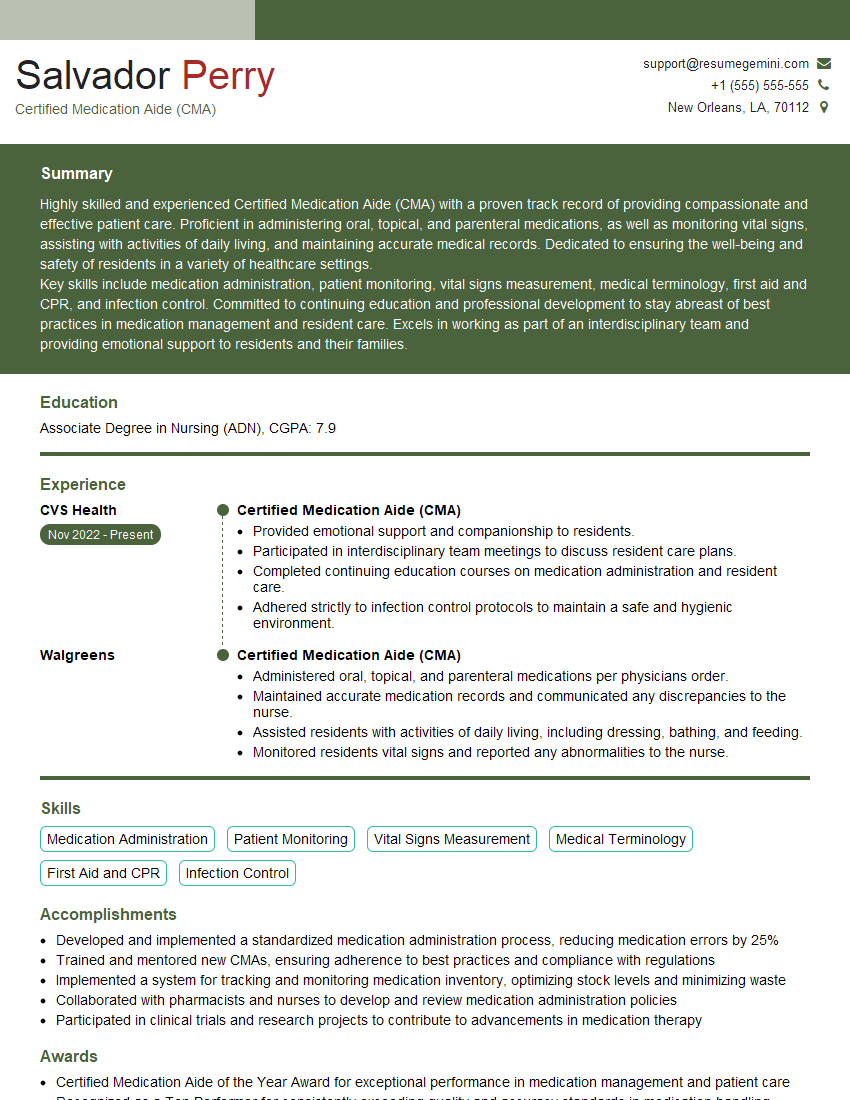
Salvador Perry
Certified Medication Aide (CMA)
Summary
Highly skilled and experienced Certified Medication Aide (CMA) with a proven track record of providing compassionate and effective patient care. Proficient in administering oral, topical, and parenteral medications, as well as monitoring vital signs, assisting with activities of daily living, and maintaining accurate medical records. Dedicated to ensuring the well-being and safety of residents in a variety of healthcare settings.
Key skills include medication administration, patient monitoring, vital signs measurement, medical terminology, first aid and CPR, and infection control. Committed to continuing education and professional development to stay abreast of best practices in medication management and resident care. Excels in working as part of an interdisciplinary team and providing emotional support to residents and their families.
Education
Associate Degree in Nursing (ADN)
October 2018
Skills
- Medication Administration
- Patient Monitoring
- Vital Signs Measurement
- Medical Terminology
- First Aid and CPR
- Infection Control
Work Experience
Certified Medication Aide (CMA)
- Provided emotional support and companionship to residents.
- Participated in interdisciplinary team meetings to discuss resident care plans.
- Completed continuing education courses on medication administration and resident care.
- Adhered strictly to infection control protocols to maintain a safe and hygienic environment.
Certified Medication Aide (CMA)
- Administered oral, topical, and parenteral medications per physicians order.
- Maintained accurate medication records and communicated any discrepancies to the nurse.
- Assisted residents with activities of daily living, including dressing, bathing, and feeding.
- Monitored residents vital signs and reported any abnormalities to the nurse.
Accomplishments
- Developed and implemented a standardized medication administration process, reducing medication errors by 25%
- Trained and mentored new CMAs, ensuring adherence to best practices and compliance with regulations
- Implemented a system for tracking and monitoring medication inventory, optimizing stock levels and minimizing waste
- Collaborated with pharmacists and nurses to develop and review medication administration policies
- Participated in clinical trials and research projects to contribute to advancements in medication therapy
Awards
- Certified Medication Aide of the Year Award for exceptional performance in medication management and patient care
- Recognized as a Top Performer for consistently exceeding quality and accuracy standards in medication handling
- Received the Patient Safety Award for proactive identification and intervention in medicationrelated incidents
- Certified in Medication Safety and Quality Improvement (MSQI)
Certificates
- Certified Medication Aide (CMA)
- CPR and First Aid Certification
- Medication Aide Training Program Certification
- Infection Control Certification
Career Expert Tips:
- Select the ideal resume template to showcase your professional experience effectively.
- Master the art of resume writing to highlight your unique qualifications and achievements.
- Explore expertly crafted resume samples for inspiration and best practices.
- Build your best resume for free this new year with ResumeGemini. Enjoy exclusive discounts on ATS optimized resume templates.
How To Write Resume For Certified Medication Aide (CMA)
- Highlight your medication administration skills and experience, as this is a core responsibility of CMAs.
- Emphasize your patient care skills, such as assisting with activities of daily living and providing emotional support.
- Showcase your ability to work effectively as part of a healthcare team.
- Demonstrate your commitment to professional development by listing any relevant continuing education courses or certifications.
Essential Experience Highlights for a Strong Certified Medication Aide (CMA) Resume
- Administering medications per physician orders, including oral, topical, and parenteral forms.
- Monitoring patients’ vital signs and reporting any abnormalities to the nurse.
- Assisting residents with activities of daily living, such as dressing, bathing, and feeding.
- Maintaining accurate medication records and communicating any discrepancies to the nurse.
- Providing emotional support and companionship to residents.
- Participating in interdisciplinary team meetings to discuss resident care plans.
- Adhering strictly to infection control protocols to maintain a safe and hygienic environment.
Frequently Asked Questions (FAQ’s) For Certified Medication Aide (CMA)
What are the primary responsibilities of a Certified Medication Aide (CMA)?
CMAs are responsible for administering medications, monitoring patients’ vital signs, assisting with activities of daily living, maintaining medication records, and providing emotional support to residents.
What qualifications are required to become a CMA?
Most states require CMAs to complete a state-approved training program and pass a national certification exam.
What are the benefits of becoming a CMA?
CMAs can enjoy job security, competitive salaries, and opportunities for career advancement in the healthcare industry.
What is the work environment like for CMAs?
CMAs typically work in hospitals, nursing homes, assisted living facilities, and other healthcare settings.
What are the career advancement opportunities for CMAs?
With experience and additional education, CMAs can advance to roles such as licensed practical nurses (LPNs) or registered nurses (RNs).
How can I find a job as a CMA?
You can search for CMA jobs online, contact healthcare facilities directly, or work with a staffing agency.
What is the average salary for a CMA?
The average salary for a CMA varies depending on experience, location, and employer, but it typically ranges from $30,000 to $50,000 per year.