Are you a seasoned Clinical Research Analyst seeking a new career path? Discover our professionally built Clinical Research Analyst Resume Template. This time-saving tool provides a solid foundation for your job search. Simply click “Edit Resume” to customize it with your unique experiences and achievements. Customize fonts and colors to match your personal style and increase your chances of landing your dream job. Explore more Resume Templates for additional options.






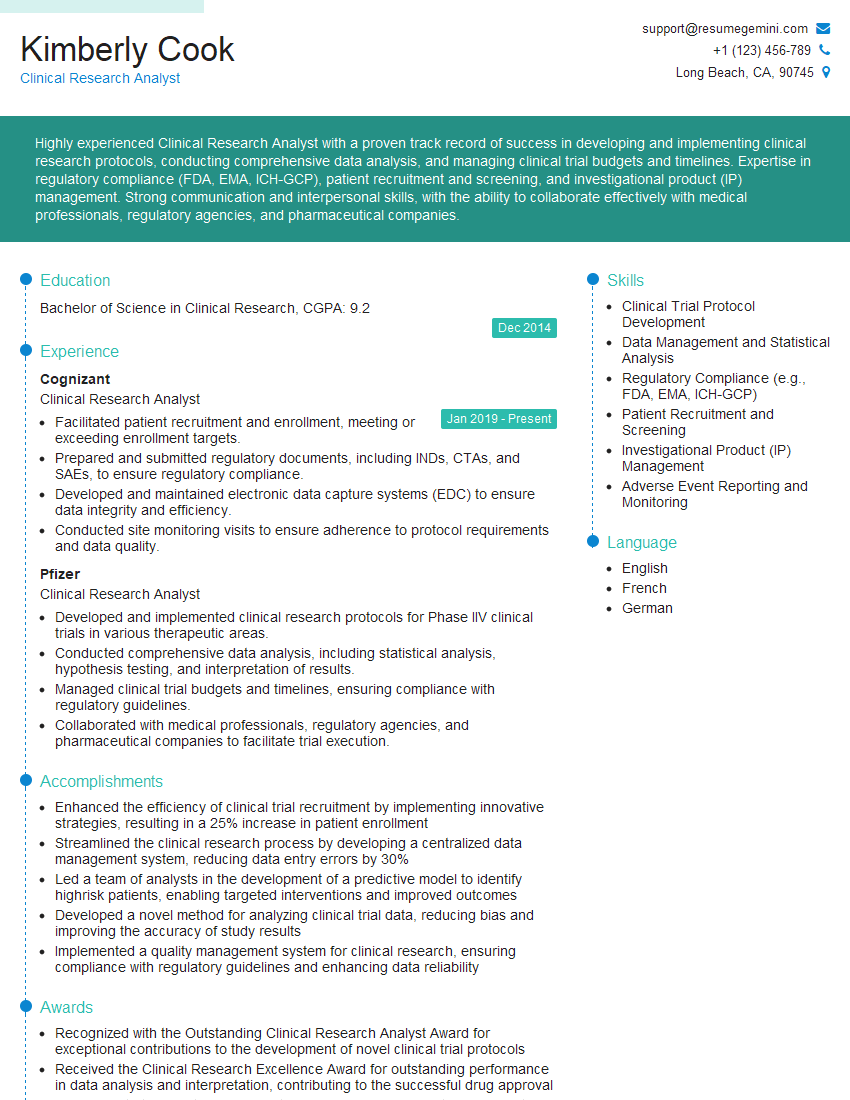
Kimberly Cook
Clinical Research Analyst
Summary
Highly experienced Clinical Research Analyst with a proven track record of success in developing and implementing clinical research protocols, conducting comprehensive data analysis, and managing clinical trial budgets and timelines. Expertise in regulatory compliance (FDA, EMA, ICH-GCP), patient recruitment and screening, and investigational product (IP) management. Strong communication and interpersonal skills, with the ability to collaborate effectively with medical professionals, regulatory agencies, and pharmaceutical companies.
Education
Bachelor of Science in Clinical Research
December 2014
Skills
- Clinical Trial Protocol Development
- Data Management and Statistical Analysis
- Regulatory Compliance (e.g., FDA, EMA, ICH-GCP)
- Patient Recruitment and Screening
- Investigational Product (IP) Management
- Adverse Event Reporting and Monitoring
Work Experience
Clinical Research Analyst
- Facilitated patient recruitment and enrollment, meeting or exceeding enrollment targets.
- Prepared and submitted regulatory documents, including INDs, CTAs, and SAEs, to ensure regulatory compliance.
- Developed and maintained electronic data capture systems (EDC) to ensure data integrity and efficiency.
- Conducted site monitoring visits to ensure adherence to protocol requirements and data quality.
Clinical Research Analyst
- Developed and implemented clinical research protocols for Phase IIV clinical trials in various therapeutic areas.
- Conducted comprehensive data analysis, including statistical analysis, hypothesis testing, and interpretation of results.
- Managed clinical trial budgets and timelines, ensuring compliance with regulatory guidelines.
- Collaborated with medical professionals, regulatory agencies, and pharmaceutical companies to facilitate trial execution.
Accomplishments
- Enhanced the efficiency of clinical trial recruitment by implementing innovative strategies, resulting in a 25% increase in patient enrollment
- Streamlined the clinical research process by developing a centralized data management system, reducing data entry errors by 30%
- Led a team of analysts in the development of a predictive model to identify highrisk patients, enabling targeted interventions and improved outcomes
- Developed a novel method for analyzing clinical trial data, reducing bias and improving the accuracy of study results
- Implemented a quality management system for clinical research, ensuring compliance with regulatory guidelines and enhancing data reliability
Awards
- Recognized with the Outstanding Clinical Research Analyst Award for exceptional contributions to the development of novel clinical trial protocols
- Received the Clinical Research Excellence Award for outstanding performance in data analysis and interpretation, contributing to the successful drug approval
- Honored with the Healthcare Innovation Award for pioneering the use of artificial intelligence in clinical trial design
- Recognized with the Research Integrity Award for adhering to the highest ethical standards in clinical research
Certificates
- Certified Clinical Research Associate (CCRA)
- Associate Certified Professional in Regulatory Affairs (ACP-RA)
- Certified Clinical Data Manager (CCDM)
- ICH-GCP Certification
Career Expert Tips:
- Select the ideal resume template to showcase your professional experience effectively.
- Master the art of resume writing to highlight your unique qualifications and achievements.
- Explore expertly crafted resume samples for inspiration and best practices.
- Build your best resume for free this new year with ResumeGemini. Enjoy exclusive discounts on ATS optimized resume templates.
How To Write Resume For Clinical Research Analyst
- Highlight your experience and skills in developing and implementing clinical research protocols.
- Quantify your accomplishments whenever possible, using specific metrics to demonstrate your impact.
- Showcase your knowledge of regulatory compliance and your ability to manage clinical trial budgets and timelines.
- Emphasize your communication and interpersonal skills, and your ability to collaborate effectively with a variety of stakeholders.
Essential Experience Highlights for a Strong Clinical Research Analyst Resume
- Developed and implemented clinical research protocols for Phase I-IV clinical trials in various therapeutic areas.
- Conducted comprehensive data analysis, including statistical analysis, hypothesis testing, and interpretation of results.
- Managed clinical trial budgets and timelines, ensuring compliance with regulatory guidelines.
- Collaborated with medical professionals, regulatory agencies, and pharmaceutical companies to facilitate trial execution.
- Facilitated patient recruitment and enrollment, meeting or exceeding enrollment targets.
- Prepared and submitted regulatory documents, including INDs, CTAs, and SAEs, to ensure regulatory compliance.
Frequently Asked Questions (FAQ’s) For Clinical Research Analyst
What is the role of a Clinical Research Analyst?
A Clinical Research Analyst is responsible for designing, implementing, and analyzing clinical trials. They work closely with medical professionals, regulatory agencies, and pharmaceutical companies to ensure that clinical trials are conducted safely and ethically, and that the data collected is accurate and reliable.
What are the qualifications for a Clinical Research Analyst?
A Clinical Research Analyst typically has a bachelor’s or master’s degree in clinical research, or a related field. They must also have a strong understanding of regulatory compliance, data analysis, and clinical trial management.
What are the key skills for a Clinical Research Analyst?
Key skills for a Clinical Research Analyst include: – Strong understanding of regulatory compliance (FDA, EMA, ICH-GCP) – Excellent data analysis and statistical skills – Ability to manage clinical trial budgets and timelines – Effective communication and interpersonal skills
What is the career path for a Clinical Research Analyst?
A Clinical Research Analyst can advance to roles such as Clinical Research Manager, Director of Clinical Operations, or Vice President of Clinical Development.
What is the salary range for a Clinical Research Analyst?
The salary range for a Clinical Research Analyst varies depending on experience, education, and location. According to Salary.com, the median salary for a Clinical Research Analyst in the United States is $75,000.