Are you a seasoned Electronics Design Engineer seeking a new career path? Discover our professionally built Electronics Design Engineer Resume Template. This time-saving tool provides a solid foundation for your job search. Simply click “Edit Resume” to customize it with your unique experiences and achievements. Customize fonts and colors to match your personal style and increase your chances of landing your dream job. Explore more Resume Templates for additional options.






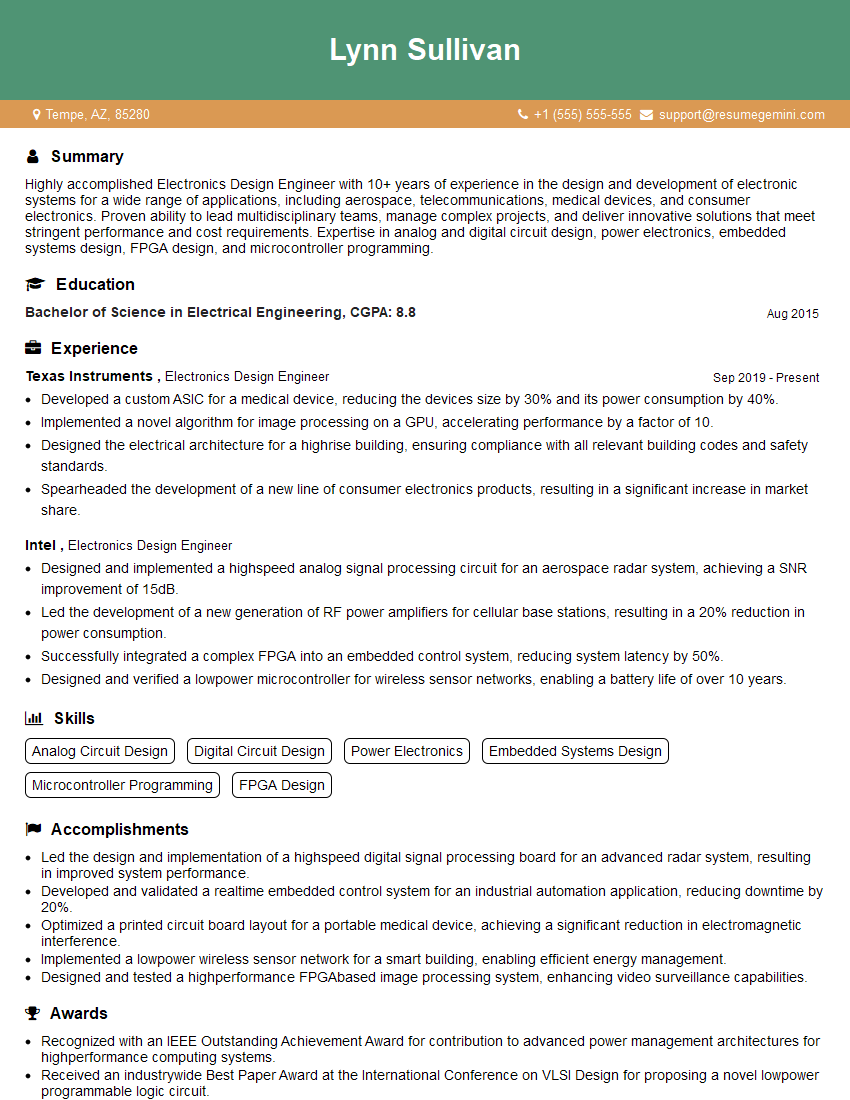
Lynn Sullivan
Electronics Design Engineer
Summary
Highly accomplished Electronics Design Engineer with 10+ years of experience in the design and development of electronic systems for a wide range of applications, including aerospace, telecommunications, medical devices, and consumer electronics. Proven ability to lead multidisciplinary teams, manage complex projects, and deliver innovative solutions that meet stringent performance and cost requirements. Expertise in analog and digital circuit design, power electronics, embedded systems design, FPGA design, and microcontroller programming.
Education
Bachelor of Science in Electrical Engineering
August 2015
Skills
- Analog Circuit Design
- Digital Circuit Design
- Power Electronics
- Embedded Systems Design
- Microcontroller Programming
- FPGA Design
Work Experience
Electronics Design Engineer
- Developed a custom ASIC for a medical device, reducing the devices size by 30% and its power consumption by 40%.
- Implemented a novel algorithm for image processing on a GPU, accelerating performance by a factor of 10.
- Designed the electrical architecture for a highrise building, ensuring compliance with all relevant building codes and safety standards.
- Spearheaded the development of a new line of consumer electronics products, resulting in a significant increase in market share.
Electronics Design Engineer
- Designed and implemented a highspeed analog signal processing circuit for an aerospace radar system, achieving a SNR improvement of 15dB.
- Led the development of a new generation of RF power amplifiers for cellular base stations, resulting in a 20% reduction in power consumption.
- Successfully integrated a complex FPGA into an embedded control system, reducing system latency by 50%.
- Designed and verified a lowpower microcontroller for wireless sensor networks, enabling a battery life of over 10 years.
Accomplishments
- Led the design and implementation of a highspeed digital signal processing board for an advanced radar system, resulting in improved system performance.
- Developed and validated a realtime embedded control system for an industrial automation application, reducing downtime by 20%.
- Optimized a printed circuit board layout for a portable medical device, achieving a significant reduction in electromagnetic interference.
- Implemented a lowpower wireless sensor network for a smart building, enabling efficient energy management.
- Designed and tested a highperformance FPGAbased image processing system, enhancing video surveillance capabilities.
Awards
- Recognized with an IEEE Outstanding Achievement Award for contribution to advanced power management architectures for highperformance computing systems.
- Received an industrywide Best Paper Award at the International Conference on VLSI Design for proposing a novel lowpower programmable logic circuit.
- Awarded a Patent for developing a highspeed interface circuit for data communication.
Certificates
- Certified Electronic Designer (CED)
- Professional Engineer (PE)
- Certified FPGA Designer (CFD)
- Certified PCB Designer (CPBD)
Career Expert Tips:
- Select the ideal resume template to showcase your professional experience effectively.
- Master the art of resume writing to highlight your unique qualifications and achievements.
- Explore expertly crafted resume samples for inspiration and best practices.
- Build your best resume for free this new year with ResumeGemini. Enjoy exclusive discounts on ATS optimized resume templates.
How To Write Resume For Electronics Design Engineer
- Quantify your accomplishments with specific metrics and results whenever possible.
- Highlight projects where you took initiative, solved complex problems, or made significant contributions.
- Use keywords relevant to the job you’re applying for to optimize your resume for applicant tracking systems.
- Proofread your resume carefully before submitting it to ensure there are no errors.
Essential Experience Highlights for a Strong Electronics Design Engineer Resume
- Design and implement high-speed analog and digital circuits for various electronic systems.
- Develop and optimize power electronics circuits to improve efficiency and reduce power consumption.
- Design and integrate embedded systems into complex electronic devices, ensuring seamless operation and low latency.
- Program and configure FPGAs to implement complex digital signal processing algorithms.
- Develop and verify microcontrollers for embedded systems, optimizing performance and battery life.
- Collaborate with cross-functional teams to ensure the successful integration of electronic systems into larger products.
- Stay abreast of the latest advancements in electronics technology and apply them to new product development.
Frequently Asked Questions (FAQ’s) For Electronics Design Engineer
What are the essential skills for an Electronics Design Engineer?
Essential skills for an Electronics Design Engineer include analog and digital circuit design, power electronics, embedded systems design, FPGA design, microcontroller programming, and a strong understanding of electronic components and devices.
What industries hire Electronics Design Engineers?
Electronics Design Engineers are employed in a wide range of industries, including aerospace, telecommunications, medical devices, consumer electronics, automotive, and industrial automation.
What is the career outlook for Electronics Design Engineers?
The career outlook for Electronics Design Engineers is expected to be excellent in the coming years due to the increasing demand for electronic devices and systems in various industries.
What are the different job titles for Electronics Design Engineers?
Electronics Design Engineers may also be known as Circuit Designers, Digital Design Engineers, or Embedded Systems Engineers, depending on their specific area of expertise.
What are the educational requirements for Electronics Design Engineers?
Most Electronics Design Engineers hold a Bachelor of Science in Electrical Engineering or a related field, such as Computer Engineering or Electronics Engineering.
What are the professional development opportunities for Electronics Design Engineers?
Electronics Design Engineers can pursue professional development through continuing education courses, workshops, conferences, and certifications offered by professional organizations such as the Institute of Electrical and Electronics Engineers (IEEE).
What are the salary expectations for Electronics Design Engineers?
The salary expectations for Electronics Design Engineers vary depending on their experience, skills, and location, but they are generally well-compensated professionals.
What are the challenges faced by Electronics Design Engineers?
Electronics Design Engineers may face challenges such as keeping up with rapidly changing technology, meeting tight deadlines, and working on complex projects that require a high level of technical expertise.