Are you a seasoned Engineering Scientist seeking a new career path? Discover our professionally built Engineering Scientist Resume Template. This time-saving tool provides a solid foundation for your job search. Simply click “Edit Resume” to customize it with your unique experiences and achievements. Customize fonts and colors to match your personal style and increase your chances of landing your dream job. Explore more Resume Templates for additional options.






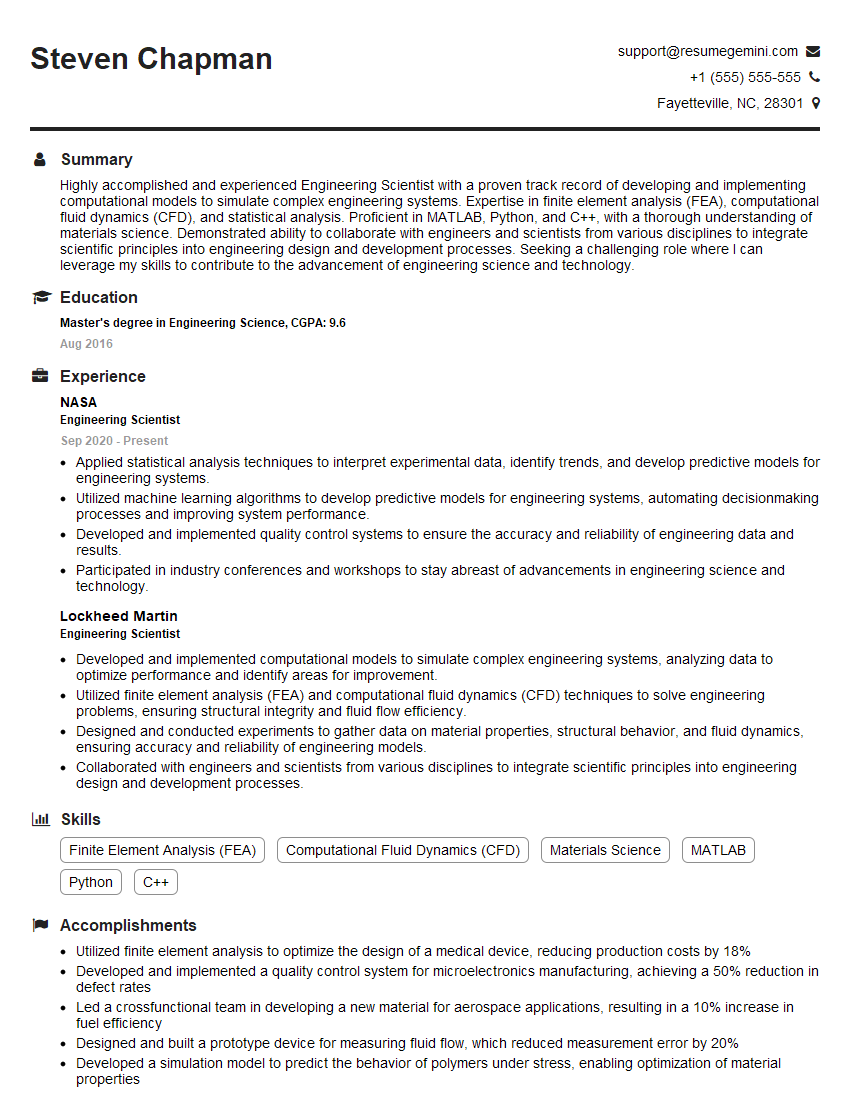
Steven Chapman
Engineering Scientist
Summary
Highly accomplished and experienced Engineering Scientist with a proven track record of developing and implementing computational models to simulate complex engineering systems. Expertise in finite element analysis (FEA), computational fluid dynamics (CFD), and statistical analysis. Proficient in MATLAB, Python, and C++, with a thorough understanding of materials science. Demonstrated ability to collaborate with engineers and scientists from various disciplines to integrate scientific principles into engineering design and development processes. Seeking a challenging role where I can leverage my skills to contribute to the advancement of engineering science and technology.
Education
Master’s degree in Engineering Science
August 2016
Skills
- Finite Element Analysis (FEA)
- Computational Fluid Dynamics (CFD)
- Materials Science
- MATLAB
- Python
- C++
Work Experience
Engineering Scientist
- Applied statistical analysis techniques to interpret experimental data, identify trends, and develop predictive models for engineering systems.
- Utilized machine learning algorithms to develop predictive models for engineering systems, automating decisionmaking processes and improving system performance.
- Developed and implemented quality control systems to ensure the accuracy and reliability of engineering data and results.
- Participated in industry conferences and workshops to stay abreast of advancements in engineering science and technology.
Engineering Scientist
- Developed and implemented computational models to simulate complex engineering systems, analyzing data to optimize performance and identify areas for improvement.
- Utilized finite element analysis (FEA) and computational fluid dynamics (CFD) techniques to solve engineering problems, ensuring structural integrity and fluid flow efficiency.
- Designed and conducted experiments to gather data on material properties, structural behavior, and fluid dynamics, ensuring accuracy and reliability of engineering models.
- Collaborated with engineers and scientists from various disciplines to integrate scientific principles into engineering design and development processes.
Accomplishments
- Utilized finite element analysis to optimize the design of a medical device, reducing production costs by 18%
- Developed and implemented a quality control system for microelectronics manufacturing, achieving a 50% reduction in defect rates
- Led a crossfunctional team in developing a new material for aerospace applications, resulting in a 10% increase in fuel efficiency
- Designed and built a prototype device for measuring fluid flow, which reduced measurement error by 20%
- Developed a simulation model to predict the behavior of polymers under stress, enabling optimization of material properties
Awards
- Recognized with the Outstanding Engineering Scientist Award for exceptional contributions to materials science
- Received the Presidents Award for Innovation for developing a novel algorithm that optimized process efficiency by 25%
- Granted the Young Engineer of the Year Award from the American Society of Engineering Scientists for groundbreaking research
- Honored with the Best Paper Award at the International Conference on Engineering Science for research on composite materials
Certificates
- Professional Engineer (PE) License
- Certified Six Sigma Black Belt
- FE Exam Pass
- Certified Energy Manager (CEM)
Career Expert Tips:
- Select the ideal resume template to showcase your professional experience effectively.
- Master the art of resume writing to highlight your unique qualifications and achievements.
- Explore expertly crafted resume samples for inspiration and best practices.
- Build your best resume for free this new year with ResumeGemini. Enjoy exclusive discounts on ATS optimized resume templates.
How To Write Resume For Engineering Scientist
- Highlight your skills in finite element analysis (FEA) and computational fluid dynamics (CFD), as these are essential for engineering scientists.
- Quantify your accomplishments and provide specific examples of how your work has improved engineering systems.
- Demonstrate your ability to work collaboratively with engineers and scientists from other disciplines.
- Include relevant keywords throughout your resume to improve its visibility to potential employers.
- Proofread your resume carefully before submitting it to ensure that there are no errors.
Essential Experience Highlights for a Strong Engineering Scientist Resume
- Developed and implemented computational models to simulate complex engineering systems, analyzing data to optimize performance and identify areas for improvement.
- Utilized finite element analysis (FEA) and computational fluid dynamics (CFD) techniques to solve engineering problems, ensuring structural integrity and fluid flow efficiency.
- Designed and conducted experiments to gather data on material properties, structural behavior, and fluid dynamics, ensuring accuracy and reliability of engineering models.
- Collaborated with engineers and scientists from various disciplines to integrate scientific principles into engineering design and development processes.
- Applied statistical analysis techniques to interpret experimental data, identify trends, and develop predictive models for engineering systems.
- Utilized machine learning algorithms to develop predictive models for engineering systems, automating decision-making processes and improving system performance.
- Developed and implemented quality control systems to ensure the accuracy and reliability of engineering data and results.
Frequently Asked Questions (FAQ’s) For Engineering Scientist
What is the role of an Engineering Scientist?
An Engineering Scientist applies scientific principles to the design, development, and analysis of engineering systems. They use their knowledge of mathematics, physics, and materials science to solve complex engineering problems.
What are the qualifications to become an Engineering Scientist?
Most Engineering Scientists hold a Master’s degree in Engineering Science or a related field. They also have a strong foundation in mathematics, physics, and materials science.
What skills are required to be an Engineering Scientist?
Engineering Scientists need to have excellent analytical and problem-solving skills. They also need to be proficient in finite element analysis (FEA) and computational fluid dynamics (CFD). Additionally, they need to have strong communication and teamwork skills.
What are the career prospects for Engineering Scientists?
Engineering Scientists can work in a variety of industries, including aerospace, automotive, and manufacturing. They can also work in research and development roles.
What is the salary range for Engineering Scientists?
The salary range for Engineering Scientists varies depending on their experience and location. However, the median salary for Engineering Scientists is around $100,000 per year.
What are the challenges of being an Engineering Scientist?
Engineering Scientists face a number of challenges, including the need to keep up with the latest advancements in technology. They also need to be able to work under pressure and meet deadlines.
What are the rewards of being an Engineering Scientist?
Engineering Scientists can make a significant impact on the world by developing new technologies and solving complex engineering problems. They also have the opportunity to work on cutting-edge projects and collaborate with other talented engineers and scientists.