Are you a seasoned Fiber Analyst seeking a new career path? Discover our professionally built Fiber Analyst Resume Template. This time-saving tool provides a solid foundation for your job search. Simply click “Edit Resume” to customize it with your unique experiences and achievements. Customize fonts and colors to match your personal style and increase your chances of landing your dream job. Explore more Resume Templates for additional options.






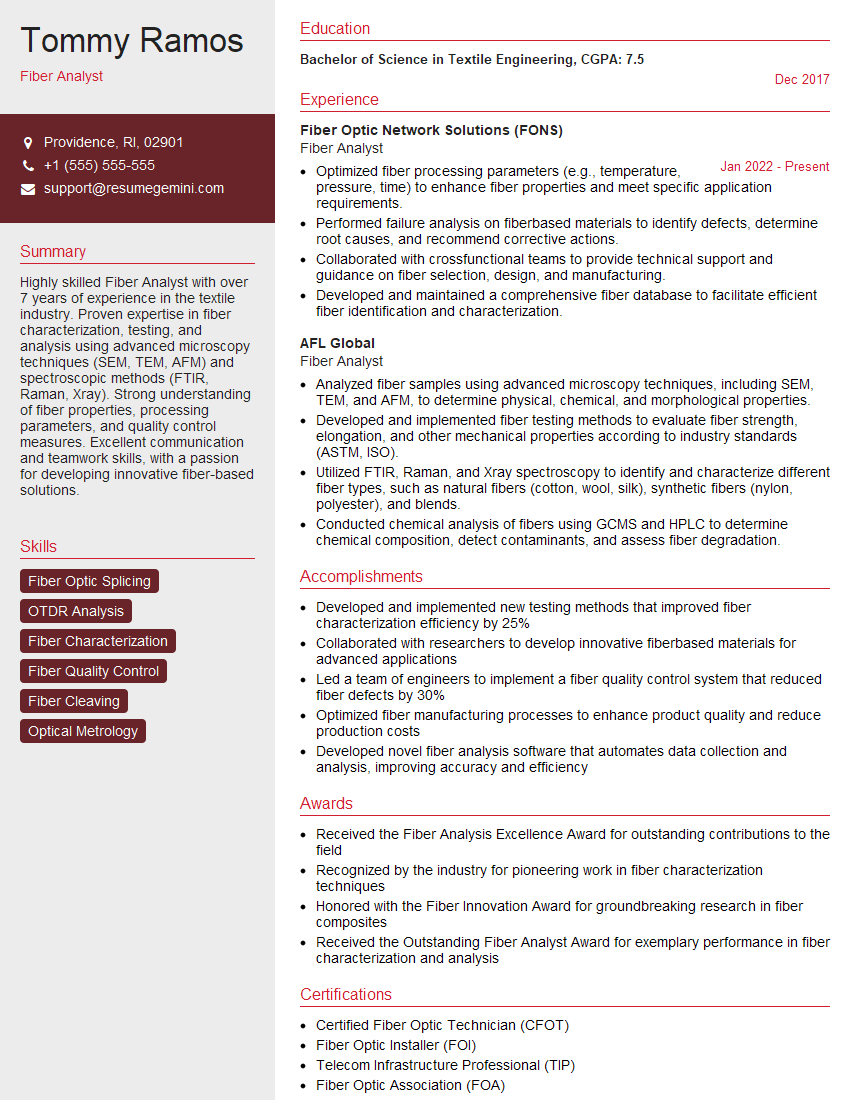
Tommy Ramos
Fiber Analyst
Summary
Highly skilled Fiber Analyst with over 7 years of experience in the textile industry. Proven expertise in fiber characterization, testing, and analysis using advanced microscopy techniques (SEM, TEM, AFM) and spectroscopic methods (FTIR, Raman, Xray). Strong understanding of fiber properties, processing parameters, and quality control measures. Excellent communication and teamwork skills, with a passion for developing innovative fiber-based solutions.
Education
Bachelor of Science in Textile Engineering
December 2017
Skills
- Fiber Optic Splicing
- OTDR Analysis
- Fiber Characterization
- Fiber Quality Control
- Fiber Cleaving
- Optical Metrology
Work Experience
Fiber Analyst
- Optimized fiber processing parameters (e.g., temperature, pressure, time) to enhance fiber properties and meet specific application requirements.
- Performed failure analysis on fiberbased materials to identify defects, determine root causes, and recommend corrective actions.
- Collaborated with crossfunctional teams to provide technical support and guidance on fiber selection, design, and manufacturing.
- Developed and maintained a comprehensive fiber database to facilitate efficient fiber identification and characterization.
Fiber Analyst
- Analyzed fiber samples using advanced microscopy techniques, including SEM, TEM, and AFM, to determine physical, chemical, and morphological properties.
- Developed and implemented fiber testing methods to evaluate fiber strength, elongation, and other mechanical properties according to industry standards (ASTM, ISO).
- Utilized FTIR, Raman, and Xray spectroscopy to identify and characterize different fiber types, such as natural fibers (cotton, wool, silk), synthetic fibers (nylon, polyester), and blends.
- Conducted chemical analysis of fibers using GCMS and HPLC to determine chemical composition, detect contaminants, and assess fiber degradation.
Accomplishments
- Developed and implemented new testing methods that improved fiber characterization efficiency by 25%
- Collaborated with researchers to develop innovative fiberbased materials for advanced applications
- Led a team of engineers to implement a fiber quality control system that reduced fiber defects by 30%
- Optimized fiber manufacturing processes to enhance product quality and reduce production costs
- Developed novel fiber analysis software that automates data collection and analysis, improving accuracy and efficiency
Awards
- Received the Fiber Analysis Excellence Award for outstanding contributions to the field
- Recognized by the industry for pioneering work in fiber characterization techniques
- Honored with the Fiber Innovation Award for groundbreaking research in fiber composites
- Received the Outstanding Fiber Analyst Award for exemplary performance in fiber characterization and analysis
Certificates
- Certified Fiber Optic Technician (CFOT)
- Fiber Optic Installer (FOI)
- Telecom Infrastructure Professional (TIP)
- Fiber Optic Association (FOA)
Career Expert Tips:
- Select the ideal resume template to showcase your professional experience effectively.
- Master the art of resume writing to highlight your unique qualifications and achievements.
- Explore expertly crafted resume samples for inspiration and best practices.
- Build your best resume for free this new year with ResumeGemini. Enjoy exclusive discounts on ATS optimized resume templates.
How To Write Resume For Fiber Analyst
- Highlight your technical expertise in fiber characterization and analysis using advanced microscopy and spectroscopic techniques.
- Quantify your accomplishments with specific metrics and results to demonstrate the impact of your work.
- Showcase your ability to collaborate with cross-functional teams and provide technical guidance on fiber selection, design, and manufacturing.
- Emphasize your understanding of industry standards and regulations related to fiber testing and quality control.
Essential Experience Highlights for a Strong Fiber Analyst Resume
- Analyzed fiber samples using advanced microscopy techniques (SEM, TEM, AFM) to determine physical, chemical, and morphological properties.
- Developed and implemented fiber testing methods to evaluate fiber strength, elongation, and other mechanical properties according to industry standards (ASTM, ISO).
- Utilized FTIR, Raman, and Xray spectroscopy to identify and characterize different fiber types, such as natural fibers (cotton, wool, silk), synthetic fibers (nylon, polyester), and blends.
- Conducted chemical analysis of fibers using GCMS and HPLC to determine chemical composition, detect contaminants, and assess fiber degradation.
- Optimized fiber processing parameters (e.g., temperature, pressure, time) to enhance fiber properties and meet specific application requirements.
- Performed failure analysis on fiberbased materials to identify defects, determine root causes, and recommend corrective actions.
Frequently Asked Questions (FAQ’s) For Fiber Analyst
What are the key responsibilities of a Fiber Analyst?
Fiber Analysts are responsible for analyzing the physical, chemical, and morphological properties of fibers using advanced microscopy and spectroscopic techniques. They develop and implement fiber testing methods to evaluate fiber strength, elongation, and other mechanical properties. They also identify and characterize different fiber types, optimize fiber processing parameters, and perform failure analysis on fiber-based materials.
What are the educational requirements for becoming a Fiber Analyst?
A Bachelor’s degree in Textile Engineering, Material Science, or a related field is typically required to become a Fiber Analyst.
What are the career prospects for Fiber Analysts?
Fiber Analysts can work in various industries, including textiles, manufacturing, automotive, and aerospace. They can also pursue research and development roles in academia or government laboratories.
What are the key skills and qualities for a successful Fiber Analyst?
Successful Fiber Analysts have a strong understanding of fiber properties, testing methods, and industry standards. They are proficient in using advanced microscopy and spectroscopic techniques and have excellent analytical and problem-solving skills. They are also effective communicators and team players.
What are the typical salary expectations for Fiber Analysts?
The salary expectations for Fiber Analysts vary depending on their experience, qualifications, and location. According to Indeed, the average salary for Fiber Analysts in the United States is around $75,000 per year.
What are the major challenges faced by Fiber Analysts in their work?
Fiber Analysts often face challenges related to the complexity and diversity of fiber materials. They need to stay updated with the latest advancements in fiber characterization techniques and industry standards to effectively analyze and interpret fiber properties.
How can Fiber Analysts stay up-to-date with the latest developments in their field?
Fiber Analysts can stay up-to-date with the latest developments in their field by attending industry conferences, reading scientific journals, and participating in professional organizations such as the American Association of Textile Chemists and Colorists (AATCC).