Are you a seasoned Food Analyst seeking a new career path? Discover our professionally built Food Analyst Resume Template. This time-saving tool provides a solid foundation for your job search. Simply click “Edit Resume” to customize it with your unique experiences and achievements. Customize fonts and colors to match your personal style and increase your chances of landing your dream job. Explore more Resume Templates for additional options.






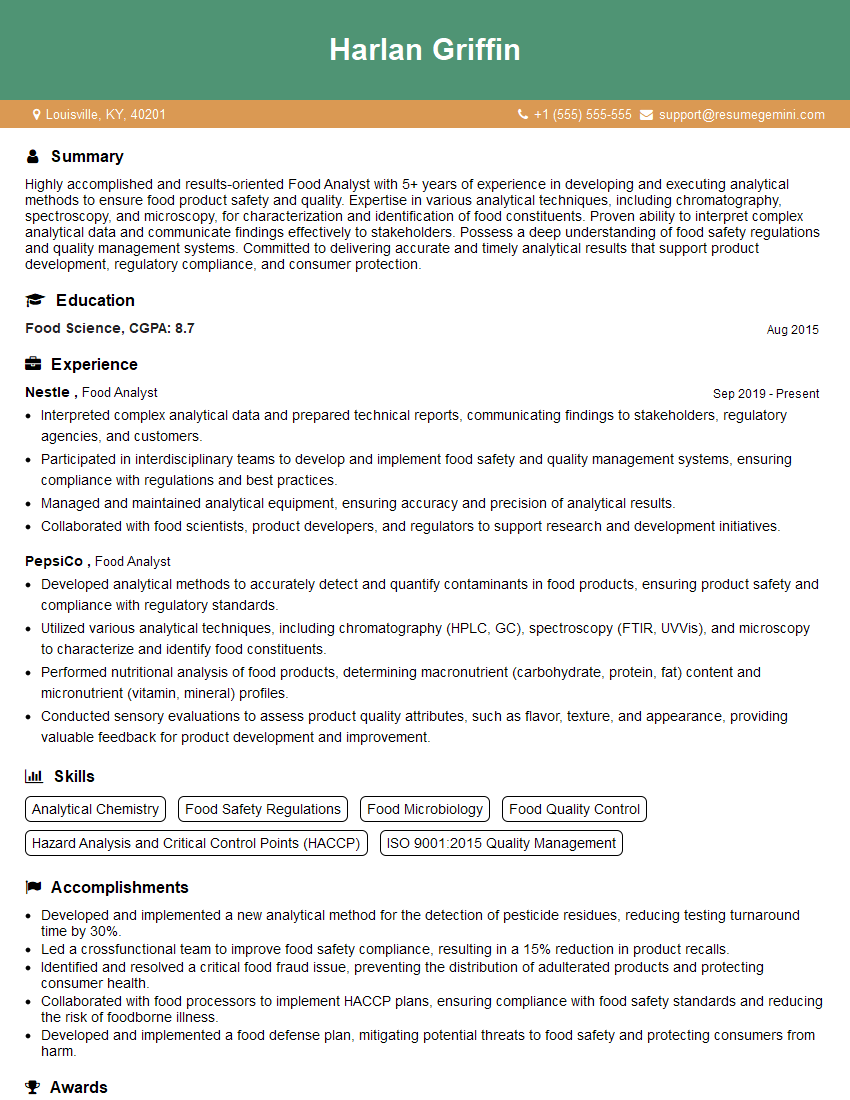
Harlan Griffin
Food Analyst
Summary
Highly accomplished and results-oriented Food Analyst with 5+ years of experience in developing and executing analytical methods to ensure food product safety and quality. Expertise in various analytical techniques, including chromatography, spectroscopy, and microscopy, for characterization and identification of food constituents. Proven ability to interpret complex analytical data and communicate findings effectively to stakeholders. Possess a deep understanding of food safety regulations and quality management systems. Committed to delivering accurate and timely analytical results that support product development, regulatory compliance, and consumer protection.
Education
Food Science
August 2015
Skills
- Analytical Chemistry
- Food Safety Regulations
- Food Microbiology
- Food Quality Control
- Hazard Analysis and Critical Control Points (HACCP)
- ISO 9001:2015 Quality Management
Work Experience
Food Analyst
- Interpreted complex analytical data and prepared technical reports, communicating findings to stakeholders, regulatory agencies, and customers.
- Participated in interdisciplinary teams to develop and implement food safety and quality management systems, ensuring compliance with regulations and best practices.
- Managed and maintained analytical equipment, ensuring accuracy and precision of analytical results.
- Collaborated with food scientists, product developers, and regulators to support research and development initiatives.
Food Analyst
- Developed analytical methods to accurately detect and quantify contaminants in food products, ensuring product safety and compliance with regulatory standards.
- Utilized various analytical techniques, including chromatography (HPLC, GC), spectroscopy (FTIR, UVVis), and microscopy to characterize and identify food constituents.
- Performed nutritional analysis of food products, determining macronutrient (carbohydrate, protein, fat) content and micronutrient (vitamin, mineral) profiles.
- Conducted sensory evaluations to assess product quality attributes, such as flavor, texture, and appearance, providing valuable feedback for product development and improvement.
Accomplishments
- Developed and implemented a new analytical method for the detection of pesticide residues, reducing testing turnaround time by 30%.
- Led a crossfunctional team to improve food safety compliance, resulting in a 15% reduction in product recalls.
- Identified and resolved a critical food fraud issue, preventing the distribution of adulterated products and protecting consumer health.
- Collaborated with food processors to implement HACCP plans, ensuring compliance with food safety standards and reducing the risk of foodborne illness.
- Developed and implemented a food defense plan, mitigating potential threats to food safety and protecting consumers from harm.
Awards
- Recipient of the Food Safety and Quality Excellence Award for outstanding contributions to food safety and quality management.
- Recognized with the FDAs Certificate of Excellence for exceptional analytical methods development and implementation.
- Awarded the FoodAnalyst of the Year Award for innovative approaches to food analysis and compliance.
- Honored with the Food Industry Leadership Award for contributions to food safety regulation and enforcement.
Certificates
- Certified Food Scientist (CFS)
- Certified Quality Auditor (CQA)
- ASQ Certified Six Sigma Green Belt
- HACCP Manager Certification
Career Expert Tips:
- Select the ideal resume template to showcase your professional experience effectively.
- Master the art of resume writing to highlight your unique qualifications and achievements.
- Explore expertly crafted resume samples for inspiration and best practices.
- Build your best resume for free this new year with ResumeGemini. Enjoy exclusive discounts on ATS optimized resume templates.
How To Write Resume For Food Analyst
- Highlight your technical expertise in analytical chemistry, emphasizing your proficiency in specific techniques.
- Quantify your accomplishments using metrics whenever possible, demonstrating the impact of your work.
- Demonstrate your understanding of food safety regulations and quality management systems.
- Showcase your communication skills by emphasizing your ability to interpret and present complex analytical data effectively.
- Consider obtaining certifications, such as the Certified Food Scientist (CFS) credential, to enhance your credibility.
Essential Experience Highlights for a Strong Food Analyst Resume
- Develop and validate analytical methods to detect and quantify contaminants in food products, ensuring compliance with regulatory standards.
- Utilize analytical techniques (HPLC, GC, FTIR, UVVis, microscopy) to characterize and identify food constituents.
- Conduct nutritional analysis of food products to determine macronutrient and micronutrient profiles.
- Perform sensory evaluations to assess product quality attributes (flavor, texture, appearance).
- Interpret complex analytical data and prepare technical reports, communicating findings to stakeholders.
- Collaborate with food scientists, product developers, and regulators to support research and development initiatives.
- Manage and maintain analytical equipment to ensure accuracy and precision of results.
Frequently Asked Questions (FAQ’s) For Food Analyst
What are the primary responsibilities of a Food Analyst?
Food Analysts are responsible for ensuring the safety and quality of food products by conducting various analytical tests. They develop and validate analytical methods, characterize food constituents, conduct nutritional analysis, perform sensory evaluations, and interpret complex data to identify potential contaminants or quality issues.
What are the educational qualifications required to become a Food Analyst?
A Bachelor’s degree in Food Science, Chemistry, or a related field is typically required to become a Food Analyst. Additional certifications, such as the Certified Food Scientist (CFS) credential, are beneficial for career advancement.
What are the key skills and qualities of a successful Food Analyst?
Successful Food Analysts possess strong analytical skills, proficiency in various analytical techniques, and a deep understanding of food chemistry and safety regulations. They are also??Excellent communication and teamwork skills.
What career opportunities are available to Food Analysts?
Food Analysts can work in various settings, including food processing plants, research and development laboratories, regulatory agencies, and consulting firms. They can advance to roles such as Food Safety Manager, Quality Assurance Manager, or Research Scientist.
What is the job outlook for Food Analysts?
The job outlook for Food Analysts is expected to be positive due to the increasing emphasis on food safety and quality. The demand for qualified professionals is expected to grow as the food industry continues to expand.
How can I prepare for a career as a Food Analyst?
To prepare for a career as a Food Analyst, consider pursuing a degree in Food Science or a related field, gaining hands-on experience through internships or research projects, and obtaining relevant certifications to enhance your credibility.