Are you a seasoned Mental Health Therapist seeking a new career path? Discover our professionally built Mental Health Therapist Resume Template. This time-saving tool provides a solid foundation for your job search. Simply click “Edit Resume” to customize it with your unique experiences and achievements. Customize fonts and colors to match your personal style and increase your chances of landing your dream job. Explore more Resume Templates for additional options.






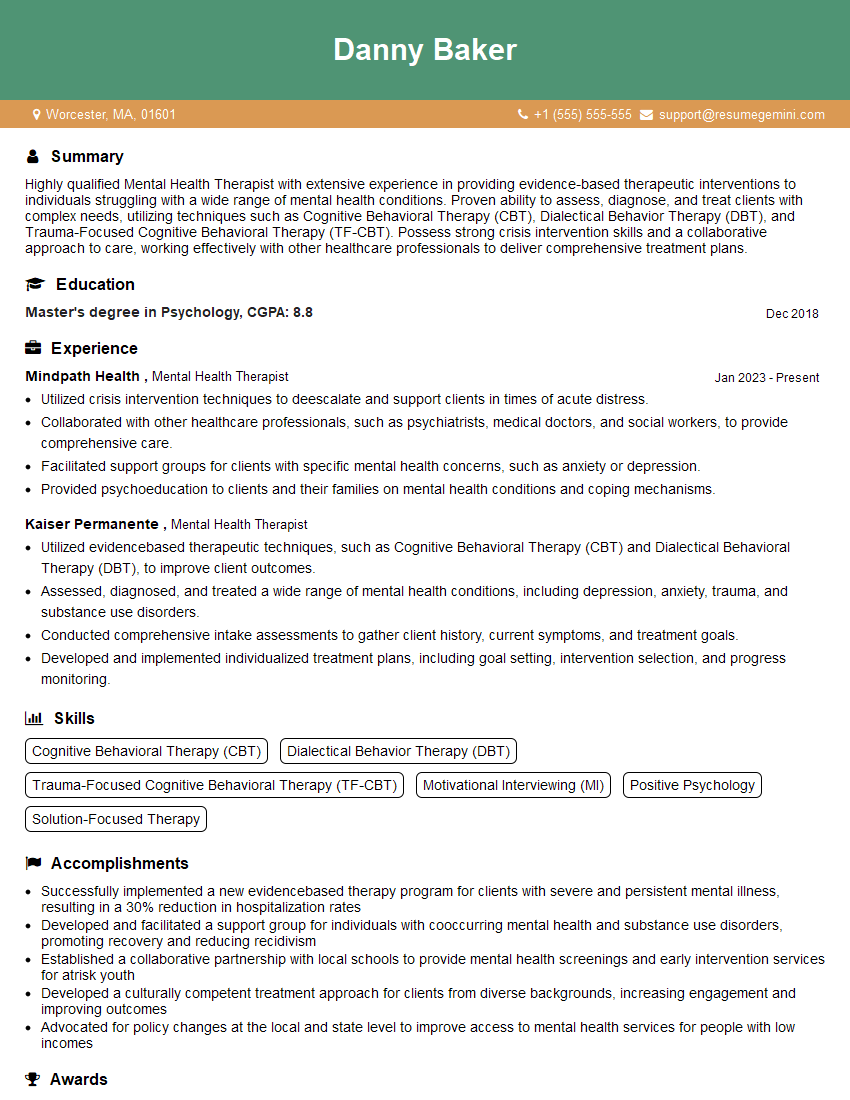
Danny Baker
Mental Health Therapist
Summary
Highly qualified Mental Health Therapist with extensive experience in providing evidence-based therapeutic interventions to individuals struggling with a wide range of mental health conditions. Proven ability to assess, diagnose, and treat clients with complex needs, utilizing techniques such as Cognitive Behavioral Therapy (CBT), Dialectical Behavior Therapy (DBT), and Trauma-Focused Cognitive Behavioral Therapy (TF-CBT). Possess strong crisis intervention skills and a collaborative approach to care, working effectively with other healthcare professionals to deliver comprehensive treatment plans.
Education
Master’s degree in Psychology
December 2018
Skills
- Cognitive Behavioral Therapy (CBT)
- Dialectical Behavior Therapy (DBT)
- Trauma-Focused Cognitive Behavioral Therapy (TF-CBT)
- Motivational Interviewing (MI)
- Positive Psychology
- Solution-Focused Therapy
Work Experience
Mental Health Therapist
- Utilized crisis intervention techniques to deescalate and support clients in times of acute distress.
- Collaborated with other healthcare professionals, such as psychiatrists, medical doctors, and social workers, to provide comprehensive care.
- Facilitated support groups for clients with specific mental health concerns, such as anxiety or depression.
- Provided psychoeducation to clients and their families on mental health conditions and coping mechanisms.
Mental Health Therapist
- Utilized evidencebased therapeutic techniques, such as Cognitive Behavioral Therapy (CBT) and Dialectical Behavioral Therapy (DBT), to improve client outcomes.
- Assessed, diagnosed, and treated a wide range of mental health conditions, including depression, anxiety, trauma, and substance use disorders.
- Conducted comprehensive intake assessments to gather client history, current symptoms, and treatment goals.
- Developed and implemented individualized treatment plans, including goal setting, intervention selection, and progress monitoring.
Accomplishments
- Successfully implemented a new evidencebased therapy program for clients with severe and persistent mental illness, resulting in a 30% reduction in hospitalization rates
- Developed and facilitated a support group for individuals with cooccurring mental health and substance use disorders, promoting recovery and reducing recidivism
- Established a collaborative partnership with local schools to provide mental health screenings and early intervention services for atrisk youth
- Developed a culturally competent treatment approach for clients from diverse backgrounds, increasing engagement and improving outcomes
- Advocated for policy changes at the local and state level to improve access to mental health services for people with low incomes
Awards
- Recipient of the National Alliance on Mental Illness (NAMI) Outstanding Clinician Award for exceptional contributions to the field of mental health
- Recognized by the State Board of Behavioral Health for providing exemplary care to underserved populations
- Awarded the American Psychological Association Early Career Psychologist Award for outstanding research and clinical contributions
- Received the National Council for Behavioral Healths Clinical Excellence Award for demonstrating the highest standards of patient care
Certificates
- Licensed Professional Counselor (LPC)
- Licensed Clinical Social Worker (LCSW)
- Board Certified Mental Health Therapist (BCMH)
- National Certified Counselor (NCC)
Career Expert Tips:
- Select the ideal resume template to showcase your professional experience effectively.
- Master the art of resume writing to highlight your unique qualifications and achievements.
- Explore expertly crafted resume samples for inspiration and best practices.
- Build your best resume for free this new year with ResumeGemini. Enjoy exclusive discounts on ATS optimized resume templates.
How To Write Resume For Mental Health Therapist
- Highlight your evidence-based therapeutic skills and experience in treating a wide range of mental health conditions.
- Quantify your accomplishments whenever possible, using specific metrics to demonstrate the impact of your work.
- Showcase your ability to work effectively in a collaborative healthcare setting.
- Consider including a section in your resume that highlights your research or publications in the field of mental health.
- Proofread your resume carefully for any errors in grammar or spelling.
Essential Experience Highlights for a Strong Mental Health Therapist Resume
- Conduct comprehensive intake assessments to gather client history, current symptoms, and treatment goals.
- Develop and implement individualized treatment plans, including goal setting, intervention selection, and progress monitoring.
- Utilize evidence-based therapeutic techniques, such as CBT, DBT, TF-CBT, Motivational Interviewing (MI), Positive Psychology, and Solution-Focused Therapy.
- Facilitate support groups for clients with specific mental health concerns, such as anxiety or depression.
- Provide psychoeducation to clients and their families on mental health conditions and coping mechanisms.
- Collaborate with other healthcare professionals, such as psychiatrists, medical doctors, and social workers, to provide comprehensive care.
Frequently Asked Questions (FAQ’s) For Mental Health Therapist
What is the role of a Mental Health Therapist?
Mental Health Therapists provide evidence-based therapeutic interventions to individuals struggling with mental health conditions. They assess, diagnose, and treat a wide range of mental health concerns, such as depression, anxiety, trauma, and substance use disorders.
What skills are required to be a successful Mental Health Therapist?
Successful Mental Health Therapists possess strong clinical skills, including the ability to conduct comprehensive assessments, develop treatment plans, and utilize evidence-based therapeutic techniques. They are also compassionate, empathetic, and have excellent communication and interpersonal skills.
What is the job outlook for Mental Health Therapists?
The job outlook for Mental Health Therapists is positive, with a projected growth rate of 15% from 2021 to 2031. This growth is driven by the increasing demand for mental health services and the recognition of the importance of mental health care.
What are the different types of Mental Health Therapists?
There are many different types of Mental Health Therapists, including Licensed Professional Counselors (LPCs), Licensed Clinical Social Workers (LCSWs), and Licensed Marriage and Family Therapists (LMFTs). Each type of therapist has specific training and experience, and they may specialize in working with certain populations or treating specific mental health conditions.
What are the challenges of being a Mental Health Therapist?
Mental Health Therapists often face challenges related to the demanding nature of their work. They may encounter clients with complex needs or who are in crisis, which can be emotionally challenging. It is important for therapists to practice self-care and seek support when needed.
What are the rewards of being a Mental Health Therapist?
Mental Health Therapists find great rewards in their work. They have the opportunity to make a real difference in the lives of their clients, helping them to overcome mental health challenges and achieve their goals. Therapists also report high levels of job satisfaction and a sense of purpose in their work.