Are you a seasoned Music Therapist seeking a new career path? Discover our professionally built Music Therapist Resume Template. This time-saving tool provides a solid foundation for your job search. Simply click “Edit Resume” to customize it with your unique experiences and achievements. Customize fonts and colors to match your personal style and increase your chances of landing your dream job. Explore more Resume Templates for additional options.






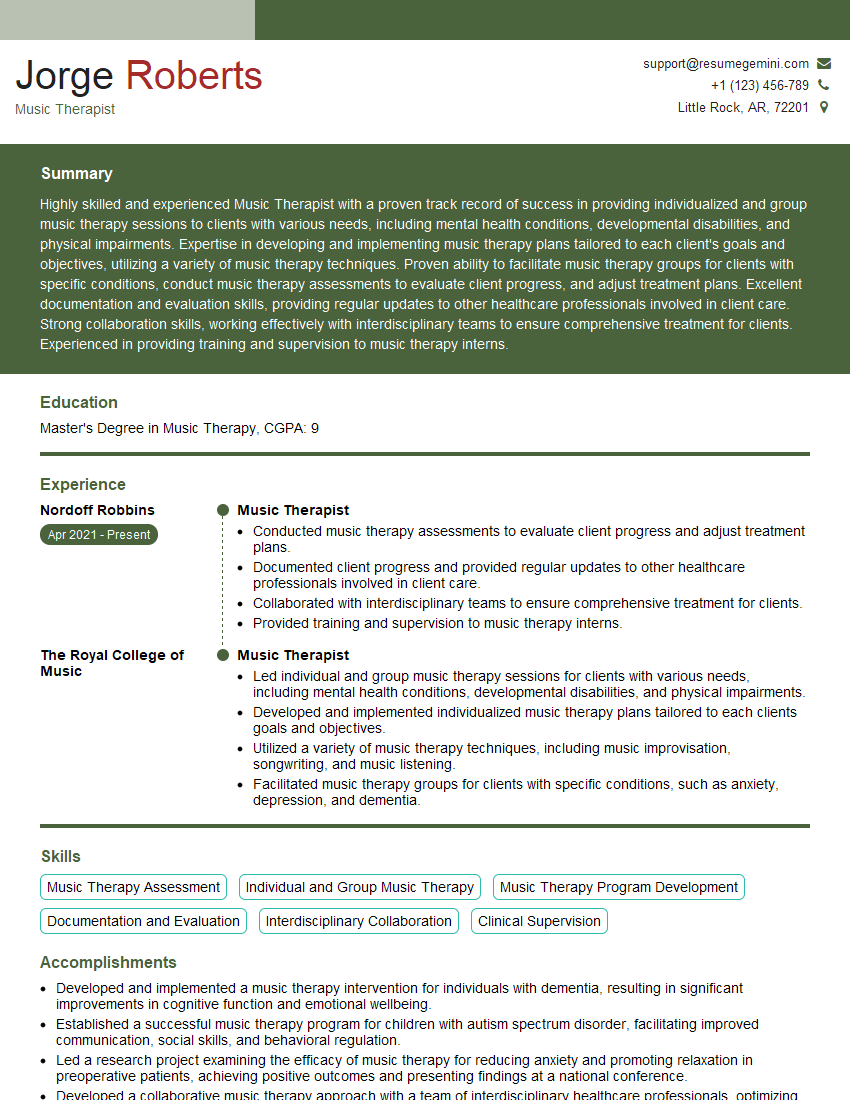
Jorge Roberts
Music Therapist
Summary
Highly skilled and experienced Music Therapist with a proven track record of success in providing individualized and group music therapy sessions to clients with various needs, including mental health conditions, developmental disabilities, and physical impairments. Expertise in developing and implementing music therapy plans tailored to each client’s goals and objectives, utilizing a variety of music therapy techniques. Proven ability to facilitate music therapy groups for clients with specific conditions, conduct music therapy assessments to evaluate client progress, and adjust treatment plans. Excellent documentation and evaluation skills, providing regular updates to other healthcare professionals involved in client care. Strong collaboration skills, working effectively with interdisciplinary teams to ensure comprehensive treatment for clients. Experienced in providing training and supervision to music therapy interns.
Education
Master’s Degree in Music Therapy
March 2017
Skills
- Music Therapy Assessment
- Individual and Group Music Therapy
- Music Therapy Program Development
- Documentation and Evaluation
- Interdisciplinary Collaboration
- Clinical Supervision
Work Experience
Music Therapist
- Conducted music therapy assessments to evaluate client progress and adjust treatment plans.
- Documented client progress and provided regular updates to other healthcare professionals involved in client care.
- Collaborated with interdisciplinary teams to ensure comprehensive treatment for clients.
- Provided training and supervision to music therapy interns.
Music Therapist
- Led individual and group music therapy sessions for clients with various needs, including mental health conditions, developmental disabilities, and physical impairments.
- Developed and implemented individualized music therapy plans tailored to each clients goals and objectives.
- Utilized a variety of music therapy techniques, including music improvisation, songwriting, and music listening.
- Facilitated music therapy groups for clients with specific conditions, such as anxiety, depression, and dementia.
Accomplishments
- Developed and implemented a music therapy intervention for individuals with dementia, resulting in significant improvements in cognitive function and emotional wellbeing.
- Established a successful music therapy program for children with autism spectrum disorder, facilitating improved communication, social skills, and behavioral regulation.
- Led a research project examining the efficacy of music therapy for reducing anxiety and promoting relaxation in preoperative patients, achieving positive outcomes and presenting findings at a national conference.
- Developed a collaborative music therapy approach with a team of interdisciplinary healthcare professionals, optimizing patient outcomes and enhancing the quality of care.
- Successfully implemented a music therapy program in a correctional facility, leading to reduced recidivism rates and improved mental health outcomes among inmates.
Awards
- Received The Music Therapy Association of Australia (MTA) Emerging Leader Award for outstanding contributions to the field of music therapy.
- Recognized with the American Music Therapy Association (AMTA) Clinical Excellence Award for exceptional clinical practice and research in music therapy.
- Awarded the National Association for Music Education (NAfME) Music Therapy Educator Award for excellence in teaching and mentoring music therapy students.
- Honored with the Society for Music Therapy (SMT) Lifetime Achievement Award for significant contributions to the field of music therapy throughout my career.
Certificates
- Board-Certified Music Therapist (MT-BC)
- Neurologic Music Therapist (NMT)
- Music Together Certified Educator
- Bonny Method Guided Imagery and Music (GIM)
Career Expert Tips:
- Select the ideal resume template to showcase your professional experience effectively.
- Master the art of resume writing to highlight your unique qualifications and achievements.
- Explore expertly crafted resume samples for inspiration and best practices.
- Build your best resume for free this new year with ResumeGemini. Enjoy exclusive discounts on ATS optimized resume templates.
How To Write Resume For Music Therapist
- Highlight your passion for music and helping others, as well as your understanding of the therapeutic benefits of music.
- Showcase your skills in music therapy assessment, individual and group music therapy, and music therapy program development.
- Provide specific examples of how you have used music therapy to help clients achieve their goals and objectives.
- Emphasize your experience in interdisciplinary collaboration and your ability to work effectively with other healthcare professionals.
Essential Experience Highlights for a Strong Music Therapist Resume
- Led individual and group music therapy sessions for clients with various needs, including mental health conditions, developmental disabilities, and physical impairments.
- Developed and implemented individualized music therapy plans tailored to each client’s goals and objectives.
- Utilized a variety of music therapy techniques, including music improvisation, songwriting, and music listening.
- Facilitated music therapy groups for clients with specific conditions, such as anxiety, depression, and dementia.
- Conducted music therapy assessments to evaluate client progress and adjust treatment plans.
- Documented client progress and provided regular updates to other healthcare professionals involved in client care.
- Collaborated with interdisciplinary teams to ensure comprehensive treatment for clients.
Frequently Asked Questions (FAQ’s) For Music Therapist
What is music therapy?
Music therapy is the clinical use of music interventions to accomplish individualized goals within a therapeutic relationship by a credentialed professional who has completed an approved music therapy program.
What are the benefits of music therapy?
Music therapy has been shown to have a variety of benefits, including reducing stress and anxiety, improving mood, enhancing memory and cognitive function, and facilitating communication and self-expression.
Who can benefit from music therapy?
Music therapy can benefit people of all ages and backgrounds, including individuals with mental health conditions, developmental disabilities, physical impairments, and chronic pain.
What is the difference between a music therapist and a musician?
A music therapist is a credentialed professional who has completed an approved music therapy program, while a musician is someone who plays music as a profession.
How do I become a music therapist?
To become a music therapist, you must complete an approved music therapy program and obtain board certification.
What are the job prospects for music therapists?
The job outlook for music therapists is expected to grow faster than average in the coming years.
What is the average salary for a music therapist?
The average salary for a music therapist is around $48,000 per year.