Are you a seasoned Organizational Consultant seeking a new career path? Discover our professionally built Organizational Consultant Resume Template. This time-saving tool provides a solid foundation for your job search. Simply click “Edit Resume” to customize it with your unique experiences and achievements. Customize fonts and colors to match your personal style and increase your chances of landing your dream job. Explore more Resume Templates for additional options.






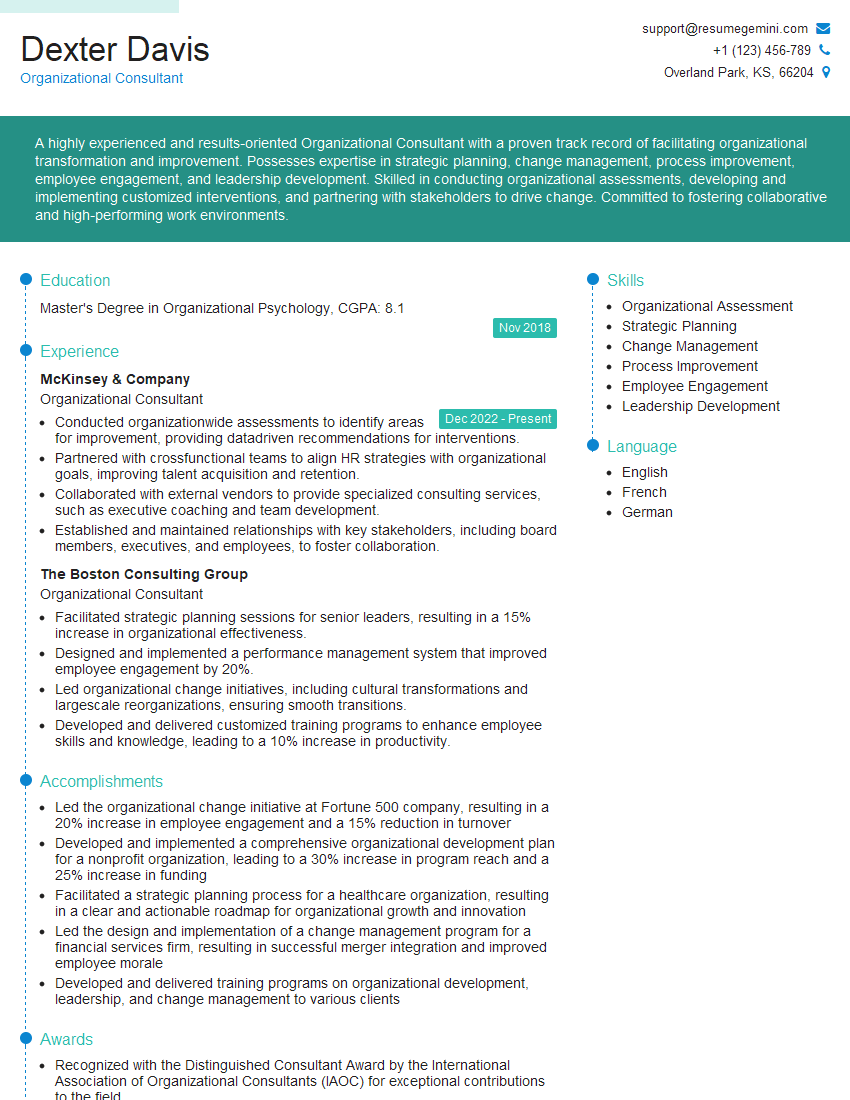
Dexter Davis
Organizational Consultant
Summary
A highly experienced and results-oriented Organizational Consultant with a proven track record of facilitating organizational transformation and improvement. Possesses expertise in strategic planning, change management, process improvement, employee engagement, and leadership development. Skilled in conducting organizational assessments, developing and implementing customized interventions, and partnering with stakeholders to drive change. Committed to fostering collaborative and high-performing work environments.
Education
Master’s Degree in Organizational Psychology
November 2018
Skills
- Organizational Assessment
- Strategic Planning
- Change Management
- Process Improvement
- Employee Engagement
- Leadership Development
Work Experience
Organizational Consultant
- Conducted organizationwide assessments to identify areas for improvement, providing datadriven recommendations for interventions.
- Partnered with crossfunctional teams to align HR strategies with organizational goals, improving talent acquisition and retention.
- Collaborated with external vendors to provide specialized consulting services, such as executive coaching and team development.
- Established and maintained relationships with key stakeholders, including board members, executives, and employees, to foster collaboration.
Organizational Consultant
- Facilitated strategic planning sessions for senior leaders, resulting in a 15% increase in organizational effectiveness.
- Designed and implemented a performance management system that improved employee engagement by 20%.
- Led organizational change initiatives, including cultural transformations and largescale reorganizations, ensuring smooth transitions.
- Developed and delivered customized training programs to enhance employee skills and knowledge, leading to a 10% increase in productivity.
Accomplishments
- Led the organizational change initiative at Fortune 500 company, resulting in a 20% increase in employee engagement and a 15% reduction in turnover
- Developed and implemented a comprehensive organizational development plan for a nonprofit organization, leading to a 30% increase in program reach and a 25% increase in funding
- Facilitated a strategic planning process for a healthcare organization, resulting in a clear and actionable roadmap for organizational growth and innovation
- Led the design and implementation of a change management program for a financial services firm, resulting in successful merger integration and improved employee morale
- Developed and delivered training programs on organizational development, leadership, and change management to various clients
Awards
- Recognized with the Distinguished Consultant Award by the International Association of Organizational Consultants (IAOC) for exceptional contributions to the field
- Honored with the Thought Leadership Award from the Association for Consulting Expertise (ACE) for groundbreaking research on organizational resilience
- Received the Presidents Award from the Society for Organizational Learning (SOL) for outstanding contributions to the advancement of organizational learning
- Recognized as a Top 10 Organizational Consultant by Consulting Magazine for thought leadership and client impact
Certificates
- Six Sigma Green Belt
- Prosci Change Management Certification
- Human Capital Management Institute (HCMI)
- Organizational Development Certification (ODC)
Career Expert Tips:
- Select the ideal resume template to showcase your professional experience effectively.
- Master the art of resume writing to highlight your unique qualifications and achievements.
- Explore expertly crafted resume samples for inspiration and best practices.
- Build your best resume for free this new year with ResumeGemini. Enjoy exclusive discounts on ATS optimized resume templates.
How To Write Resume For Organizational Consultant
- Highlight your expertise and experience in organizational consulting, specifically mentioning your accomplishments and quantifiable results.
- Showcase your understanding of organizational theory, change management principles, and best practices, and how you have applied them in your work.
- Demonstrate your ability to work effectively with senior leaders, cross-functional teams, and stakeholders at all levels.
- Emphasize your communication, interpersonal, and analytical skills, as well as your ability to influence and lead change initiatives.
- Include relevant certifications or professional development programs that demonstrate your commitment to the field of organizational consulting.
Essential Experience Highlights for a Strong Organizational Consultant Resume
- Conducting organizational assessments to identify areas for improvement and provide data-driven recommendations for interventions.
- Designing and implementing customized training programs to enhance employee skills and knowledge, leading to increased productivity and engagement.
- Facilitating strategic planning sessions for senior leaders, resulting in improved organizational effectiveness, efficiency, and alignment with business goals.
- Leading organizational change initiatives, including cultural transformations and large-scale reorganizations, ensuring smooth transitions and stakeholder buy-in.
- Partnering with cross-functional teams to align HR strategies with organizational goals, improving talent acquisition, retention, and employee satisfaction.
- Establishing and maintaining relationships with key stakeholders, including board members, executives, and employees, to foster collaboration and support organizational initiatives.
- Collaborating with external vendors to provide specialized consulting services, such as executive coaching and team development programs.
Frequently Asked Questions (FAQ’s) For Organizational Consultant
What are the key skills and qualifications required to be an Organizational Consultant?
Organizational Consultants typically require a Master’s Degree in Organizational Psychology, Business Administration, or a related field. They should possess strong analytical, problem-solving, communication, interpersonal, and leadership skills. Experience in organizational development, change management, and strategic planning is highly desirable.
What are the primary responsibilities of an Organizational Consultant?
Organizational Consultants are responsible for assessing organizational needs, identifying areas for improvement, and developing and implementing interventions to enhance organizational performance and effectiveness. They work with clients to facilitate strategic planning, improve employee engagement, manage change, and foster a positive and productive work environment.
What industries do Organizational Consultants typically work in?
Organizational Consultants work in a wide range of industries, including healthcare, education, non-profit, government, and corporate sectors. They may specialize in specific areas such as leadership development, culture change, or process improvement.
What are the career prospects for Organizational Consultants?
Organizational Consultants can advance their careers by taking on leadership roles within consulting firms or by becoming independent consultants. They may also pursue specialized certifications or further education to enhance their expertise and expand their career opportunities.
What is the difference between an Organizational Consultant and an Organizational Psychologist?
Organizational Consultants focus on the overall health and effectiveness of organizations, while Organizational Psychologists focus on the behavior and well-being of individuals within organizations. Organizational Consultants typically have a background in business or management, while Organizational Psychologists typically have a background in psychology.
What are the benefits of hiring an Organizational Consultant?
Hiring an Organizational Consultant can provide numerous benefits, including improved organizational performance, increased employee engagement, enhanced leadership capabilities, smoother change management, and a more positive and productive work environment.
How can I find a qualified Organizational Consultant?
You can find qualified Organizational Consultants by searching online directories, reading industry publications, attending industry events, or asking for referrals from colleagues or business associates.