Are you a seasoned Pharmaceutical Process Engineer seeking a new career path? Discover our professionally built Pharmaceutical Process Engineer Resume Template. This time-saving tool provides a solid foundation for your job search. Simply click “Edit Resume” to customize it with your unique experiences and achievements. Customize fonts and colors to match your personal style and increase your chances of landing your dream job. Explore more Resume Templates for additional options.






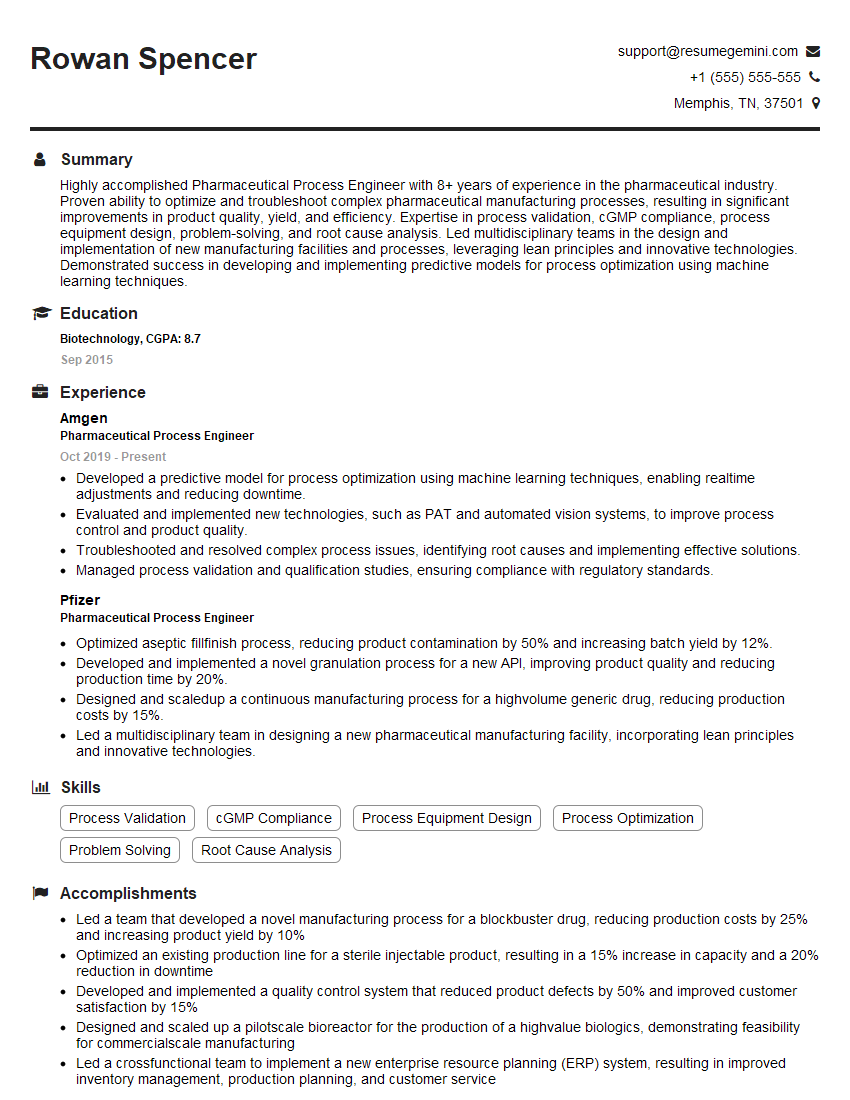
Rowan Spencer
Pharmaceutical Process Engineer
Summary
Highly accomplished Pharmaceutical Process Engineer with 8+ years of experience in the pharmaceutical industry. Proven ability to optimize and troubleshoot complex pharmaceutical manufacturing processes, resulting in significant improvements in product quality, yield, and efficiency. Expertise in process validation, cGMP compliance, process equipment design, problem-solving, and root cause analysis. Led multidisciplinary teams in the design and implementation of new manufacturing facilities and processes, leveraging lean principles and innovative technologies. Demonstrated success in developing and implementing predictive models for process optimization using machine learning techniques.
Education
Biotechnology
September 2015
Skills
- Process Validation
- cGMP Compliance
- Process Equipment Design
- Process Optimization
- Problem Solving
- Root Cause Analysis
Work Experience
Pharmaceutical Process Engineer
- Developed a predictive model for process optimization using machine learning techniques, enabling realtime adjustments and reducing downtime.
- Evaluated and implemented new technologies, such as PAT and automated vision systems, to improve process control and product quality.
- Troubleshooted and resolved complex process issues, identifying root causes and implementing effective solutions.
- Managed process validation and qualification studies, ensuring compliance with regulatory standards.
Pharmaceutical Process Engineer
- Optimized aseptic fillfinish process, reducing product contamination by 50% and increasing batch yield by 12%.
- Developed and implemented a novel granulation process for a new API, improving product quality and reducing production time by 20%.
- Designed and scaledup a continuous manufacturing process for a highvolume generic drug, reducing production costs by 15%.
- Led a multidisciplinary team in designing a new pharmaceutical manufacturing facility, incorporating lean principles and innovative technologies.
Accomplishments
- Led a team that developed a novel manufacturing process for a blockbuster drug, reducing production costs by 25% and increasing product yield by 10%
- Optimized an existing production line for a sterile injectable product, resulting in a 15% increase in capacity and a 20% reduction in downtime
- Developed and implemented a quality control system that reduced product defects by 50% and improved customer satisfaction by 15%
- Designed and scaled up a pilotscale bioreactor for the production of a highvalue biologics, demonstrating feasibility for commercialscale manufacturing
- Led a crossfunctional team to implement a new enterprise resource planning (ERP) system, resulting in improved inventory management, production planning, and customer service
Awards
- Recipient of the American Institute of Chemical Engineers (AIChE) Outstanding Young Engineer Award for contributions to pharmaceutical process engineering
- Recognized by the International Society for Pharmaceutical Engineering (ISPE) for significant contributions to the advancement of pharmaceutical process engineering
- Received the R&D 100 Award for the development of a novel drug delivery system that improved patient compliance and efficacy
- Honored by the American Chemical Society (ACS) for outstanding achievements in the field of pharmaceutical process engineering
Certificates
- Certified Pharmaceutical Process Engineer (CPPE)
- Good Manufacturing Practices (GMP) Certification
- Process Validation Certification
- Water System Management Certification
Career Expert Tips:
- Select the ideal resume template to showcase your professional experience effectively.
- Master the art of resume writing to highlight your unique qualifications and achievements.
- Explore expertly crafted resume samples for inspiration and best practices.
- Build your best resume for free this new year with ResumeGemini. Enjoy exclusive discounts on ATS optimized resume templates.
How To Write Resume For Pharmaceutical Process Engineer
- Quantify your accomplishments with specific metrics and data whenever possible. For example, instead of saying ‘optimized aseptic fill-finish process’, say ‘optimized aseptic fill-finish process, reducing product contamination by 50% and increasing batch yield by 12%’.
- Highlight your experience in process validation and cGMP compliance, as these are essential requirements for Pharmaceutical Process Engineers.
- Showcase your problem-solving and root cause analysis skills, as these are highly valued in the pharmaceutical industry. Provide examples of complex process issues you have resolved and the steps you took to identify and address the root causes.
- Emphasize your knowledge of innovative process control technologies, such as PAT and automated vision systems. These technologies are becoming increasingly important in the pharmaceutical industry for improving product quality and reducing manufacturing costs.
- Tailor your resume to each specific job you apply for. Highlight the skills and experience that are most relevant to the position you are seeking.
Essential Experience Highlights for a Strong Pharmaceutical Process Engineer Resume
- Optimized pharmaceutical manufacturing processes, including aseptic fill-finish, granulation, and continuous manufacturing, resulting in improved product quality, yield, and efficiency.
- Designed and scaled-up manufacturing processes for new and existing APIs, ensuring compliance with regulatory standards and meeting production targets.
- Managed and executed process validation and qualification studies, ensuring adherence to cGMP guidelines and regulatory requirements.
- Troubleshooted and resolved complex process issues, identifying root causes and implementing effective solutions to minimize downtime and maintain production efficiency.
- Developed and implemented innovative process control strategies using PAT and automated vision systems to enhance product quality and reduce manufacturing costs.
- Led multidisciplinary teams in the design and implementation of a new pharmaceutical manufacturing facility, incorporating lean principles and state-of-the-art technologies.
- Collaborated with R&D, Quality Control, and Regulatory Affairs teams to ensure the seamless integration of new processes and products into the manufacturing environment.
Frequently Asked Questions (FAQ’s) For Pharmaceutical Process Engineer
What are the key responsibilities of a Pharmaceutical Process Engineer?
The key responsibilities of a Pharmaceutical Process Engineer include optimizing manufacturing processes, designing and scaling-up new processes, managing process validation and qualification studies, troubleshooting and resolving process issues, and implementing innovative process control technologies.
What are the educational requirements for a Pharmaceutical Process Engineer?
A Bachelor’s degree in Biotechnology, Chemical Engineering, or a related field is typically required for a Pharmaceutical Process Engineer.
What are the career prospects for a Pharmaceutical Process Engineer?
Pharmaceutical Process Engineers have excellent career prospects, with high demand in the pharmaceutical industry. They can advance to roles such as Senior Process Engineer, Manufacturing Manager, or Director of Operations.
What are the key skills for a Pharmaceutical Process Engineer?
The key skills for a Pharmaceutical Process Engineer include process optimization, problem-solving, root cause analysis, process validation, and cGMP compliance.
What is the salary range for a Pharmaceutical Process Engineer?
The salary range for a Pharmaceutical Process Engineer varies depending on experience, location, and company size. According to Salary.com, the average salary for a Pharmaceutical Process Engineer in the United States is $105,000.
What are the top companies that hire Pharmaceutical Process Engineers?
Some of the top companies that hire Pharmaceutical Process Engineers include Amgen, Pfizer, Merck, and Johnson & Johnson.
What is the job outlook for Pharmaceutical Process Engineers?
The job outlook for Pharmaceutical Process Engineers is expected to be good in the coming years. The pharmaceutical industry is growing, and there is a high demand for qualified engineers to design, optimize, and troubleshoot manufacturing processes.
What are the benefits of working as a Pharmaceutical Process Engineer?
The benefits of working as a Pharmaceutical Process Engineer include a competitive salary, good job security, and the opportunity to make a real difference in the lives of others by helping to develop and manufacture safe and effective medicines.