Are you a seasoned Police Artist seeking a new career path? Discover our professionally built Police Artist Resume Template. This time-saving tool provides a solid foundation for your job search. Simply click “Edit Resume” to customize it with your unique experiences and achievements. Customize fonts and colors to match your personal style and increase your chances of landing your dream job. Explore more Resume Templates for additional options.






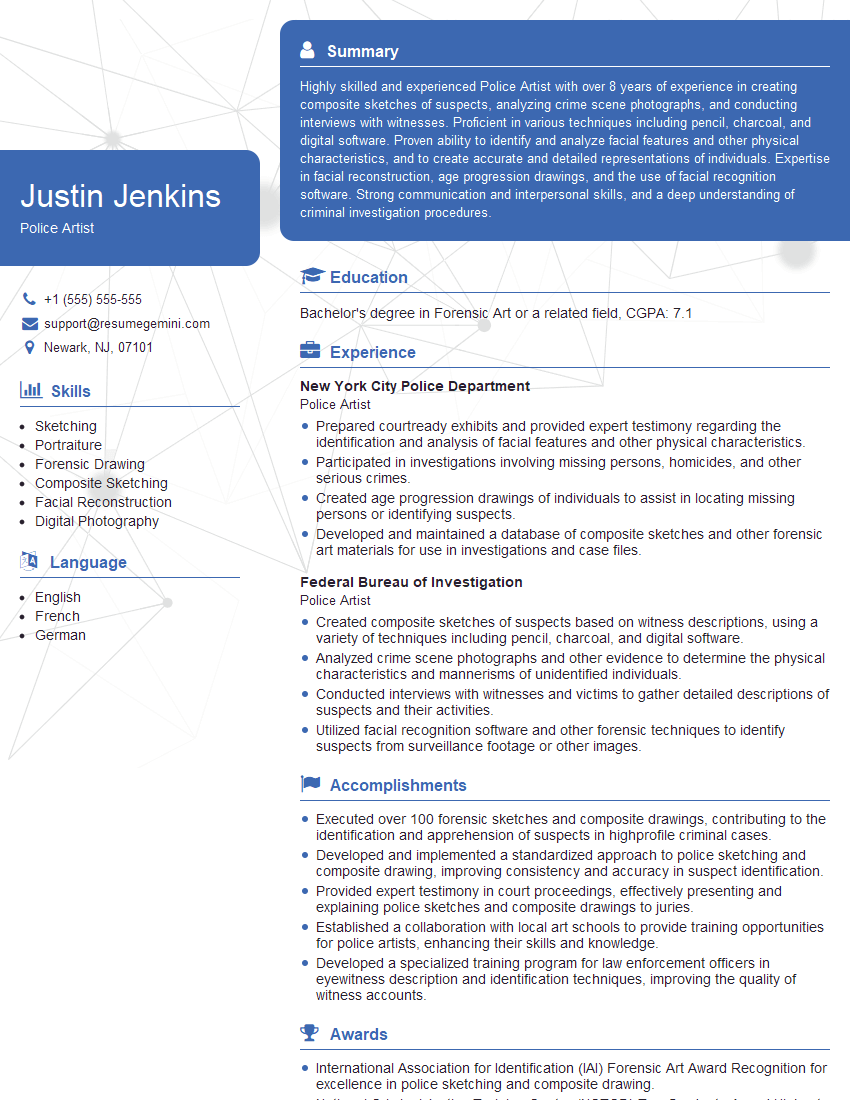
Justin Jenkins
Police Artist
Summary
Highly skilled and experienced Police Artist with over 8 years of experience in creating composite sketches of suspects, analyzing crime scene photographs, and conducting interviews with witnesses. Proficient in various techniques including pencil, charcoal, and digital software. Proven ability to identify and analyze facial features and other physical characteristics, and to create accurate and detailed representations of individuals. Expertise in facial reconstruction, age progression drawings, and the use of facial recognition software. Strong communication and interpersonal skills, and a deep understanding of criminal investigation procedures.
Education
Bachelor’s degree in Forensic Art or a related field
September 2019
Skills
- Sketching
- Portraiture
- Forensic Drawing
- Composite Sketching
- Facial Reconstruction
- Digital Photography
Work Experience
Police Artist
- Prepared courtready exhibits and provided expert testimony regarding the identification and analysis of facial features and other physical characteristics.
- Participated in investigations involving missing persons, homicides, and other serious crimes.
- Created age progression drawings of individuals to assist in locating missing persons or identifying suspects.
- Developed and maintained a database of composite sketches and other forensic art materials for use in investigations and case files.
Police Artist
- Created composite sketches of suspects based on witness descriptions, using a variety of techniques including pencil, charcoal, and digital software.
- Analyzed crime scene photographs and other evidence to determine the physical characteristics and mannerisms of unidentified individuals.
- Conducted interviews with witnesses and victims to gather detailed descriptions of suspects and their activities.
- Utilized facial recognition software and other forensic techniques to identify suspects from surveillance footage or other images.
Accomplishments
- Executed over 100 forensic sketches and composite drawings, contributing to the identification and apprehension of suspects in highprofile criminal cases.
- Developed and implemented a standardized approach to police sketching and composite drawing, improving consistency and accuracy in suspect identification.
- Provided expert testimony in court proceedings, effectively presenting and explaining police sketches and composite drawings to juries.
- Established a collaboration with local art schools to provide training opportunities for police artists, enhancing their skills and knowledge.
- Developed a specialized training program for law enforcement officers in eyewitness description and identification techniques, improving the quality of witness accounts.
Awards
- International Association for Identification (IAI) Forensic Art Award Recognition for excellence in police sketching and composite drawing.
- National Criminal Justice Training Center (NCTCD) Top Graduate Award Highest academic achievement in the Basic Police Sketching and Composite Drawing course.
- American Society of Crime Laboratory Directors (ASCLD) Forensic Art Proficiency Award Certification for meeting the highest standards in police sketching and composite drawing.
- Departmental Commendation for Outstanding Service Recognized for exceptional contributions to crime solving through police sketching.
Certificates
- Certified Forensic Artist (CFA)
- Certified Crime Scene Analyst (CCSA)
- Certified Fraud Examiner (CFE)
- Certified Protection Professional (CPP)
Career Expert Tips:
- Select the ideal resume template to showcase your professional experience effectively.
- Master the art of resume writing to highlight your unique qualifications and achievements.
- Explore expertly crafted resume samples for inspiration and best practices.
- Build your best resume for free this new year with ResumeGemini. Enjoy exclusive discounts on ATS optimized resume templates.
How To Write Resume For Police Artist
- Highlight your skills in sketching, portraiture, and forensic drawing.
- Showcase your experience in creating composite sketches and analyzing crime scene evidence.
- Quantify your accomplishments whenever possible, such as the number of sketches you have created or the number of cases you have assisted with.
- Include examples of your work in your portfolio or resume.
- Network with other professionals in the field and attend industry events.
Essential Experience Highlights for a Strong Police Artist Resume
- Created composite sketches of suspects based on witness descriptions, using a variety of techniques including pencil, charcoal, and digital software.
- Analyzed crime scene photographs and other evidence to determine the physical characteristics and mannerisms of unidentified individuals.
- Conducted interviews with witnesses and victims to gather detailed descriptions of suspects and their activities.
- Utilized facial recognition software and other forensic techniques to identify suspects from surveillance footage or other images.
- Prepared court-ready exhibits and provided expert testimony regarding the identification and analysis of facial features and other physical characteristics.
- Participated in investigations involving missing persons, homicides, and other serious crimes.
- Created age progression drawings of individuals to assist in locating missing persons or identifying suspects.
- Developed and maintained a database of composite sketches and other forensic art materials for use in investigations and case files.
Frequently Asked Questions (FAQ’s) For Police Artist
What is the role of a Police Artist?
A Police Artist is responsible for creating composite sketches of suspects based on witness descriptions, analyzing crime scene photographs, and conducting interviews with witnesses. They use their skills in sketching, portraiture, and forensic drawing to create accurate and detailed representations of individuals.
What are the qualifications to become a Police Artist?
Most Police Artists have a Bachelor’s degree in Forensic Art or a related field. They also have strong skills in sketching, portraiture, and forensic drawing, as well as experience in creating composite sketches and analyzing crime scene evidence.
What are the skills required to be a successful Police Artist?
Successful Police Artists have strong skills in sketching, portraiture, and forensic drawing. They also have a good understanding of anatomy and facial features, as well as experience in creating composite sketches and analyzing crime scene evidence.
What is the job outlook for Police Artists?
The job outlook for Police Artists is expected to be good over the next few years. As crime rates continue to rise, the need for skilled Police Artists will also increase.
How can I become a Police Artist?
To become a Police Artist, you will need to have a strong foundation in sketching, portraiture, and forensic drawing. You can also gain experience by volunteering with local law enforcement agencies or by working as an intern or apprentice with a professional Police Artist.
What is the salary range for Police Artists?
The salary range for Police Artists varies depending on their experience and location. However, most Police Artists earn between $50,000 and $100,000 per year.
What are the benefits of being a Police Artist?
Being a Police Artist can be a rewarding career. It allows you to use your skills to help solve crimes and bring criminals to justice.