Are you a seasoned Police Investigator seeking a new career path? Discover our professionally built Police Investigator Resume Template. This time-saving tool provides a solid foundation for your job search. Simply click “Edit Resume” to customize it with your unique experiences and achievements. Customize fonts and colors to match your personal style and increase your chances of landing your dream job. Explore more Resume Templates for additional options.






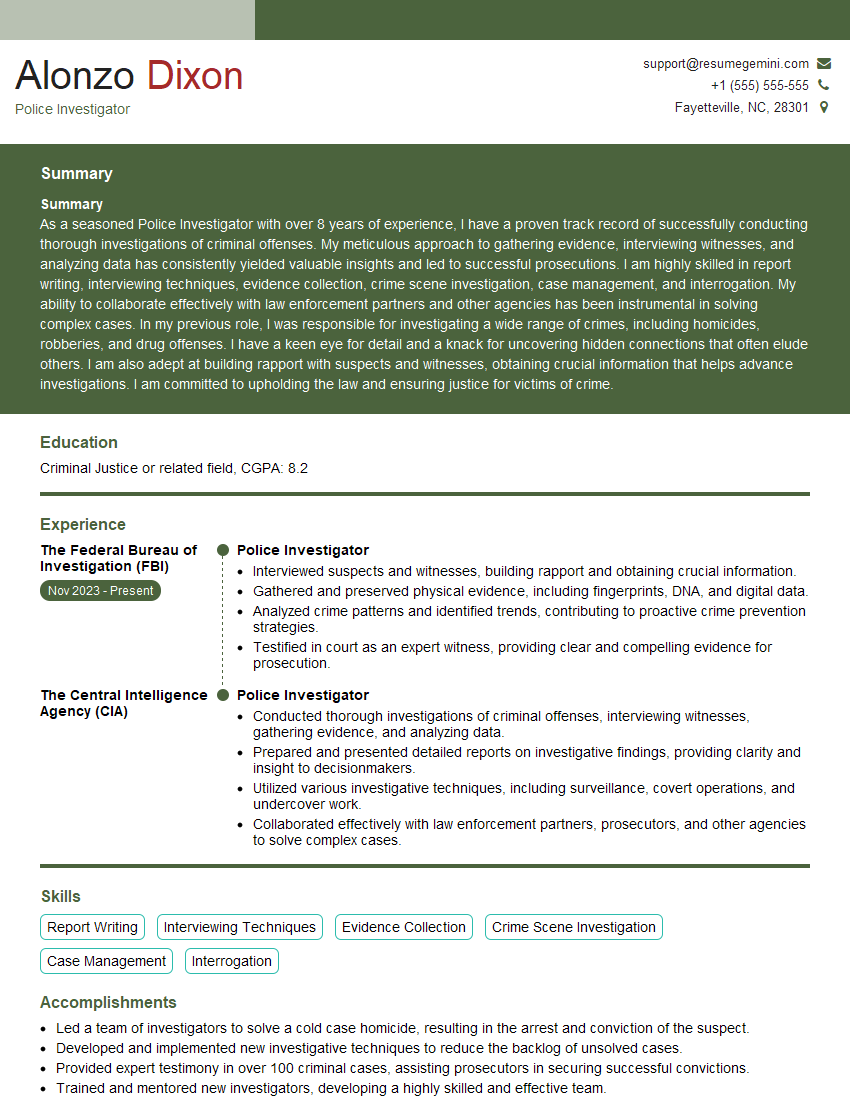
Alonzo Dixon
Police Investigator
Summary
Summary
As a seasoned Police Investigator with over 8 years of experience, I have a proven track record of successfully conducting thorough investigations of criminal offenses. My meticulous approach to gathering evidence, interviewing witnesses, and analyzing data has consistently yielded valuable insights and led to successful prosecutions. I am highly skilled in report writing, interviewing techniques, evidence collection, crime scene investigation, case management, and interrogation. My ability to collaborate effectively with law enforcement partners and other agencies has been instrumental in solving complex cases. In my previous role, I was responsible for investigating a wide range of crimes, including homicides, robberies, and drug offenses. I have a keen eye for detail and a knack for uncovering hidden connections that often elude others. I am also adept at building rapport with suspects and witnesses, obtaining crucial information that helps advance investigations. I am committed to upholding the law and ensuring justice for victims of crime.Education
Criminal Justice or related field
October 2019
Skills
- Report Writing
- Interviewing Techniques
- Evidence Collection
- Crime Scene Investigation
- Case Management
- Interrogation
Work Experience
Police Investigator
- Interviewed suspects and witnesses, building rapport and obtaining crucial information.
- Gathered and preserved physical evidence, including fingerprints, DNA, and digital data.
- Analyzed crime patterns and identified trends, contributing to proactive crime prevention strategies.
- Testified in court as an expert witness, providing clear and compelling evidence for prosecution.
Police Investigator
- Conducted thorough investigations of criminal offenses, interviewing witnesses, gathering evidence, and analyzing data.
- Prepared and presented detailed reports on investigative findings, providing clarity and insight to decisionmakers.
- Utilized various investigative techniques, including surveillance, covert operations, and undercover work.
- Collaborated effectively with law enforcement partners, prosecutors, and other agencies to solve complex cases.
Accomplishments
- Led a team of investigators to solve a cold case homicide, resulting in the arrest and conviction of the suspect.
- Developed and implemented new investigative techniques to reduce the backlog of unsolved cases.
- Provided expert testimony in over 100 criminal cases, assisting prosecutors in securing successful convictions.
- Trained and mentored new investigators, developing a highly skilled and effective team.
- Managed highprofile and sensitive investigations involving organized crime, major fraud, and cybercrimes.
Awards
- Received the Investigator of the Year Award for outstanding performance in solving complex criminal cases.
- Awarded the Medal of Valor for bravery and dedication during a highrisk operation.
- Recognized with the Distinguished Service Award for exceptional contributions to the field of police investigations.
Certificates
- Certified Police Investigator (CPI)
- Advanced Crime Scene Investigation Certification
- Certified Forensic Interviewer
- Certified Law Enforcement Executive (CLEE)
Career Expert Tips:
- Select the ideal resume template to showcase your professional experience effectively.
- Master the art of resume writing to highlight your unique qualifications and achievements.
- Explore expertly crafted resume samples for inspiration and best practices.
- Build your best resume for free this new year with ResumeGemini. Enjoy exclusive discounts on ATS optimized resume templates.
How To Write Resume For Police Investigator
Highlight your experience and skills.
Make sure your resume showcases your experience in investigating criminal offenses, as well as your skills in interviewing witnesses, gathering evidence, and analyzing data.Quantify your accomplishments.
When possible, use numbers to quantify your accomplishments. For example, you could say that you “solved 25 homicide cases” or “recovered $1 million in stolen property.”Tailor your resume to the job you’re applying for.
Take the time to tailor your resume to each job you apply for. This means highlighting the skills and experience that are most relevant to the position.Proofread carefully.
Before you submit your resume, proofread it carefully for any errors. This includes checking for typos, grammatical errors, and formatting issues.Get feedback from others.
Ask a friend, family member, or career counselor to review your resume and provide feedback.
Essential Experience Highlights for a Strong Police Investigator Resume
- Conduct thorough investigations of criminal offenses, including homicides, robberies, and drug offenses.
- Interview witnesses, gather evidence, and analyze data to uncover hidden connections and solve complex cases.
- Prepare and present detailed reports on investigative findings, providing clarity and insight to decision-makers.
- Utilize various investigative techniques, including surveillance, covert operations, and undercover work.
- Collaborate effectively with law enforcement partners, prosecutors, and other agencies to solve complex cases.
- Interview suspects and witnesses, building rapport and obtaining crucial information.
- Gather and preserve physical evidence, including fingerprints, DNA, and digital data.
- Analyze crime patterns and identify trends, contributing to proactive crime prevention strategies.
- Testify in court as an expert witness, providing clear and compelling evidence for prosecution.
Frequently Asked Questions (FAQ’s) For Police Investigator
What is the role of a Police Investigator?
Police Investigators are responsible for investigating criminal offenses, interviewing witnesses, gathering evidence, and preparing reports. They may also conduct surveillance, perform undercover operations, and testify in court.
What are the qualifications for becoming a Police Investigator?
Most Police Investigators have a bachelor’s degree in criminal justice or a related field. They must also have experience in law enforcement, typically as a police officer.
What are the benefits of being a Police Investigator?
Police Investigators enjoy a variety of benefits, including job security, a competitive salary, and the opportunity to make a difference in their community.
What are the challenges of being a Police Investigator?
Police Investigators face a number of challenges, including long hours, exposure to danger, and the need to deal with difficult people.
What is the future outlook for Police Investigators?
The future outlook for Police Investigators is positive. The demand for qualified investigators is expected to grow in the coming years.
How can I become a Police Investigator?
To become a Police Investigator, you will need to meet the qualifications listed above and apply for open positions. You may also want to consider taking courses in criminal justice or law enforcement to improve your chances of getting hired.
What are the career advancement opportunities for Police Investigators?
Police Investigators can advance their careers by becoming supervisors, managers, or directors. They may also specialize in a particular area of investigation, such as homicide or narcotics.
What is the salary range for Police Investigators?
The salary range for Police Investigators varies depending on experience, location, and employer. However, the median salary for Police Investigators is around $60,000 per year.