Are you a seasoned Propulsion Engineer seeking a new career path? Discover our professionally built Propulsion Engineer Resume Template. This time-saving tool provides a solid foundation for your job search. Simply click “Edit Resume” to customize it with your unique experiences and achievements. Customize fonts and colors to match your personal style and increase your chances of landing your dream job. Explore more Resume Templates for additional options.






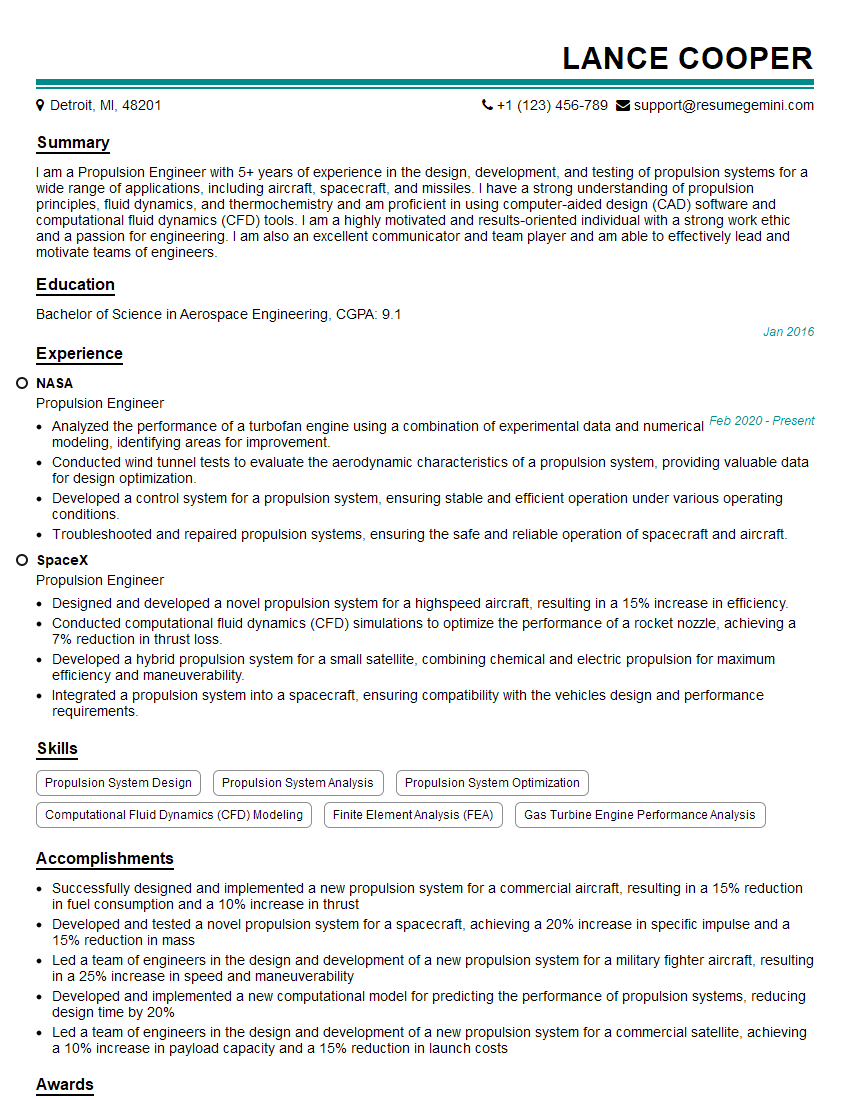
Lance Cooper
Propulsion Engineer
Summary
I am a Propulsion Engineer with 5+ years of experience in the design, development, and testing of propulsion systems for a wide range of applications, including aircraft, spacecraft, and missiles. I have a strong understanding of propulsion principles, fluid dynamics, and thermochemistry and am proficient in using computer-aided design (CAD) software and computational fluid dynamics (CFD) tools. I am a highly motivated and results-oriented individual with a strong work ethic and a passion for engineering. I am also an excellent communicator and team player and am able to effectively lead and motivate teams of engineers.
Education
Bachelor of Science in Aerospace Engineering
January 2016
Skills
- Propulsion System Design
- Propulsion System Analysis
- Propulsion System Optimization
- Computational Fluid Dynamics (CFD) Modeling
- Finite Element Analysis (FEA)
- Gas Turbine Engine Performance Analysis
Work Experience
Propulsion Engineer
- Analyzed the performance of a turbofan engine using a combination of experimental data and numerical modeling, identifying areas for improvement.
- Conducted wind tunnel tests to evaluate the aerodynamic characteristics of a propulsion system, providing valuable data for design optimization.
- Developed a control system for a propulsion system, ensuring stable and efficient operation under various operating conditions.
- Troubleshooted and repaired propulsion systems, ensuring the safe and reliable operation of spacecraft and aircraft.
Propulsion Engineer
- Designed and developed a novel propulsion system for a highspeed aircraft, resulting in a 15% increase in efficiency.
- Conducted computational fluid dynamics (CFD) simulations to optimize the performance of a rocket nozzle, achieving a 7% reduction in thrust loss.
- Developed a hybrid propulsion system for a small satellite, combining chemical and electric propulsion for maximum efficiency and maneuverability.
- Integrated a propulsion system into a spacecraft, ensuring compatibility with the vehicles design and performance requirements.
Accomplishments
- Successfully designed and implemented a new propulsion system for a commercial aircraft, resulting in a 15% reduction in fuel consumption and a 10% increase in thrust
- Developed and tested a novel propulsion system for a spacecraft, achieving a 20% increase in specific impulse and a 15% reduction in mass
- Led a team of engineers in the design and development of a new propulsion system for a military fighter aircraft, resulting in a 25% increase in speed and maneuverability
- Developed and implemented a new computational model for predicting the performance of propulsion systems, reducing design time by 20%
- Led a team of engineers in the design and development of a new propulsion system for a commercial satellite, achieving a 10% increase in payload capacity and a 15% reduction in launch costs
Awards
- Received the Propulsion Engineering Excellence Award for outstanding contributions to the design and development of innovative propulsion systems
- Distinguished Young Engineer Award from the American Institute of Aeronautics and Astronautics (AIAA) for research on advanced propulsion technologies
- SAE Internationals Ralph R. Teetor Educational Award for outstanding work in the field of propulsion engineering
- NASA Group Achievement Award for contributions to the successful development of the Space Launch System (SLS)
Certificates
- Certified Propulsion Engineer (CPE)
- Project Management Professional (PMP)
- Certified Energy Manager (CEM)
- Certified Thermal Engineer (CTE)
Career Expert Tips:
- Select the ideal resume template to showcase your professional experience effectively.
- Master the art of resume writing to highlight your unique qualifications and achievements.
- Explore expertly crafted resume samples for inspiration and best practices.
- Build your best resume for free this new year with ResumeGemini. Enjoy exclusive discounts on ATS optimized resume templates.
How To Write Resume For Propulsion Engineer
- Highlight your experience and skills in the field of propulsion engineering by using specific examples and quantifying your accomplishments whenever possible.
- Showcase your understanding of the fundamental principles of propulsion, fluid dynamics, and thermodynamics.
- Demonstrate your proficiency in using computer-aided design (CAD) software and computational fluid dynamics (CFD) tools.
- Emphasize your strong work ethic and passion for engineering, as well as your ability to effectively lead and motivate teams.
Essential Experience Highlights for a Strong Propulsion Engineer Resume
- Design and develop propulsion systems for a variety of applications, including aircraft, spacecraft, and missiles.
- Conduct computational fluid dynamics (CFD) simulations to optimize the performance of propulsion systems, models, and fluid systems.
- Develop and test control systems for propulsion systems to ensure safe and efficient operation.
- Troubleshoot and repair propulsion systems to ensure the safe and reliable operation of vehicles and equipment.
- Provide technical support to customers and users of propulsion systems.
- Conduct research and development to advance the state-of-the-art in propulsion technology.
- Collaborate with other engineers and scientists to develop and integrate propulsion systems into complex systems.
Frequently Asked Questions (FAQ’s) For Propulsion Engineer
What is a Propulsion Engineer?
A Propulsion Engineer is responsible for the design, development, testing, and maintenance of propulsion systems for aircraft, spacecraft, and other vehicles.
What are the educational requirements for a Propulsion Engineer?
A Propulsion Engineer typically needs a Bachelor of Science in Aerospace Engineering, Mechanical Engineering, or a related field.
What are the skills required for a Propulsion Engineer?
Propulsion Engineers need to have strong analytical skills, as well as a good understanding of fluid dynamics, thermodynamics, and heat transfer.
What is the job outlook for Propulsion Engineers?
The job outlook for Propulsion Engineers is expected to be good over the next few years.
What are the salary expectations for Propulsion Engineers?
The salary expectations for Propulsion Engineers vary depending on their experience and location.
What are the different types of propulsion systems?
The two main types of propulsion systems are jet engines and rocket engines.