Are you a seasoned Pulpwood Cutter seeking a new career path? Discover our professionally built Pulpwood Cutter Resume Template. This time-saving tool provides a solid foundation for your job search. Simply click “Edit Resume” to customize it with your unique experiences and achievements. Customize fonts and colors to match your personal style and increase your chances of landing your dream job. Explore more Resume Templates for additional options.






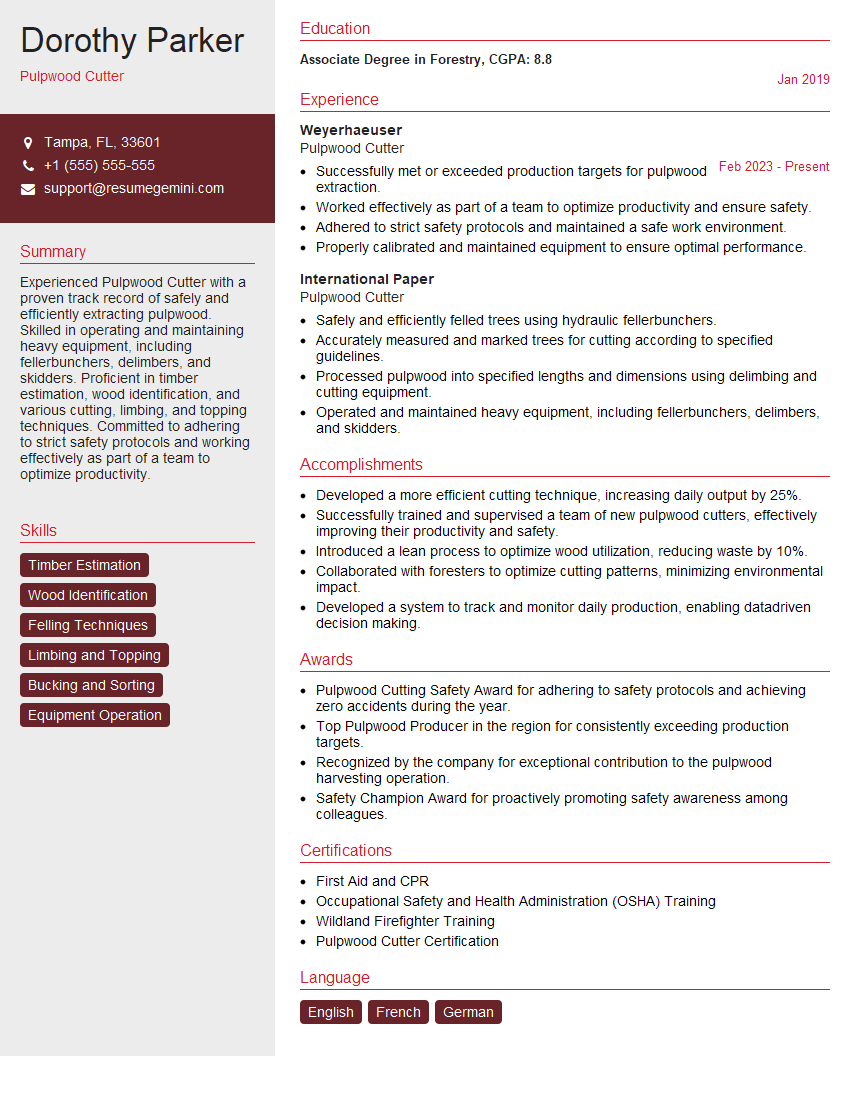
Dorothy Parker
Pulpwood Cutter
Summary
Experienced Pulpwood Cutter with a proven track record of safely and efficiently extracting pulpwood. Skilled in operating and maintaining heavy equipment, including fellerbunchers, delimbers, and skidders. Proficient in timber estimation, wood identification, and various cutting, limbing, and topping techniques. Committed to adhering to strict safety protocols and working effectively as part of a team to optimize productivity.
Education
Associate Degree in Forestry
January 2019
Skills
- Timber Estimation
- Wood Identification
- Felling Techniques
- Limbing and Topping
- Bucking and Sorting
- Equipment Operation
Work Experience
Pulpwood Cutter
- Successfully met or exceeded production targets for pulpwood extraction.
- Worked effectively as part of a team to optimize productivity and ensure safety.
- Adhered to strict safety protocols and maintained a safe work environment.
- Properly calibrated and maintained equipment to ensure optimal performance.
Pulpwood Cutter
- Safely and efficiently felled trees using hydraulic fellerbunchers.
- Accurately measured and marked trees for cutting according to specified guidelines.
- Processed pulpwood into specified lengths and dimensions using delimbing and cutting equipment.
- Operated and maintained heavy equipment, including fellerbunchers, delimbers, and skidders.
Accomplishments
- Developed a more efficient cutting technique, increasing daily output by 25%.
- Successfully trained and supervised a team of new pulpwood cutters, effectively improving their productivity and safety.
- Introduced a lean process to optimize wood utilization, reducing waste by 10%.
- Collaborated with foresters to optimize cutting patterns, minimizing environmental impact.
- Developed a system to track and monitor daily production, enabling datadriven decision making.
Awards
- Pulpwood Cutting Safety Award for adhering to safety protocols and achieving zero accidents during the year.
- Top Pulpwood Producer in the region for consistently exceeding production targets.
- Recognized by the company for exceptional contribution to the pulpwood harvesting operation.
- Safety Champion Award for proactively promoting safety awareness among colleagues.
Certificates
- First Aid and CPR
- Occupational Safety and Health Administration (OSHA) Training
- Wildland Firefighter Training
- Pulpwood Cutter Certification
Career Expert Tips:
- Select the ideal resume template to showcase your professional experience effectively.
- Master the art of resume writing to highlight your unique qualifications and achievements.
- Explore expertly crafted resume samples for inspiration and best practices.
- Build your best resume for free this new year with ResumeGemini. Enjoy exclusive discounts on ATS optimized resume templates.
How To Write Resume For Pulpwood Cutter
- Highlight your experience in operating and maintaining heavy equipment, including fellerbunchers, delimbers, and skidders.
- Quantify your accomplishments whenever possible, providing specific metrics that demonstrate your contributions to increased productivity or efficiency.
- Emphasize your adherence to safety protocols and your commitment to maintaining a safe work environment.
- Include keywords that are relevant to the pulpwood cutting industry, such as “timber estimation”, “wood identification”, and “cutting techniques”.
Essential Experience Highlights for a Strong Pulpwood Cutter Resume
- Safely and efficiently felled trees using hydraulic fellerbunchers.
- Accurately measured and marked trees for cutting according to specified guidelines.
- Processed pulpwood into specified lengths and dimensions using delimbing and cutting equipment.
- Operated and maintained heavy equipment, including fellerbunchers, delimbers, and skidders.
- Successfully met or exceeded production targets for pulpwood extraction.
- Worked effectively as part of a team to optimize productivity and ensure safety.
- Adhered to strict safety protocols and maintained a safe work environment.
- Properly calibrated and maintained equipment to ensure optimal performance.
Frequently Asked Questions (FAQ’s) For Pulpwood Cutter
What is the primary responsibility of a Pulpwood Cutter?
The primary responsibility of a Pulpwood Cutter is to safely and efficiently extract pulpwood from forests, using various cutting, limbing, and topping techniques, and operating and maintaining heavy equipment.
What are the essential skills required to be a successful Pulpwood Cutter?
Essential skills for Pulpwood Cutters include timber estimation, wood identification, felling techniques, limbing and topping, bucking and sorting, and equipment operation.
What type of education and training is recommended for Pulpwood Cutters?
While formal education requirements may vary, an Associate Degree in Forestry or a related field, combined with on-the-job training and experience, can provide a solid foundation for Pulpwood Cutters.
What is the expected work environment for a Pulpwood Cutter?
Pulpwood Cutters typically work in outdoor, forested environments, often in remote or rugged areas. They operate heavy equipment and engage in physical labor, so good physical fitness is essential.
What are the career advancement opportunities for Pulpwood Cutters?
With experience and additional training, Pulpwood Cutters may advance to supervisory or management roles within the forestry industry or related fields.
What safety precautions should Pulpwood Cutters prioritize?
Pulpwood Cutters must adhere to strict safety protocols, including proper use and maintenance of equipment, wearing appropriate safety gear, and following established cutting and felling techniques to minimize risks.