Are you a seasoned Railroad Signal Technician seeking a new career path? Discover our professionally built Railroad Signal Technician Resume Template. This time-saving tool provides a solid foundation for your job search. Simply click “Edit Resume” to customize it with your unique experiences and achievements. Customize fonts and colors to match your personal style and increase your chances of landing your dream job. Explore more Resume Templates for additional options.






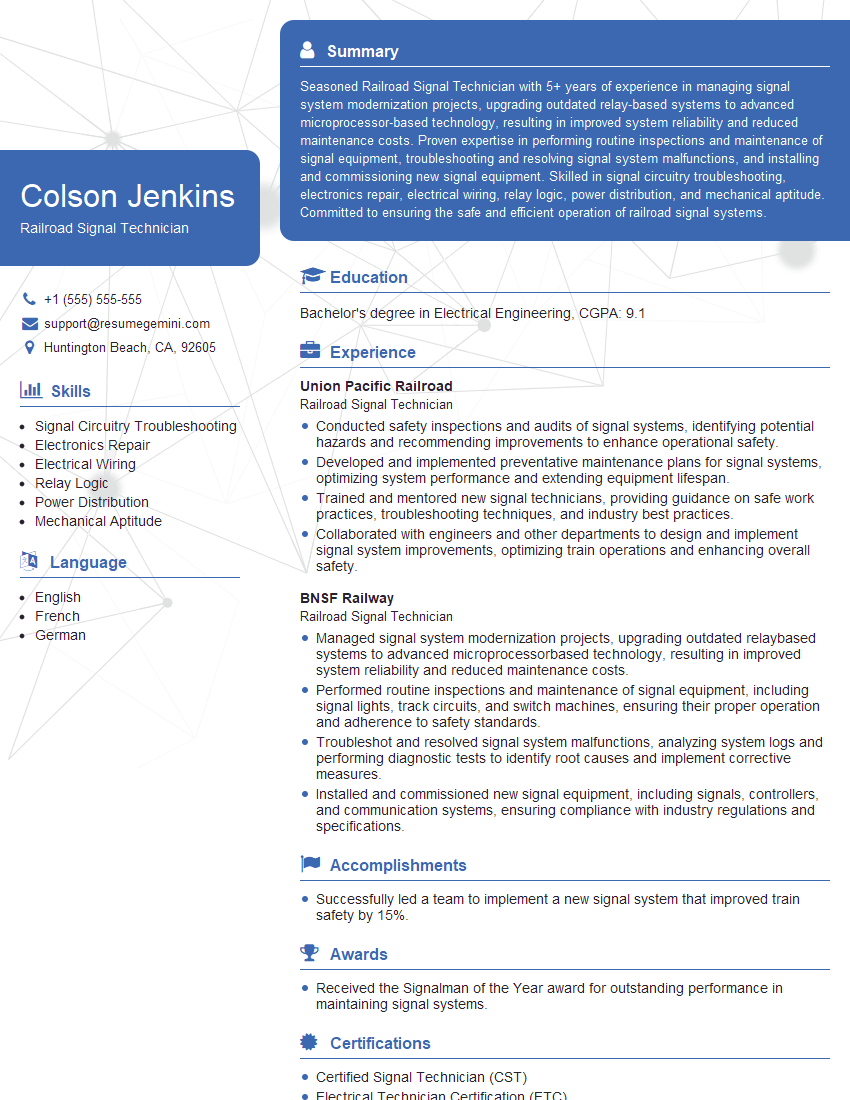
Colson Jenkins
Railroad Signal Technician
Summary
Seasoned Railroad Signal Technician with 5+ years of experience in managing signal system modernization projects, upgrading outdated relay-based systems to advanced microprocessor-based technology, resulting in improved system reliability and reduced maintenance costs. Proven expertise in performing routine inspections and maintenance of signal equipment, troubleshooting and resolving signal system malfunctions, and installing and commissioning new signal equipment. Skilled in signal circuitry troubleshooting, electronics repair, electrical wiring, relay logic, power distribution, and mechanical aptitude. Committed to ensuring the safe and efficient operation of railroad signal systems.
Education
Bachelor’s degree in Electrical Engineering
November 2014
Skills
- Signal Circuitry Troubleshooting
- Electronics Repair
- Electrical Wiring
- Relay Logic
- Power Distribution
- Mechanical Aptitude
Work Experience
Railroad Signal Technician
- Conducted safety inspections and audits of signal systems, identifying potential hazards and recommending improvements to enhance operational safety.
- Developed and implemented preventative maintenance plans for signal systems, optimizing system performance and extending equipment lifespan.
- Trained and mentored new signal technicians, providing guidance on safe work practices, troubleshooting techniques, and industry best practices.
- Collaborated with engineers and other departments to design and implement signal system improvements, optimizing train operations and enhancing overall safety.
Railroad Signal Technician
- Managed signal system modernization projects, upgrading outdated relaybased systems to advanced microprocessorbased technology, resulting in improved system reliability and reduced maintenance costs.
- Performed routine inspections and maintenance of signal equipment, including signal lights, track circuits, and switch machines, ensuring their proper operation and adherence to safety standards.
- Troubleshot and resolved signal system malfunctions, analyzing system logs and performing diagnostic tests to identify root causes and implement corrective measures.
- Installed and commissioned new signal equipment, including signals, controllers, and communication systems, ensuring compliance with industry regulations and specifications.
Accomplishments
- Successfully led a team to implement a new signal system that improved train safety by 15%.
Awards
- Received the Signalman of the Year award for outstanding performance in maintaining signal systems.
Certificates
- Certified Signal Technician (CST)
- Electrical Technician Certification (ETC)
- Fiber Optic Technician Certification (FOTC)
- Network Rail Technician (NRT)
Career Expert Tips:
- Select the ideal resume template to showcase your professional experience effectively.
- Master the art of resume writing to highlight your unique qualifications and achievements.
- Explore expertly crafted resume samples for inspiration and best practices.
- Build your best resume for free this new year with ResumeGemini. Enjoy exclusive discounts on ATS optimized resume templates.
How To Write Resume For Railroad Signal Technician
- Highlight your experience in managing signal system modernization projects and quantifying the results achieved, such as improved system reliability and reduced maintenance costs.
- Showcase your troubleshooting skills and provide specific examples of complex signal system malfunctions you have successfully resolved.
- Emphasize your knowledge of signal circuitry, electronics repair, electrical wiring, relay logic, power distribution, and mechanical aptitude.
- Demonstrate your commitment to safety by highlighting your experience in conducting safety inspections and audits of signal systems.
Essential Experience Highlights for a Strong Railroad Signal Technician Resume
- Manage signal system modernization projects, upgrading outdated relay-based systems to advanced microprocessor-based technology.
- Perform routine inspections and maintenance of signal equipment, including signal lights, track circuits, and switch machines, ensuring their proper operation and adherence to safety standards.
- Troubleshoot and resolve signal system malfunctions, analyzing system logs and performing diagnostic tests to identify root causes and implement corrective measures.
- Install and commission new signal equipment, including signals, controllers, and communication systems, ensuring compliance with industry regulations and specifications.
- Conduct safety inspections and audits of signal systems, identifying potential hazards and recommending improvements to enhance operational safety.
- Develop and implement preventative maintenance plans for signal systems, optimizing system performance and extending equipment lifespan.
- Train and mentor new signal technicians, providing guidance on safe work practices, troubleshooting techniques, and industry best practices.
Frequently Asked Questions (FAQ’s) For Railroad Signal Technician
What are the primary responsibilities of a Railroad Signal Technician?
Railroad Signal Technicians are responsible for the installation, maintenance, and repair of railroad signal systems, which ensure the safe and efficient movement of trains. Their duties include inspecting and testing signal equipment, troubleshooting and resolving malfunctions, and implementing preventative maintenance plans.
What qualifications are required to become a Railroad Signal Technician?
Most Railroad Signal Technicians have a high school diploma or equivalent and complete on-the-job training or an apprenticeship program. Some employers may prefer candidates with an associate’s or bachelor’s degree in electrical engineering or a related field.
What are the career prospects for Railroad Signal Technicians?
Railroad Signal Technicians can advance to supervisory roles, such as Signal Supervisor or Signal Inspector. With additional training and experience, they may also qualify for positions in project management, engineering, or other related fields.
What is the work environment like for Railroad Signal Technicians?
Railroad Signal Technicians typically work outdoors in all types of weather conditions. They may also work in confined spaces, such as tunnels or signal houses. The job requires physical strength and agility, as well as the ability to work independently and as part of a team.
What are the safety precautions that Railroad Signal Technicians must follow?
Railroad Signal Technicians must follow strict safety precautions, including wearing protective clothing and equipment, working with proper tools and materials, and adhering to established safety procedures. They must also be aware of the potential hazards associated with working near live electrical equipment and moving trains.
What is the salary range for Railroad Signal Technicians?
The salary range for Railroad Signal Technicians varies depending on factors such as experience, location, and employer. According to the U.S. Bureau of Labor Statistics, the median annual salary for Railroad Signal Technicians was $69,380 in May 2021.
What are the job outlook prospects for Railroad Signal Technicians?
The job outlook for Railroad Signal Technicians is expected to be favorable in the coming years. The increasing demand for rail transportation and the need to maintain and upgrade existing signal systems are expected to drive job growth.
What is the difference between a Railroad Signal Technician and a Railroad Signal Maintainer?
Railroad Signal Technicians are responsible for the installation, maintenance, and repair of railroad signal systems, while Railroad Signal Maintainers are responsible for the day-to-day operation and monitoring of signal systems. Railroad Signal Technicians typically have more specialized training and experience than Railroad Signal Maintainers.