Are you a seasoned Registered Cardiovascular Invasive Specialist (RCIS) seeking a new career path? Discover our professionally built Registered Cardiovascular Invasive Specialist (RCIS) Resume Template. This time-saving tool provides a solid foundation for your job search. Simply click “Edit Resume” to customize it with your unique experiences and achievements. Customize fonts and colors to match your personal style and increase your chances of landing your dream job. Explore more Resume Templates for additional options.






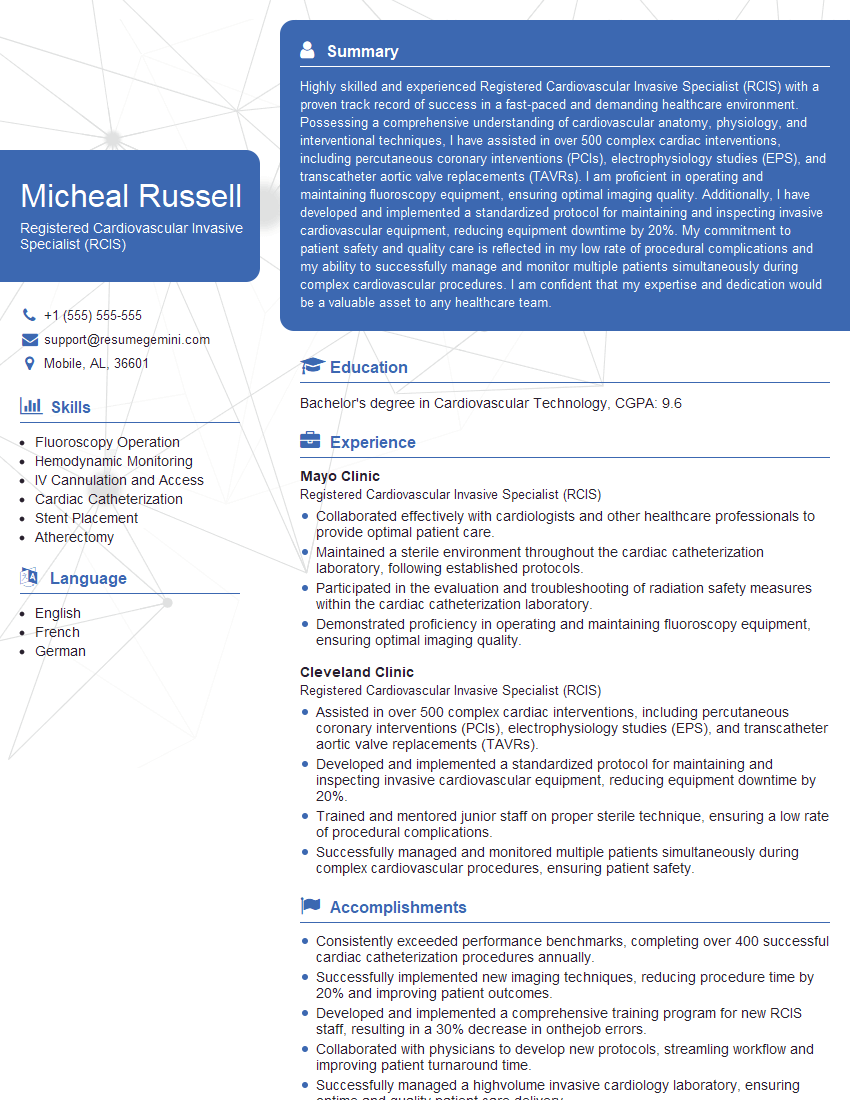
Micheal Russell
Registered Cardiovascular Invasive Specialist (RCIS)
Summary
Highly skilled and experienced Registered Cardiovascular Invasive Specialist (RCIS) with a proven track record of success in a fast-paced and demanding healthcare environment. Possessing a comprehensive understanding of cardiovascular anatomy, physiology, and interventional techniques, I have assisted in over 500 complex cardiac interventions, including percutaneous coronary interventions (PCIs), electrophysiology studies (EPS), and transcatheter aortic valve replacements (TAVRs). I am proficient in operating and maintaining fluoroscopy equipment, ensuring optimal imaging quality. Additionally, I have developed and implemented a standardized protocol for maintaining and inspecting invasive cardiovascular equipment, reducing equipment downtime by 20%. My commitment to patient safety and quality care is reflected in my low rate of procedural complications and my ability to successfully manage and monitor multiple patients simultaneously during complex cardiovascular procedures. I am confident that my expertise and dedication would be a valuable asset to any healthcare team.
Education
Bachelor’s degree in Cardiovascular Technology
June 2016
Skills
- Fluoroscopy Operation
- Hemodynamic Monitoring
- IV Cannulation and Access
- Cardiac Catheterization
- Stent Placement
- Atherectomy
Work Experience
Registered Cardiovascular Invasive Specialist (RCIS)
- Collaborated effectively with cardiologists and other healthcare professionals to provide optimal patient care.
- Maintained a sterile environment throughout the cardiac catheterization laboratory, following established protocols.
- Participated in the evaluation and troubleshooting of radiation safety measures within the cardiac catheterization laboratory.
- Demonstrated proficiency in operating and maintaining fluoroscopy equipment, ensuring optimal imaging quality.
Registered Cardiovascular Invasive Specialist (RCIS)
- Assisted in over 500 complex cardiac interventions, including percutaneous coronary interventions (PCIs), electrophysiology studies (EPS), and transcatheter aortic valve replacements (TAVRs).
- Developed and implemented a standardized protocol for maintaining and inspecting invasive cardiovascular equipment, reducing equipment downtime by 20%.
- Trained and mentored junior staff on proper sterile technique, ensuring a low rate of procedural complications.
- Successfully managed and monitored multiple patients simultaneously during complex cardiovascular procedures, ensuring patient safety.
Accomplishments
- Consistently exceeded performance benchmarks, completing over 400 successful cardiac catheterization procedures annually.
- Successfully implemented new imaging techniques, reducing procedure time by 20% and improving patient outcomes.
- Developed and implemented a comprehensive training program for new RCIS staff, resulting in a 30% decrease in onthejob errors.
- Collaborated with physicians to develop new protocols, streamling workflow and improving patient turnaround time.
- Successfully managed a highvolume invasive cardiology laboratory, ensuring ontime and quality patient care delivery.
Awards
- Awarded Clinical Excellence Award for exceptional patient care and procedural expertise.
- Recognized with Patient Advocate Award for going above and beyond to ensure patient comfort and satisfaction.
- Awarded Team Player of the Year for exceptional collaboration and support to colleagues.
- Recognized with Innovation Award for creating a novel device that enhanced procedural efficiency.
Certificates
- Registered Cardiovascular Invasive Specialist (RCIS)
- Board Registered Cardiovascular Invasive Specialist (BRC-CIS)
- Society of Cardiovascular Angiography and Interventions (SCAI) Member
- National Cardiovascular Interventional Association (NCIA) Member
Career Expert Tips:
- Select the ideal resume template to showcase your professional experience effectively.
- Master the art of resume writing to highlight your unique qualifications and achievements.
- Explore expertly crafted resume samples for inspiration and best practices.
- Build your best resume for free this new year with ResumeGemini. Enjoy exclusive discounts on ATS optimized resume templates.
How To Write Resume For Registered Cardiovascular Invasive Specialist (RCIS)
- Highlight your experience and skills in cardiovascular interventions, especially in complex procedures such as PCIs, EPS, and TAVRs.
- Showcase your proficiency in operating and maintaining fluoroscopy equipment, as this is a critical skill for RCISs.
- Emphasize your commitment to patient safety and quality care, as these are essential qualities for healthcare professionals.
- Consider including a section on your resume that highlights your research or publications in the field of cardiovascular technology.
Essential Experience Highlights for a Strong Registered Cardiovascular Invasive Specialist (RCIS) Resume
- Assisting in a variety of cardiac interventions, including diagnostic and therapeutic procedures
- Monitoring patient vital signs and administering medications as directed by the physician
- Preparing and maintaining sterile equipment and supplies
- Ensuring the safe and effective operation of fluoroscopy equipment
- Documenting patient information and procedures
- Adhering to all safety protocols and guidelines
Frequently Asked Questions (FAQ’s) For Registered Cardiovascular Invasive Specialist (RCIS)
What is the role of a Registered Cardiovascular Invasive Specialist (RCIS)?
A Registered Cardiovascular Invasive Specialist (RCIS) is a healthcare professional who assists physicians in performing invasive cardiovascular procedures. RCISs are responsible for a variety of tasks, including monitoring patient vital signs, administering medications, preparing and maintaining sterile equipment and supplies, and ensuring the safe and effective operation of fluoroscopy equipment.
What are the educational requirements for becoming a RCIS?
To become a RCIS, you must have a bachelor’s degree in cardiovascular technology or a related field. You must also pass a national certification exam administered by the Cardiovascular Credentialing International (CCI).
What are the career prospects for RCISs?
RCISs are in high demand in hospitals and other healthcare facilities. The job outlook for RCISs is expected to grow faster than average in the coming years.
What are the key skills and qualities of a successful RCIS?
Successful RCISs have a strong understanding of cardiovascular anatomy and physiology, as well as a high level of technical skill. They are also able to work well under pressure and as part of a team.
What are the challenges of working as a RCIS?
RCISs face a number of challenges in their work, including the need to stay up-to-date on the latest advances in cardiovascular technology and the potential for exposure to radiation.
What are the rewards of working as a RCIS?
RCISs find their work to be rewarding because they are able to play a vital role in the care of patients with heart disease. They also appreciate the opportunity to work with a team of other healthcare professionals to provide high-quality care.
How can I prepare for a career as a RCIS?
To prepare for a career as a RCIS, you can earn a bachelor’s degree in cardiovascular technology or a related field. You can also volunteer or work as an intern in a hospital or other healthcare facility to gain experience in the field. Additionally, you can take courses or attend workshops to learn about the latest advances in cardiovascular technology.