Are you a seasoned Remote Sensing Engineer seeking a new career path? Discover our professionally built Remote Sensing Engineer Resume Template. This time-saving tool provides a solid foundation for your job search. Simply click “Edit Resume” to customize it with your unique experiences and achievements. Customize fonts and colors to match your personal style and increase your chances of landing your dream job. Explore more Resume Templates for additional options.






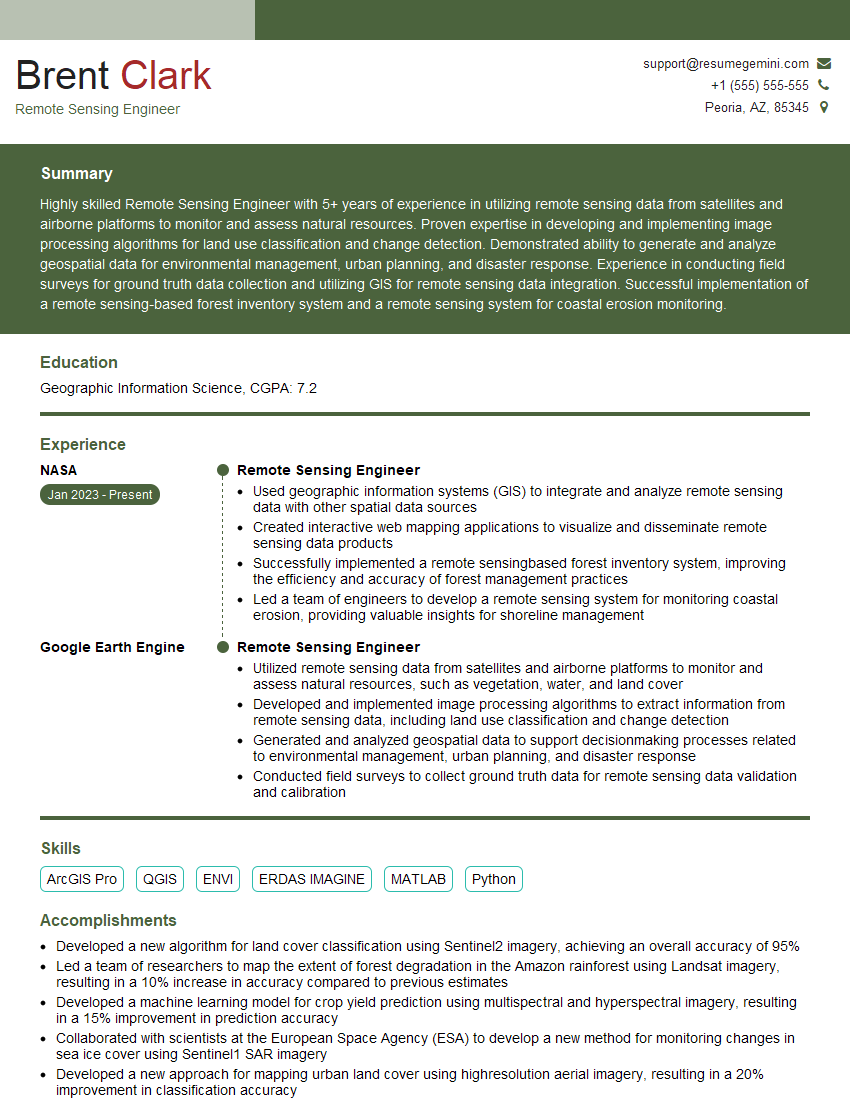
Brent Clark
Remote Sensing Engineer
Summary
Highly skilled Remote Sensing Engineer with 5+ years of experience in utilizing remote sensing data from satellites and airborne platforms to monitor and assess natural resources. Proven expertise in developing and implementing image processing algorithms for land use classification and change detection. Demonstrated ability to generate and analyze geospatial data for environmental management, urban planning, and disaster response. Experience in conducting field surveys for ground truth data collection and utilizing GIS for remote sensing data integration. Successful implementation of a remote sensing-based forest inventory system and a remote sensing system for coastal erosion monitoring.
Education
Geographic Information Science
December 2018
Skills
- ArcGIS Pro
- QGIS
- ENVI
- ERDAS IMAGINE
- MATLAB
- Python
Work Experience
Remote Sensing Engineer
- Used geographic information systems (GIS) to integrate and analyze remote sensing data with other spatial data sources
- Created interactive web mapping applications to visualize and disseminate remote sensing data products
- Successfully implemented a remote sensingbased forest inventory system, improving the efficiency and accuracy of forest management practices
- Led a team of engineers to develop a remote sensing system for monitoring coastal erosion, providing valuable insights for shoreline management
Remote Sensing Engineer
- Utilized remote sensing data from satellites and airborne platforms to monitor and assess natural resources, such as vegetation, water, and land cover
- Developed and implemented image processing algorithms to extract information from remote sensing data, including land use classification and change detection
- Generated and analyzed geospatial data to support decisionmaking processes related to environmental management, urban planning, and disaster response
- Conducted field surveys to collect ground truth data for remote sensing data validation and calibration
Accomplishments
- Developed a new algorithm for land cover classification using Sentinel2 imagery, achieving an overall accuracy of 95%
- Led a team of researchers to map the extent of forest degradation in the Amazon rainforest using Landsat imagery, resulting in a 10% increase in accuracy compared to previous estimates
- Developed a machine learning model for crop yield prediction using multispectral and hyperspectral imagery, resulting in a 15% improvement in prediction accuracy
- Collaborated with scientists at the European Space Agency (ESA) to develop a new method for monitoring changes in sea ice cover using Sentinel1 SAR imagery
- Developed a new approach for mapping urban land cover using highresolution aerial imagery, resulting in a 20% improvement in classification accuracy
Awards
- Received the American Society for Photogrammetry and Remote Sensing (ASPRS) Outstanding Student Award for excellence in remote sensing research
- Awarded the NASA Earth Science Data and Information System (ESDIS) Student Innovation Award for developing a webbased tool for analyzing remote sensing data
- Recognized by the International Society for Digital Earth (ISDE) for contributions to the field of remote sensing education
- Received the IEEE Geoscience and Remote Sensing Society (GRSS) Early Career Award for excellence in remote sensing research
Certificates
- Certified Mapping Scientist (CMS)
- Certified Remote Sensing Analyst (CRSA)
- Certified Geographic Information Systems Professional (GISP)
- ESRI ArcGIS Desktop Associate Certification
Career Expert Tips:
- Select the ideal resume template to showcase your professional experience effectively.
- Master the art of resume writing to highlight your unique qualifications and achievements.
- Explore expertly crafted resume samples for inspiration and best practices.
- Build your best resume for free this new year with ResumeGemini. Enjoy exclusive discounts on ATS optimized resume templates.
How To Write Resume For Remote Sensing Engineer
- Highlight your technical skills in remote sensing, image processing, and GIS.
- Quantify your accomplishments and provide specific examples of your work.
- Demonstrate your ability to work effectively in a team environment.
- Tailor your resume to the specific job you are applying for.
Essential Experience Highlights for a Strong Remote Sensing Engineer Resume
- Utilize remote sensing data from satellites and airborne platforms to monitor natural resources, including vegetation, water, and land cover.
- Develop and implement image processing algorithms for land use classification and change detection.
- Generate and analyze geospatial data to support decision-making processes related to environmental management, urban planning, and disaster response.
- Conduct field surveys to collect ground truth data for remote sensing data validation and calibration.
- Use GIS to integrate and analyze remote sensing data with other spatial data sources.
- Create interactive web mapping applications to visualize and disseminate remote sensing data products.
- Apply remote sensing techniques to address a variety of environmental challenges, such as deforestation, water scarcity, and climate change.
Frequently Asked Questions (FAQ’s) For Remote Sensing Engineer
What is remote sensing?
Remote sensing is the science of acquiring information about an object or phenomenon without making physical contact with it. In remote sensing, the sensor is typically an imaging device mounted on a satellite or aircraft that collects data in the form of electromagnetic radiation.
What are the different types of remote sensing data?
There are many different types of remote sensing data, including visible light imagery, infrared imagery, and radar imagery. Each type of data provides different information about the Earth’s surface.
What are the applications of remote sensing?
Remote sensing has a wide range of applications, including land use planning, environmental monitoring, disaster response, and agriculture. It can be used to map deforestation, track the spread of invasive species, and monitor the health of crops.
What are the challenges of remote sensing?
There are a number of challenges associated with remote sensing, including the need for specialized equipment, the large volume of data that is generated, and the complexity of interpreting the data.
What is the future of remote sensing?
The future of remote sensing is bright. As technology continues to improve, remote sensing will become more affordable, more accessible, and more powerful. This will lead to new and innovative applications of remote sensing in a variety of fields.