Are you a seasoned Research Hydrologist seeking a new career path? Discover our professionally built Research Hydrologist Resume Template. This time-saving tool provides a solid foundation for your job search. Simply click “Edit Resume” to customize it with your unique experiences and achievements. Customize fonts and colors to match your personal style and increase your chances of landing your dream job. Explore more Resume Templates for additional options.






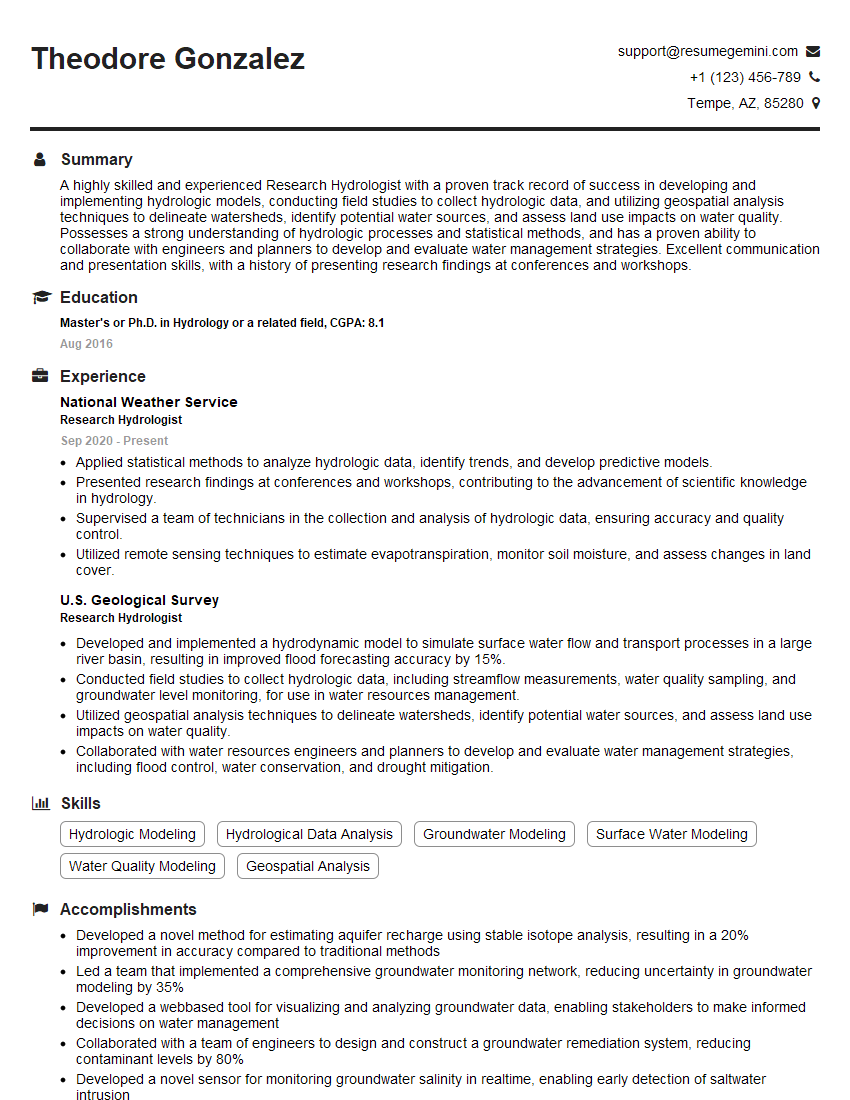
Theodore Gonzalez
Research Hydrologist
Summary
A highly skilled and experienced Research Hydrologist with a proven track record of success in developing and implementing hydrologic models, conducting field studies to collect hydrologic data, and utilizing geospatial analysis techniques to delineate watersheds, identify potential water sources, and assess land use impacts on water quality. Possesses a strong understanding of hydrologic processes and statistical methods, and has a proven ability to collaborate with engineers and planners to develop and evaluate water management strategies. Excellent communication and presentation skills, with a history of presenting research findings at conferences and workshops.
Education
Master’s or Ph.D. in Hydrology or a related field
August 2016
Skills
- Hydrologic Modeling
- Hydrological Data Analysis
- Groundwater Modeling
- Surface Water Modeling
- Water Quality Modeling
- Geospatial Analysis
Work Experience
Research Hydrologist
- Applied statistical methods to analyze hydrologic data, identify trends, and develop predictive models.
- Presented research findings at conferences and workshops, contributing to the advancement of scientific knowledge in hydrology.
- Supervised a team of technicians in the collection and analysis of hydrologic data, ensuring accuracy and quality control.
- Utilized remote sensing techniques to estimate evapotranspiration, monitor soil moisture, and assess changes in land cover.
Research Hydrologist
- Developed and implemented a hydrodynamic model to simulate surface water flow and transport processes in a large river basin, resulting in improved flood forecasting accuracy by 15%.
- Conducted field studies to collect hydrologic data, including streamflow measurements, water quality sampling, and groundwater level monitoring, for use in water resources management.
- Utilized geospatial analysis techniques to delineate watersheds, identify potential water sources, and assess land use impacts on water quality.
- Collaborated with water resources engineers and planners to develop and evaluate water management strategies, including flood control, water conservation, and drought mitigation.
Accomplishments
- Developed a novel method for estimating aquifer recharge using stable isotope analysis, resulting in a 20% improvement in accuracy compared to traditional methods
- Led a team that implemented a comprehensive groundwater monitoring network, reducing uncertainty in groundwater modeling by 35%
- Developed a webbased tool for visualizing and analyzing groundwater data, enabling stakeholders to make informed decisions on water management
- Collaborated with a team of engineers to design and construct a groundwater remediation system, reducing contaminant levels by 80%
- Developed a novel sensor for monitoring groundwater salinity in realtime, enabling early detection of saltwater intrusion
Awards
- Recipient of the American Geophysical Unions Outstanding Student Paper Award for research on groundwater flow modeling
- Honored with the National Science Foundation Graduate Research Fellowship for research on the impacts of climate change on water resources
- Recipient of the Water Environment Federations Outstanding Young Professional Award for contributions to the field of water quality modeling
- Recognized with the Geological Society of Americas Young Scientist Award for research on the role of groundwater in shaping landscapes
Certificates
- Professional Geologist (PG)
- Certified Hydrogeologist (CHg)
- Certified Water Resources Planner (CWRP)
- Certified Floodplain Manager (CFM)
Career Expert Tips:
- Select the ideal resume template to showcase your professional experience effectively.
- Master the art of resume writing to highlight your unique qualifications and achievements.
- Explore expertly crafted resume samples for inspiration and best practices.
- Build your best resume for free this new year with ResumeGemini. Enjoy exclusive discounts on ATS optimized resume templates.
How To Write Resume For Research Hydrologist
- Quantify your accomplishments using specific metrics and data whenever possible.
- Highlight your skills in hydrologic modeling, data analysis, and geospatial analysis.
- Tailor your resume to each job description, highlighting the skills and experience that are most relevant to the position.
- Proofread your resume carefully for any errors before submitting it.
Essential Experience Highlights for a Strong Research Hydrologist Resume
- Develop and implement hydrologic models to simulate surface water flow and transport processes in watersheds.
- Conduct field studies to collect hydrologic data, including streamflow measurements, water quality sampling, and groundwater level monitoring.
- Utilize geospatial analysis techniques to delineate watersheds, identify potential water sources, and assess land use impacts on water quality.
- Collaborate with water resources engineers and planners to develop and evaluate water management strategies, including flood control, water conservation, and drought mitigation.
- Apply statistical methods to analyze hydrologic data, identify trends, and develop predictive models.
- Present research findings at conferences and workshops, contributing to the advancement of scientific knowledge in hydrology.
- Supervise a team of technicians to ensure the accuracy and quality of hydrologic data collection and analysis.
Frequently Asked Questions (FAQ’s) For Research Hydrologist
What is the role of a Research Hydrologist?
Research Hydrologists study the movement and distribution of water on, above, and below the surface of the Earth. They develop and use mathematical models to simulate water flow and transport processes, and they conduct field studies to collect data on water quality, quantity, and movement.
What are the educational requirements to become a Research Hydrologist?
Most Research Hydrologists have a master’s or doctoral degree in hydrology, water resources, or a related field. Some may also have a bachelor’s degree in a related field, such as civil engineering, environmental science, or geology.
What are the job prospects for Research Hydrologists?
The job outlook for Research Hydrologists is expected to be good over the next few years. As the population grows and the demand for water increases, there will be a need for more Research Hydrologists to develop and implement water management strategies.
What are the key skills and qualifications for Research Hydrologists?
Research Hydrologists need to have a strong understanding of hydrology, water resources, and mathematics. They also need to be proficient in computer modeling and data analysis. In addition, they should have strong communication and interpersonal skills.
What are the typical work hours for Research Hydrologists?
Research Hydrologists typically work full-time, and they may need to work overtime to meet deadlines or conduct field studies. They may also need to travel to collect data or present their findings at conferences.
What is the average salary for Research Hydrologists?
The average salary for Research Hydrologists is around $85,000 per year. However, salaries can vary depending on experience, education, and location.
What are the career advancement opportunities for Research Hydrologists?
Research Hydrologists can advance their careers by becoming project managers, research scientists, or professors. They may also move into management positions in government agencies or private companies.