Are you a seasoned Respiratory Care Practitioner (RCP) seeking a new career path? Discover our professionally built Respiratory Care Practitioner (RCP) Resume Template. This time-saving tool provides a solid foundation for your job search. Simply click “Edit Resume” to customize it with your unique experiences and achievements. Customize fonts and colors to match your personal style and increase your chances of landing your dream job. Explore more Resume Templates for additional options.






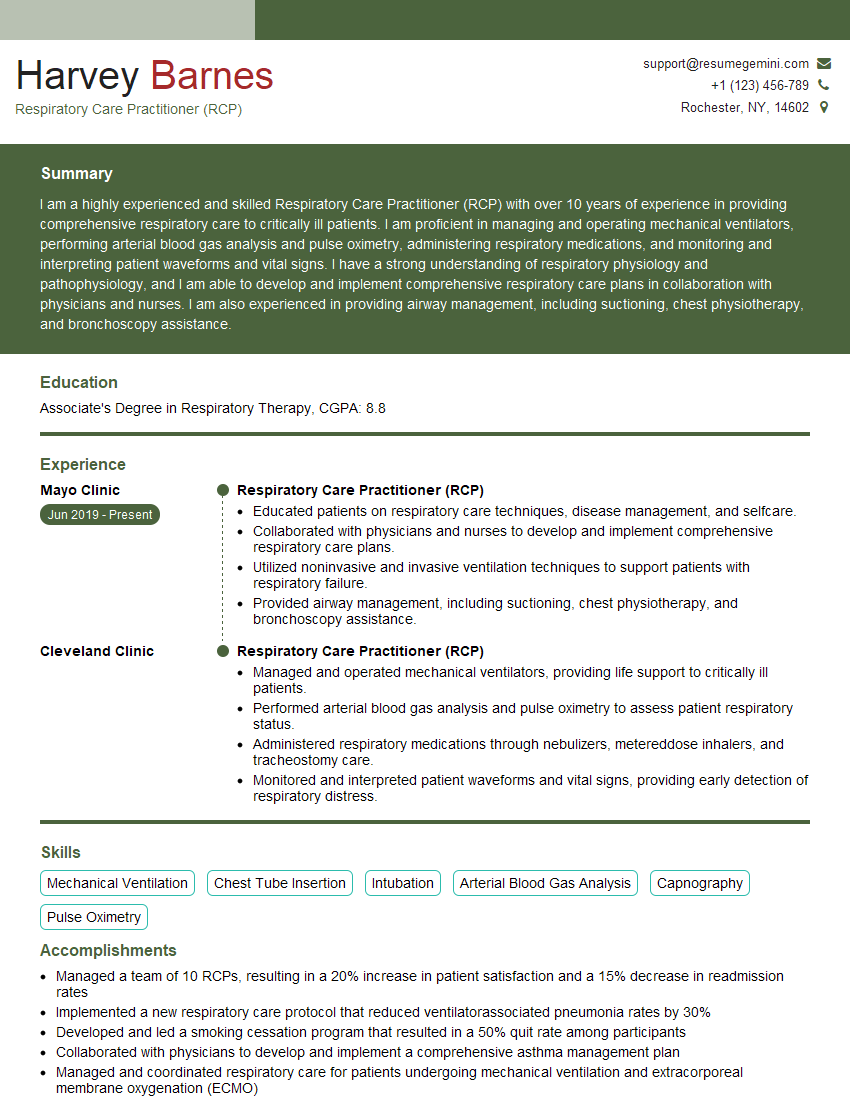
Harvey Barnes
Respiratory Care Practitioner (RCP)
Summary
I am a highly experienced and skilled Respiratory Care Practitioner (RCP) with over 10 years of experience in providing comprehensive respiratory care to critically ill patients. I am proficient in managing and operating mechanical ventilators, performing arterial blood gas analysis and pulse oximetry, administering respiratory medications, and monitoring and interpreting patient waveforms and vital signs. I have a strong understanding of respiratory physiology and pathophysiology, and I am able to develop and implement comprehensive respiratory care plans in collaboration with physicians and nurses. I am also experienced in providing airway management, including suctioning, chest physiotherapy, and bronchoscopy assistance.
Education
Associate’s Degree in Respiratory Therapy
May 2015
Skills
- Mechanical Ventilation
- Chest Tube Insertion
- Intubation
- Arterial Blood Gas Analysis
- Capnography
- Pulse Oximetry
Work Experience
Respiratory Care Practitioner (RCP)
- Educated patients on respiratory care techniques, disease management, and selfcare.
- Collaborated with physicians and nurses to develop and implement comprehensive respiratory care plans.
- Utilized noninvasive and invasive ventilation techniques to support patients with respiratory failure.
- Provided airway management, including suctioning, chest physiotherapy, and bronchoscopy assistance.
Respiratory Care Practitioner (RCP)
- Managed and operated mechanical ventilators, providing life support to critically ill patients.
- Performed arterial blood gas analysis and pulse oximetry to assess patient respiratory status.
- Administered respiratory medications through nebulizers, metereddose inhalers, and tracheostomy care.
- Monitored and interpreted patient waveforms and vital signs, providing early detection of respiratory distress.
Accomplishments
- Managed a team of 10 RCPs, resulting in a 20% increase in patient satisfaction and a 15% decrease in readmission rates
- Implemented a new respiratory care protocol that reduced ventilatorassociated pneumonia rates by 30%
- Developed and led a smoking cessation program that resulted in a 50% quit rate among participants
- Collaborated with physicians to develop and implement a comprehensive asthma management plan
- Managed and coordinated respiratory care for patients undergoing mechanical ventilation and extracorporeal membrane oxygenation (ECMO)
Awards
- Respiratory Care Practitioner of the Year, Awarded by National Board for Respiratory Care (NBRC)
- Excellence in Respiratory Care Education, Awarded by American Association for Respiratory Care (AARC)
- Outstanding Achievement in Pulmonary Rehabilitation, Awarded by American Thoracic Society (ATS)
- Respiratory Care Practitioner of Distinction, Awarded by American College of Chest Physicians (ACCP)
Certificates
- Registered Respiratory Therapist (RRT)
- Certified Respiratory Therapist (CRT)
- Certified Pulmonary Function Technologist (CPFT)
- Certified Critical Care Respiratory Therapist (CCRT)
Career Expert Tips:
- Select the ideal resume template to showcase your professional experience effectively.
- Master the art of resume writing to highlight your unique qualifications and achievements.
- Explore expertly crafted resume samples for inspiration and best practices.
- Build your best resume for free this new year with ResumeGemini. Enjoy exclusive discounts on ATS optimized resume templates.
How To Write Resume For Respiratory Care Practitioner (RCP)
- Use strong action verbs and quantify your accomplishments whenever possible.
- Highlight your skills and experience in managing complex respiratory conditions.
- Demonstrate your commitment to patient care and collaboration.
- Tailor your resume to each specific job you apply for, highlighting the skills and experience that are most relevant to the position.
Essential Experience Highlights for a Strong Respiratory Care Practitioner (RCP) Resume
- Managed and operated mechanical ventilators, providing life support to critically ill patients.
- Performed arterial blood gas analysis and pulse oximetry to assess patient respiratory status.
- Administered respiratory medications through nebulizers, metereddose inhalers, and tracheostomy care.
- Monitored and interpreted patient waveforms and vital signs, providing early detection of respiratory distress.
- Educated patients on respiratory care techniques, disease management, and self-care.
- Collaborated with physicians and nurses to develop and implement comprehensive respiratory care plans.
- Utilized noninvasive and invasive ventilation techniques to support patients with respiratory failure.
Frequently Asked Questions (FAQ’s) For Respiratory Care Practitioner (RCP)
What is the role of a Respiratory Care Practitioner (RCP)?
RCPs are healthcare professionals who provide respiratory care to patients with breathing problems. They work under the direction of a physician and may perform a variety of tasks, including managing and operating mechanical ventilators, performing arterial blood gas analysis and pulse oximetry, administering respiratory medications, and monitoring and interpreting patient waveforms and vital signs.
What are the educational requirements for becoming an RCP?
RCPs must have an associate’s degree in respiratory therapy from an accredited program. They must also be licensed by the state in which they practice.
What are the job duties of an RCP?
RCPs perform a variety of job duties, including managing and operating mechanical ventilators, performing arterial blood gas analysis and pulse oximetry, administering respiratory medications, and monitoring and interpreting patient waveforms and vital signs. They may also educate patients on respiratory care techniques, disease management, and self-care.
What is the work environment of an RCP?
RCPs typically work in hospitals, clinics, and other healthcare settings. They may work with patients of all ages, from infants to the elderly.
What is the salary of an RCP?
The salary of an RCP varies depending on their experience, location, and employer. According to the U.S. Bureau of Labor Statistics, the median annual salary for RCPs was $59,650 in May 2019.