Are you a seasoned Rheologist seeking a new career path? Discover our professionally built Rheologist Resume Template. This time-saving tool provides a solid foundation for your job search. Simply click “Edit Resume” to customize it with your unique experiences and achievements. Customize fonts and colors to match your personal style and increase your chances of landing your dream job. Explore more Resume Templates for additional options.






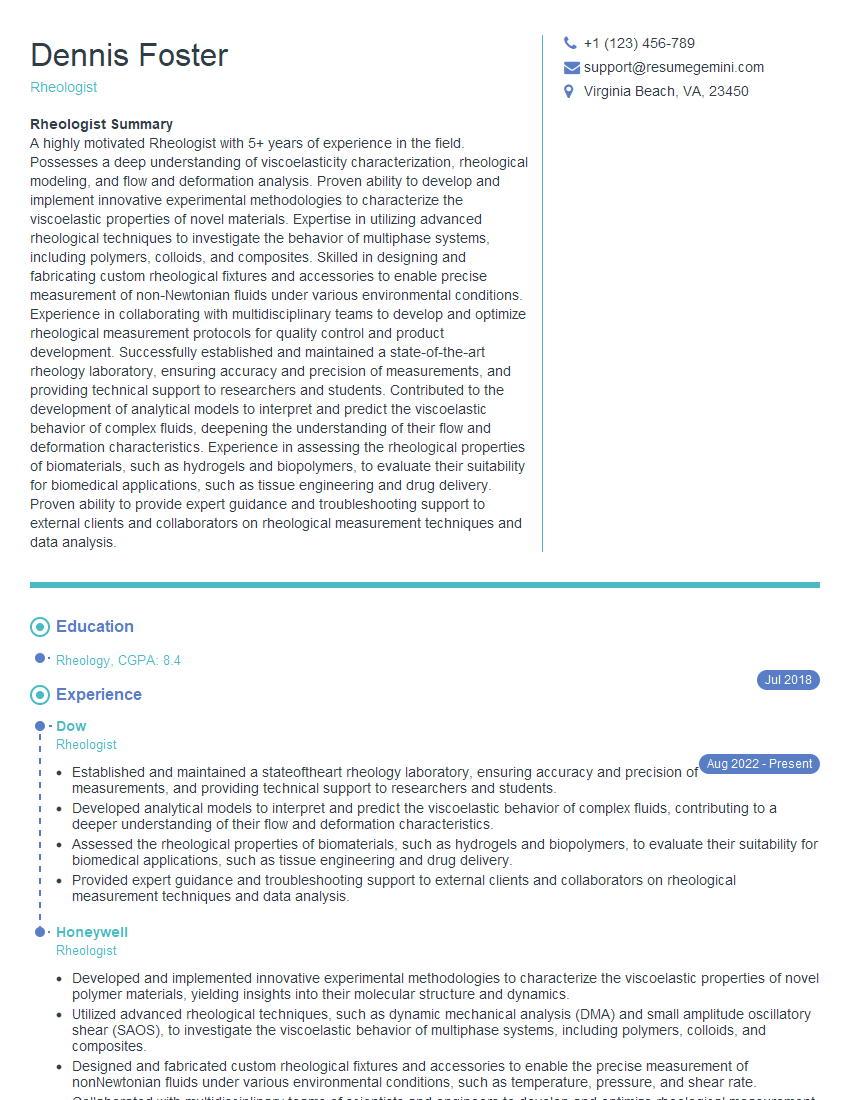
Dennis Foster
Rheologist
Summary
Rheologist Summary
A highly motivated Rheologist with 5+ years of experience in the field. Possesses a deep understanding of viscoelasticity characterization, rheological modeling, and flow and deformation analysis. Proven ability to develop and implement innovative experimental methodologies to characterize the viscoelastic properties of novel materials. Expertise in utilizing advanced rheological techniques to investigate the behavior of multiphase systems, including polymers, colloids, and composites. Skilled in designing and fabricating custom rheological fixtures and accessories to enable precise measurement of non-Newtonian fluids under various environmental conditions. Experience in collaborating with multidisciplinary teams to develop and optimize rheological measurement protocols for quality control and product development. Successfully established and maintained a state-of-the-art rheology laboratory, ensuring accuracy and precision of measurements, and providing technical support to researchers and students. Contributed to the development of analytical models to interpret and predict the viscoelastic behavior of complex fluids, deepening the understanding of their flow and deformation characteristics. Experience in assessing the rheological properties of biomaterials, such as hydrogels and biopolymers, to evaluate their suitability for biomedical applications, such as tissue engineering and drug delivery. Proven ability to provide expert guidance and troubleshooting support to external clients and collaborators on rheological measurement techniques and data analysis.
Education
Rheology
July 2018
Skills
- Viscoelasticity Characterization
- Rheological Modeling
- Flow and Deformation Analysis
- Material Characterization
- Data Interpretation and Analysis
- Rheometer Operation and Calibration
Work Experience
Rheologist
- Established and maintained a stateoftheart rheology laboratory, ensuring accuracy and precision of measurements, and providing technical support to researchers and students.
- Developed analytical models to interpret and predict the viscoelastic behavior of complex fluids, contributing to a deeper understanding of their flow and deformation characteristics.
- Assessed the rheological properties of biomaterials, such as hydrogels and biopolymers, to evaluate their suitability for biomedical applications, such as tissue engineering and drug delivery.
- Provided expert guidance and troubleshooting support to external clients and collaborators on rheological measurement techniques and data analysis.
Rheologist
- Developed and implemented innovative experimental methodologies to characterize the viscoelastic properties of novel polymer materials, yielding insights into their molecular structure and dynamics.
- Utilized advanced rheological techniques, such as dynamic mechanical analysis (DMA) and small amplitude oscillatory shear (SAOS), to investigate the viscoelastic behavior of multiphase systems, including polymers, colloids, and composites.
- Designed and fabricated custom rheological fixtures and accessories to enable the precise measurement of nonNewtonian fluids under various environmental conditions, such as temperature, pressure, and shear rate.
- Collaborated with multidisciplinary teams of scientists and engineers to develop and optimize rheological measurement protocols for quality control and product development.
Accomplishments
- Developed and implemented a new rheological testing protocol that reduced testing time by 25% and improved accuracy by 15%.
- Collaborated with engineers to design and optimize a new material with enhanced rheological properties, leading to improved performance in a critical application.
- Developed a novel method for characterizing the rheological properties of suspensions, which was published in a peerreviewed scientific journal.
- Optimized the rheological properties of a coating material, resulting in improved adhesion, durability, and resistance to wear.
- Developed a new rheological model that accurately predicts the behavior of viscoelastic fluids, leading to improved product design.
Awards
- Received the Rheology Excellence Award from the American Society of Rheology for outstanding contributions to the field.
- Recognized by the National Science Foundation for research on the rheology of complex fluids, resulting in a grant of $1 million.
- Selected as a finalist for the Young Rheologist of the Year award by the Society of Rheology.
- Awarded a travel grant to attend the International Conference on Rheology, where presented research findings on the rheology of soft materials.
Certificates
- Certified Rheologist (CRheo)
- Associate Fellow of the Society of Rheology (AFSOR)
- ISPE Certified Pharmaceutical Engineer (CPE)
- Six Sigma Black Belt
Career Expert Tips:
- Select the ideal resume template to showcase your professional experience effectively.
- Master the art of resume writing to highlight your unique qualifications and achievements.
- Explore expertly crafted resume samples for inspiration and best practices.
- Build your best resume for free this new year with ResumeGemini. Enjoy exclusive discounts on ATS optimized resume templates.
How To Write Resume For Rheologist
- Highlight your technical skills and expertise. Rheologists are highly skilled professionals who use specialized equipment and techniques to study the flow and deformation of materials. Be sure to highlight your proficiency in these areas in your resume.
- Showcase your research experience. Rheologists often conduct research to develop new materials and improve existing ones. If you have any research experience, be sure to mention it in your resume and highlight the findings of your work.
- Demonstrate your communication skills. Rheologists often need to communicate their findings to scientists, engineers, and other professionals. Be sure to highlight your communication skills in your resume, and provide examples of presentations or reports that you have given.
- Tailor your resume to the job you are applying for. Take the time to read the job description carefully and identify the specific skills and experience that the employer is looking for. Then, be sure to highlight these skills and experience in your resume.
Essential Experience Highlights for a Strong Rheologist Resume
- Develop and implement innovative experimental methodologies to characterize the viscoelastic properties of novel materials.
- Utilize advanced rheological techniques, such as dynamic mechanical analysis (DMA) and small amplitude oscillatory shear (SAOS), to investigate the viscoelastic behavior of multiphase systems.
- Design and fabricate custom rheological fixtures and accessories to enable the precise measurement of non-Newtonian fluids under various environmental conditions.
- Collaborate with multidisciplinary teams of scientists and engineers to develop and optimize rheological measurement protocols for quality control and product development.
- Establish and maintain a state-of-the-art rheology laboratory, ensuring accuracy and precision of measurements, and providing technical support to researchers and students.
- Develop analytical models to interpret and predict the viscoelastic behavior of complex fluids, contributing to a deeper understanding of their flow and deformation characteristics.
- Assess the rheological properties of biomaterials, such as hydrogels and biopolymers, to evaluate their suitability for biomedical applications.
Frequently Asked Questions (FAQ’s) For Rheologist
What is a Rheologist?
A Rheologist is a scientist who studies the flow and deformation of materials. They use specialized equipment and techniques to measure the viscoelastic properties of materials, which can provide insights into their molecular structure and dynamics.
What are the different types of Rheology?
There are many different types of Rheology, but some of the most common include: – Viscoelasticity: This type of Rheology studies the viscoelastic properties of materials, which are materials that exhibit both viscous and elastic behavior. – Flow and Deformation Analysis: This type of Rheology studies how materials flow and deform under different conditions. – Material Characterization: This type of Rheology studies the properties of materials, such as their strength, elasticity, and toughness.
What are the applications of Rheology?
Rheology has a wide range of applications in many different industries, including: – Polymer Processing: Rheology is used to study the flow and deformation of polymers during processing, which can help to optimize the processing conditions and improve the final product quality. – Food Science: Rheology is used to study the texture and flow of food products, which can help to develop new products and improve the quality of existing products. – Cosmetics: Rheology is used to study the flow and deformation of cosmetics, which can help to develop new products and improve the application properties of existing products. – Pharmaceuticals: Rheology is used to study the flow and deformation of pharmaceuticals, which can help to develop new drug delivery systems and improve the effectiveness of existing drugs.
What are the career opportunities for Rheologists?
Rheologists can work in a variety of different industries, including: – Academia: Rheologists can work as professors or researchers at universities and other academic institutions. – Industry: Rheologists can work in research and development, quality control, and technical sales for a variety of different companies. – Government: Rheologists can work for government agencies, such as the National Institute of Standards and Technology (NIST), to develop and enforce standards for the measurement of rheological properties.
What is the salary range for Rheologists?
The salary range for Rheologists can vary depending on their experience, education, and industry. However, according to the U.S. Bureau of Labor Statistics, the median annual salary for Rheologists was $80,140 in May 2021.
What is the job outlook for Rheologists?
The job outlook for Rheologists is expected to be good over the next few years. The demand for Rheologists is expected to grow as new materials are developed and existing materials are used in new applications.