Are you a seasoned Solid Waste Engineer seeking a new career path? Discover our professionally built Solid Waste Engineer Resume Template. This time-saving tool provides a solid foundation for your job search. Simply click “Edit Resume” to customize it with your unique experiences and achievements. Customize fonts and colors to match your personal style and increase your chances of landing your dream job. Explore more Resume Templates for additional options.






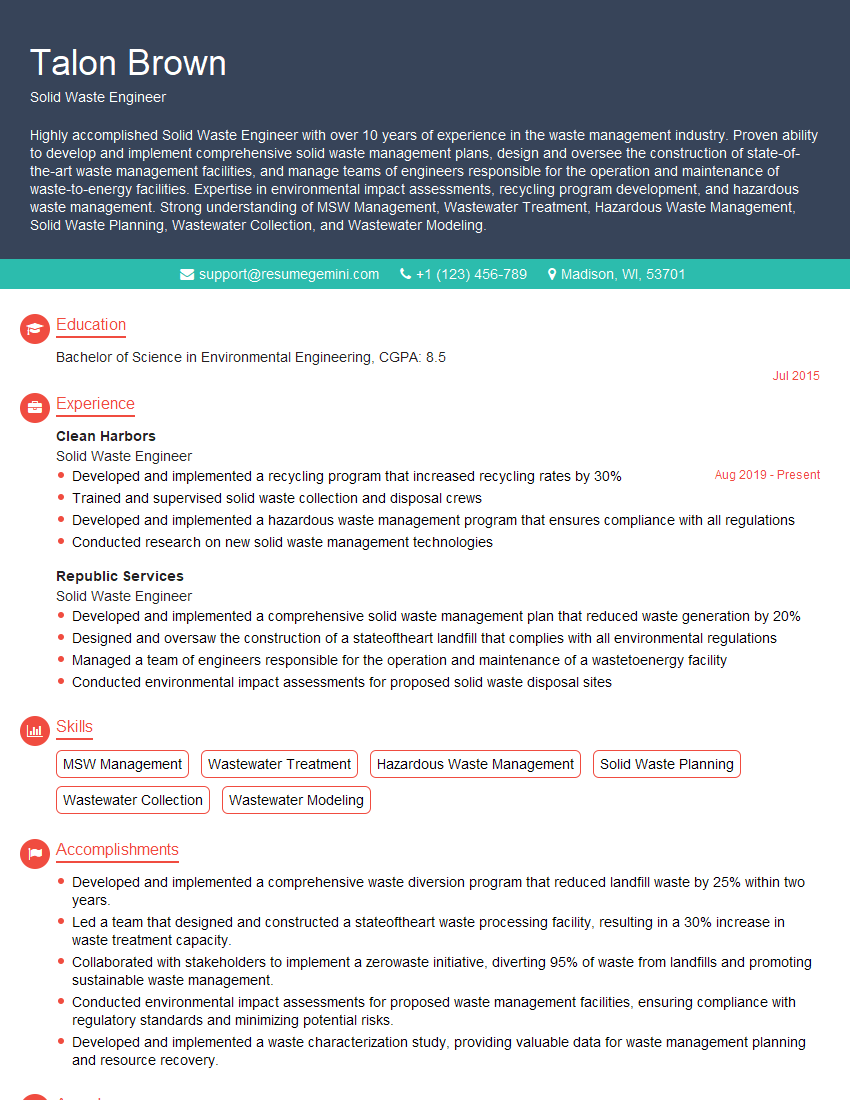
Talon Brown
Solid Waste Engineer
Summary
Highly accomplished Solid Waste Engineer with over 10 years of experience in the waste management industry. Proven ability to develop and implement comprehensive solid waste management plans, design and oversee the construction of state-of-the-art waste management facilities, and manage teams of engineers responsible for the operation and maintenance of waste-to-energy facilities. Expertise in environmental impact assessments, recycling program development, and hazardous waste management. Strong understanding of MSW Management, Wastewater Treatment, Hazardous Waste Management, Solid Waste Planning, Wastewater Collection, and Wastewater Modeling.
Education
Bachelor of Science in Environmental Engineering
July 2015
Skills
- MSW Management
- Wastewater Treatment
- Hazardous Waste Management
- Solid Waste Planning
- Wastewater Collection
- Wastewater Modeling
Work Experience
Solid Waste Engineer
- Developed and implemented a recycling program that increased recycling rates by 30%
- Trained and supervised solid waste collection and disposal crews
- Developed and implemented a hazardous waste management program that ensures compliance with all regulations
- Conducted research on new solid waste management technologies
Solid Waste Engineer
- Developed and implemented a comprehensive solid waste management plan that reduced waste generation by 20%
- Designed and oversaw the construction of a stateoftheart landfill that complies with all environmental regulations
- Managed a team of engineers responsible for the operation and maintenance of a wastetoenergy facility
- Conducted environmental impact assessments for proposed solid waste disposal sites
Accomplishments
- Developed and implemented a comprehensive waste diversion program that reduced landfill waste by 25% within two years.
- Led a team that designed and constructed a stateoftheart waste processing facility, resulting in a 30% increase in waste treatment capacity.
- Collaborated with stakeholders to implement a zerowaste initiative, diverting 95% of waste from landfills and promoting sustainable waste management.
- Conducted environmental impact assessments for proposed waste management facilities, ensuring compliance with regulatory standards and minimizing potential risks.
- Developed and implemented a waste characterization study, providing valuable data for waste management planning and resource recovery.
Awards
- Received National Association of Solid Waste Management (NASWM) Environmental Excellence Award for innovative waste management solutions.
- Recognized with the Excellence in Solid Waste Management Award by the Environmental Protection Agency (EPA) for exceptional contributions to the field.
- Awarded the Solid Waste Engine of the Year Award by the American Society of Civil Engineers (ASCE) for significant advancements in waste management practices.
- Received a citation from the Mayors Office for exceptional contributions to the citys waste management efforts.
Certificates
- Professional Engineer (PE)
- Board Certified Environmental Engineer (BCEE)
- Solid Waste Association of North America (SWANA) Manager of Landfill Operations (MOLO)
- American Water Works Association (AWWA) Water Treatment Operator (WTP)
Career Expert Tips:
- Select the ideal resume template to showcase your professional experience effectively.
- Master the art of resume writing to highlight your unique qualifications and achievements.
- Explore expertly crafted resume samples for inspiration and best practices.
- Build your best resume for free this new year with ResumeGemini. Enjoy exclusive discounts on ATS optimized resume templates.
How To Write Resume For Solid Waste Engineer
- Quantify your accomplishments with specific metrics, such as the percentage of waste reduction achieved or the amount of money saved through recycling.
- Highlight your experience in developing and implementing new technologies or processes that have improved the efficiency or effectiveness of waste management operations.
- Demonstrate your understanding of the latest trends and regulations in the waste management industry.
- Tailor your resume to each specific job you are applying for, highlighting the skills and experience that are most relevant to the position.
- Proofread your resume carefully before submitting it to ensure that it is free of errors.
Essential Experience Highlights for a Strong Solid Waste Engineer Resume
- Develop and implement comprehensive solid waste management plans to reduce waste generation and improve waste diversion rates.
- Design and oversee the construction of state-of-the-art waste management facilities, including landfills, transfer stations, and waste-to-energy plants.
- Manage teams of engineers responsible for the operation and maintenance of waste management facilities, ensuring compliance with all environmental regulations.
- Conduct environmental impact assessments for proposed solid waste disposal sites, evaluating the potential impacts on air, water, and soil quality.
- Develop and implement recycling programs to increase recycling rates and reduce the amount of waste sent to landfills.
- Train and supervise solid waste collection and disposal crews, ensuring that waste is collected and disposed of in a safe and environmentally sound manner.
- Develop and implement hazardous waste management programs, ensuring compliance with all applicable regulations and minimizing the risks associated with hazardous waste.
Frequently Asked Questions (FAQ’s) For Solid Waste Engineer
What is the role of a Solid Waste Engineer?
Solid Waste Engineers play a vital role in protecting the environment and public health by designing, implementing, and maintaining solid waste management systems. They work to reduce waste generation, improve waste diversion rates, and ensure that waste is disposed of in a safe and environmentally sound manner.
What are the key skills and qualifications for a Solid Waste Engineer?
Solid Waste Engineers typically have a bachelor’s degree in environmental engineering or a related field. They should also have a strong understanding of solid waste management principles, environmental regulations, and engineering design. Excellent communication and interpersonal skills are also essential.
What are the career prospects for Solid Waste Engineers?
Solid Waste Engineers are in high demand due to the increasing need for sustainable waste management practices. They can find employment in a variety of settings, including government agencies, private consulting firms, and waste management companies.
What are the challenges facing Solid Waste Engineers?
Solid Waste Engineers face a number of challenges, including the need to develop new and innovative waste management technologies, reduce greenhouse gas emissions, and address the increasing amount of electronic waste.
What are the rewards of being a Solid Waste Engineer?
Solid Waste Engineers have the opportunity to make a real difference in the world by protecting the environment and public health. They can also enjoy a rewarding career with good pay and benefits.
What are the different types of solid waste management facilities?
There are a variety of different types of solid waste management facilities, including landfills, transfer stations, waste-to-energy plants, and recycling centers.
What are the latest trends in solid waste management?
The latest trends in solid waste management include the use of new technologies to reduce waste generation, improve recycling rates, and generate energy from waste.
What are the challenges facing the solid waste management industry?
The solid waste management industry faces a number of challenges, including the increasing amount of waste generated, the need to reduce greenhouse gas emissions, and the need to develop new and innovative waste management technologies.