Are you a seasoned Taxidermist seeking a new career path? Discover our professionally built Taxidermist Resume Template. This time-saving tool provides a solid foundation for your job search. Simply click “Edit Resume” to customize it with your unique experiences and achievements. Customize fonts and colors to match your personal style and increase your chances of landing your dream job. Explore more Resume Templates for additional options.






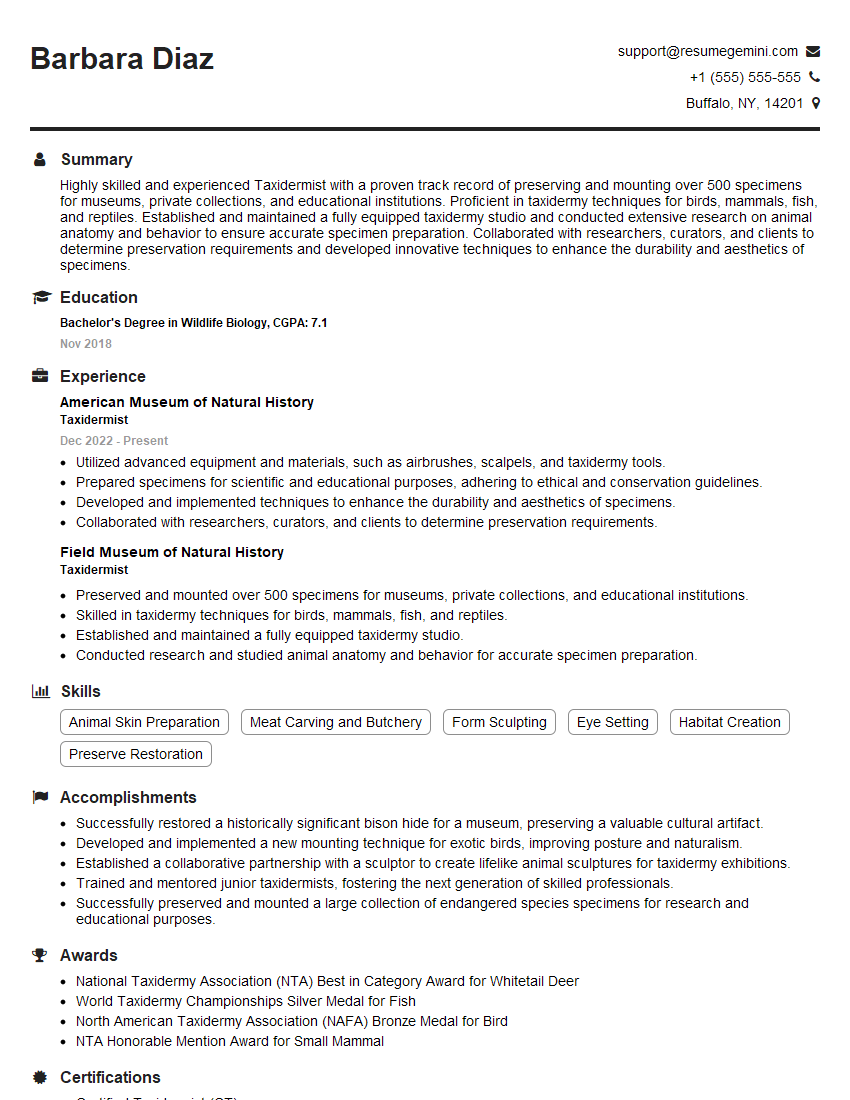
Barbara Diaz
Taxidermist
Summary
Highly skilled and experienced Taxidermist with a proven track record of preserving and mounting over 500 specimens for museums, private collections, and educational institutions. Proficient in taxidermy techniques for birds, mammals, fish, and reptiles. Established and maintained a fully equipped taxidermy studio and conducted extensive research on animal anatomy and behavior to ensure accurate specimen preparation. Collaborated with researchers, curators, and clients to determine preservation requirements and developed innovative techniques to enhance the durability and aesthetics of specimens.
Education
Bachelor’s Degree in Wildlife Biology
November 2018
Skills
- Animal Skin Preparation
- Meat Carving and Butchery
- Form Sculpting
- Eye Setting
- Habitat Creation
- Preserve Restoration
Work Experience
Taxidermist
- Utilized advanced equipment and materials, such as airbrushes, scalpels, and taxidermy tools.
- Prepared specimens for scientific and educational purposes, adhering to ethical and conservation guidelines.
- Developed and implemented techniques to enhance the durability and aesthetics of specimens.
- Collaborated with researchers, curators, and clients to determine preservation requirements.
Taxidermist
- Preserved and mounted over 500 specimens for museums, private collections, and educational institutions.
- Skilled in taxidermy techniques for birds, mammals, fish, and reptiles.
- Established and maintained a fully equipped taxidermy studio.
- Conducted research and studied animal anatomy and behavior for accurate specimen preparation.
Accomplishments
- Successfully restored a historically significant bison hide for a museum, preserving a valuable cultural artifact.
- Developed and implemented a new mounting technique for exotic birds, improving posture and naturalism.
- Established a collaborative partnership with a sculptor to create lifelike animal sculptures for taxidermy exhibitions.
- Trained and mentored junior taxidermists, fostering the next generation of skilled professionals.
- Successfully preserved and mounted a large collection of endangered species specimens for research and educational purposes.
Awards
- National Taxidermy Association (NTA) Best in Category Award for Whitetail Deer
- World Taxidermy Championships Silver Medal for Fish
- North American Taxidermy Association (NAFA) Bronze Medal for Bird
- NTA Honorable Mention Award for Small Mammal
Certificates
- Certified Taxidermist (CT)
- National Taxidermists Association Member (NTA)
- Association of European Taxidermists (AET)
- Wildlife Preservation Trust (WPT)
Career Expert Tips:
- Select the ideal resume template to showcase your professional experience effectively.
- Master the art of resume writing to highlight your unique qualifications and achievements.
- Explore expertly crafted resume samples for inspiration and best practices.
- Build your best resume for free this new year with ResumeGemini. Enjoy exclusive discounts on ATS optimized resume templates.
How To Write Resume For Taxidermist
- Quantify your accomplishments by providing specific numbers and metrics.
- Showcase your passion for wildlife conservation and ethical taxidermy practices.
- Highlight any specialized skills or techniques that set you apart.
- Include a portfolio of your taxidermy work to demonstrate your craftsmanship and attention to detail.
Essential Experience Highlights for a Strong Taxidermist Resume
- Prepare and mount animal specimens using traditional and modern taxidermy techniques.
- Skin and preserve animal hides, ensuring proper curing and tanning.
- Carve and shape forms to accurately replicate the animal’s anatomy.
- Set eyes and create realistic facial expressions to bring specimens to life.
- Design and build custom habitats to showcase specimens in a natural and engaging manner.
- Restore and repair damaged or deteriorated specimens to preserve their historical and educational value.
Frequently Asked Questions (FAQ’s) For Taxidermist
What is the role of a Taxidermist?
Taxidermists are responsible for preserving and mounting animal specimens for museums, private collections, and educational institutions. They use a variety of techniques to prepare and mount specimens, including skinning, preserving, carving, and setting eyes.
What are the educational requirements to become a Taxidermist?
While there is no formal educational requirement to become a Taxidermist, many professionals in the field have a background in biology, wildlife management, or a related field.
What skills are required to be a successful Taxidermist?
Successful Taxidermists typically have strong artistic skills, as well as a deep understanding of animal anatomy and behavior. They must also be patient, detail-oriented, and have a strong work ethic.
What is the job outlook for Taxidermists?
The job outlook for Taxidermists is expected to be good in the coming years, as there is a growing demand for skilled professionals to preserve and mount animal specimens for museums, private collections, and educational institutions.
What are the salary expectations for Taxidermists?
The salary expectations for Taxidermists vary depending on their experience, skill level, and location. However, experienced Taxidermists with a strong portfolio can earn a comfortable living.
What are the ethical considerations in taxidermy?
Taxidermists must adhere to strict ethical guidelines to ensure that animals are treated with respect and that their remains are preserved in a humane and responsible manner.