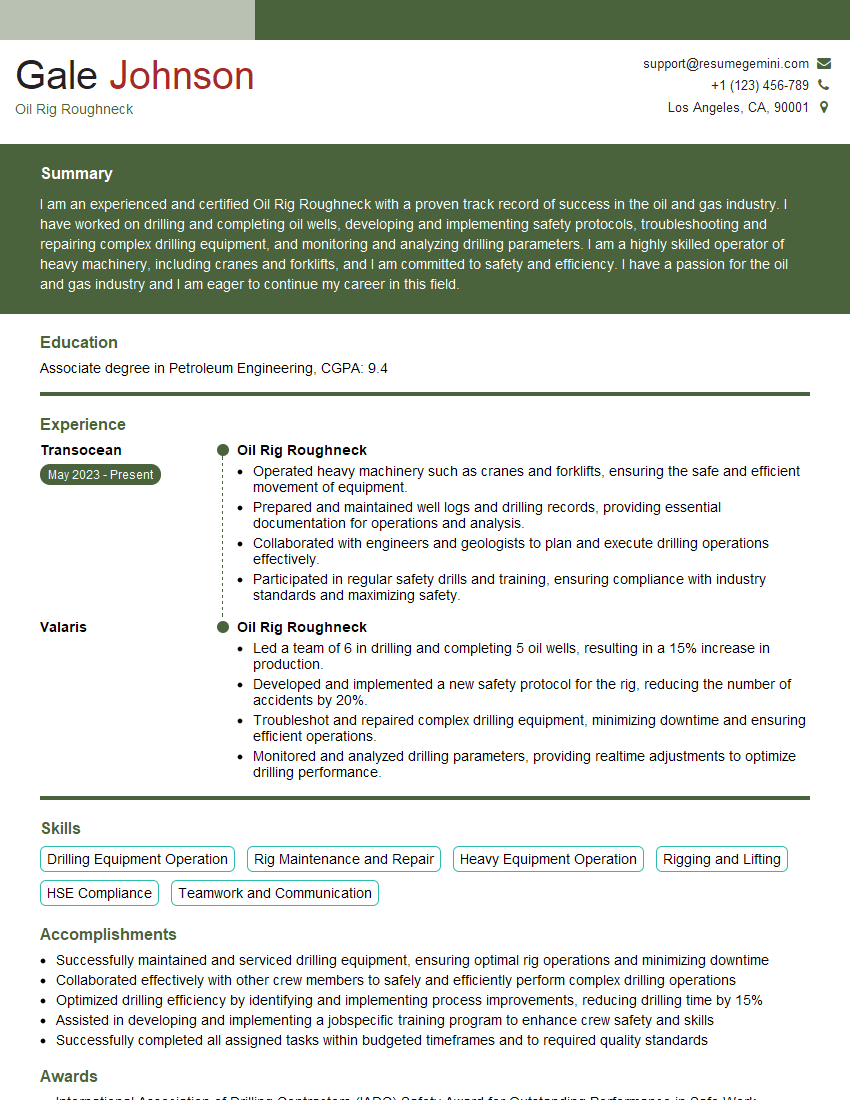
Feeling lost in a sea of interview questions? Landed that dream interview for Oil Rig Roughneck but worried you might not have the answers? You’re not alone! This blog is your guide for interview success. We’ll break down the most common Oil Rig Roughneck interview questions, providing insightful answers and tips to leave a lasting impression. Plus, we’ll delve into the key responsibilities of this exciting role, so you can walk into your interview feeling confident and prepared.
Acing the interview is crucial, but landing one requires a compelling resume that gets you noticed. Crafting a professional document that highlights your skills and experience is the first step toward interview success. ResumeGemini can help you build a standout resume that gets you called in for that dream job.






Essential Interview Questions For Oil Rig Roughneck
1. What are the primary responsibilities of an Oil Rig Roughneck?
As an Oil Rig Roughneck, I am responsible for:
- Operating and maintaining drilling equipment, including drawworks, rotary table, and mud pumps
- Handling and securing drill pipe, casing, and other tubulars
- Monitoring drilling operations and making adjustments as needed
- Performing routine maintenance and repairs on drilling equipment
- Assisting with well control operations in the event of an emergency
2. Describe your experience in handling and securing drill pipe, casing, and other tubulars?
Tubular Handling
- Using tongs and elevators to connect and disconnect drill pipe and casing
- Operating the pipe handling system to move tubulars on and off the rig
- Ensuring that tubulars are properly secured and protected
Inspection and Maintenance
- Inspecting tubulars for damage or wear
- Performing routine maintenance on tubulars, including lubrication and cleaning
- Identifying and repairing minor defects
3. What are the safety protocols you follow while working on an oil rig?
I strictly adhere to the following safety protocols:
- Wearing appropriate personal protective equipment (PPE), including hard hat, safety glasses, gloves, and coveralls
- Following established procedures for operating and maintaining equipment
- Being aware of my surroundings and potential hazards
- Reporting any unsafe conditions or practices to my supervisor
- Participating in regular safety training and drills
4. Explain the role of mud pumps in drilling operations?
Mud pumps play a vital role in drilling operations by:
- Circulating drilling fluid (mud) through the drill string and up the annulus
- Cooling and lubricating the drill bit and drill string
- Removing cuttings from the wellbore
- Controlling formation pressure and preventing blowouts
- Providing a hydraulic seal between the drill string and the wellbore
5. What are the key elements of a successful drilling operation?
Key elements of a successful drilling operation include:
- Proper planning and preparation
- Experienced and competent personnel
- High-quality equipment and materials
- Effective communication and teamwork
- Adherence to safety protocols
- Efficient and timely execution of drilling operations
- Proper well control and blowout prevention measures
6. Describe your experience in maintaining and repairing drilling equipment?
I have extensive experience in maintaining and repairing drilling equipment, including:
- Troubleshooting and diagnosing equipment problems
- Performing routine maintenance and servicing
- Replacing worn or damaged parts
- Overhauling and rebuilding major components
- Working with a team to ensure that equipment is operating safely and efficiently
7. What are the different types of drilling rigs and their applications?
The main types of drilling rigs are:
- Land rigs: Used for onshore drilling
- Jackup rigs: Used for offshore drilling in shallow waters
- Semisubmersible rigs: Used for offshore drilling in deeper waters
- Drill ships: Used for offshore drilling in deep waters or in remote locations
- ROV (Remotely Operated Vehicle) drilling rigs: Used for specialized drilling operations, such as subsea well intervention
8. What are the challenges of working as an Oil Rig Roughneck?
The challenges of working as an Oil Rig Roughneck include:
- Long and irregular work hours
- Working in harsh and hazardous conditions
- Being away from home for extended periods
- Physical demands of the job
- Potential for accidents and injuries
9. What is your motivation for wanting to work as an Oil Rig Roughneck?
My motivation for wanting to work as an Oil Rig Roughneck stems from:
- My passion for the oil and gas industry
- My desire to contribute to a critical energy sector
- My physical and mental fortitude
- My eagerness to learn and develop in a challenging environment
- My belief that I possess the skills and experience necessary to excel in this role
10. What is your understanding of the importance of teamwork in the drilling process?
Teamwork is paramount in the drilling process as it ensures:
- Efficient and safe operations
- Effective communication and coordination
- Shared responsibility and accountability
- Mutual support and assistance in demanding situations
- Positive work environment and increased job satisfaction
Interviewers often ask about specific skills and experiences. With ResumeGemini‘s customizable templates, you can tailor your resume to showcase the skills most relevant to the position, making a powerful first impression. Also check out Resume Template specially tailored for Oil Rig Roughneck.
Career Expert Tips:
- Ace those interviews! Prepare effectively by reviewing the Top 50 Most Common Interview Questions on ResumeGemini.
- Navigate your job search with confidence! Explore a wide range of Career Tips on ResumeGemini. Learn about common challenges and recommendations to overcome them.
- Craft the perfect resume! Master the Art of Resume Writing with ResumeGemini’s guide. Showcase your unique qualifications and achievements effectively.
- Great Savings With New Year Deals and Discounts! In 2025, boost your job search and build your dream resume with ResumeGemini’s ATS optimized templates.
Researching the company and tailoring your answers is essential. Once you have a clear understanding of the Oil Rig Roughneck‘s requirements, you can use ResumeGemini to adjust your resume to perfectly match the job description.
Key Job Responsibilities
Oil Rig Roughnecks are responsible for a variety of tasks that ensure the smooth operation of an oil rig. Their duties include assisting with the assembly, maintenance, and repair of drilling equipment, assisting in the drilling and extraction of oil and gas, and ensuring the safety of the rig and its crew.
1. Drilling and Extraction
Roughnecks are involved in all aspects of the drilling and extraction process, including:
- Operating drilling equipment, such as derricks, draw works, and mud pumps.
- Monitoring drilling parameters, such as depth, pressure, and temperature.
- Performing routine maintenance and repairs on drilling equipment.
- Assisting in the installation and removal of drill bits and other downhole tools.
2. Rig Maintenance
Roughnecks are also responsible for maintaining the rig and its equipment, including:
- Performing routine maintenance and repairs on engines, generators, pumps, and other mechanical equipment.
- Inspecting and repairing electrical systems, such as wiring, lighting, and communication systems.
- Keeping the rig clean and organized.
- Assisting in the loading and unloading of supplies and equipment.
3. Safety
Safety is a top priority on oil rigs, and roughnecks are responsible for ensuring the safety of themselves and their crewmates, including:
- Following all safety regulations and procedures.
- Wearing appropriate safety gear, such as hard hats, safety glasses, and gloves.
- Being aware of potential hazards and taking steps to avoid them.
- Responding to emergencies promptly and effectively.
4. Teamwork
Roughnecks work as part of a team and must be able to communicate effectively with each other, including:
- Working with other roughnecks to complete tasks safely and efficiently.
- Following instructions from supervisors.
- Reporting any safety concerns or hazards to supervisors.
Interview Tips
Preparing for an interview for an Oil Rig Roughneck position can be challenging, but with the right strategies, you can increase your chances of success. Here are a few tips to help you ace your interview:
1. Research the Company and the Job
Before you go to your interview, do your homework. Research the company you’re applying to and the specific job you’re interested in. This will help you understand the company’s culture, goals, and what they’re looking for in a roughneck.
2. Practice Answering Common Interview Questions
There are a few common interview questions that you’re likely to be asked, such as “Why do you want to work for our company?” and “What are your strengths and weaknesses?” It’s a good idea to practice answering these questions in advance so that you can deliver your responses confidently and concisely.
3. Be Prepared to Discuss Your Experience
The interviewer will want to know about your experience working as a roughneck. Be prepared to discuss your previous work experiences, including the types of equipment you’ve worked with, the tasks you’ve performed, and the safety procedures you’ve followed.
4. Emphasize Your Safety Consciousness
Safety is a top priority in the oil and gas industry. Make sure you emphasize your commitment to safety during your interview. Discuss your safety training and experience and how you would contribute to the safety of the rig.
5. Be Enthusiastic and Positive
Employers are looking for roughnecks who are enthusiastic and positive about their work. Show the interviewer that you’re excited about the opportunity to work for their company and that you’re confident in your abilities.
By following these tips, you can increase your chances of making a good impression during your interview and landing the job you want.
Next Step:
Now that you’re armed with a solid understanding of what it takes to succeed as a Oil Rig Roughneck, it’s time to turn that knowledge into action. Take a moment to revisit your resume, ensuring it highlights your relevant skills and experiences. Tailor it to reflect the insights you’ve gained from this blog and make it shine with your unique qualifications. Don’t wait for opportunities to come to you—start applying for Oil Rig Roughneck positions today and take the first step towards your next career milestone. Your dream job is within reach, and with a polished resume and targeted applications, you’ll be well on your way to achieving your career goals! Build your resume now with ResumeGemini.