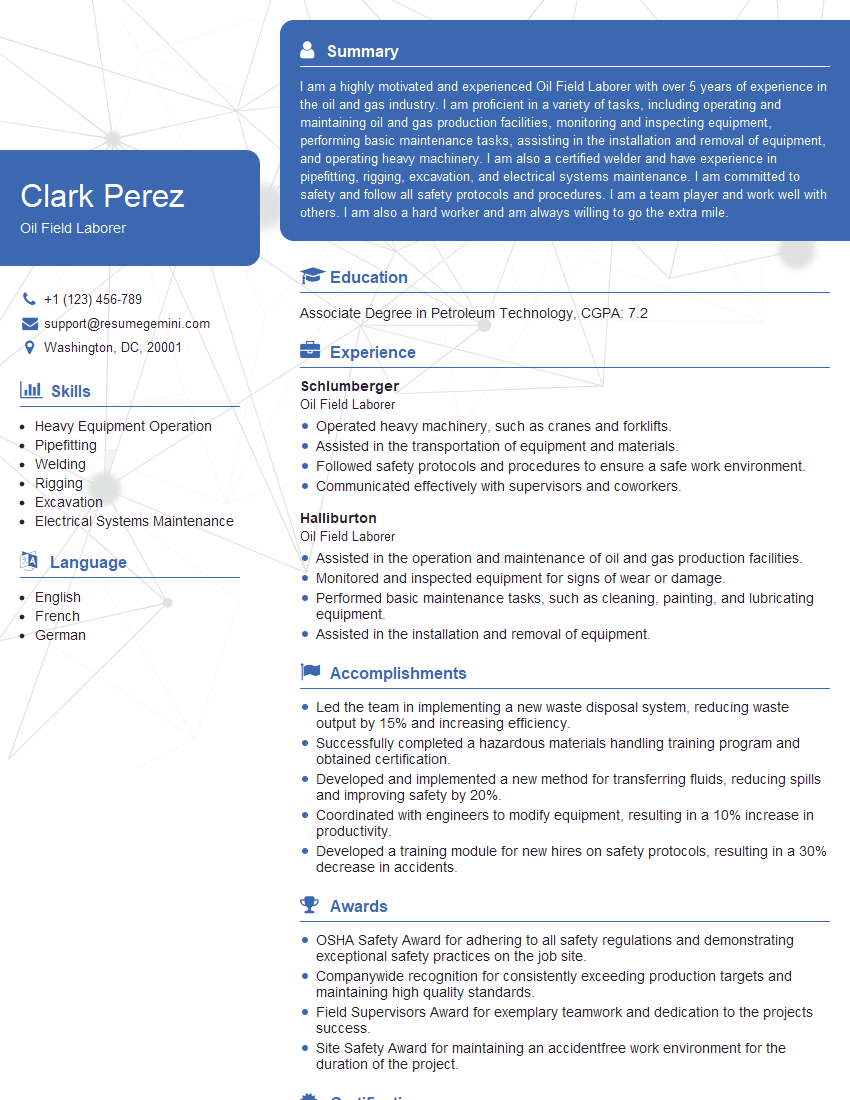
Feeling lost in a sea of interview questions? Landed that dream interview for Oil Field Laborer but worried you might not have the answers? You’re not alone! This blog is your guide for interview success. We’ll break down the most common Oil Field Laborer interview questions, providing insightful answers and tips to leave a lasting impression. Plus, we’ll delve into the key responsibilities of this exciting role, so you can walk into your interview feeling confident and prepared.
Acing the interview is crucial, but landing one requires a compelling resume that gets you noticed. Crafting a professional document that highlights your skills and experience is the first step toward interview success. ResumeGemini can help you build a standout resume that gets you called in for that dream job.






Essential Interview Questions For Oil Field Laborer
1. How would you ensure that the equipment used in the oil field is properly calibrated and maintained?
- Conduct regular inspections and tests to verify accuracy and functionality.
- Maintain detailed maintenance records and follow manufacturer’s recommendations for calibration intervals.
- Work closely with equipment operators to monitor performance and identify potential issues early on.
- Receive training on proper calibration and maintenance techniques to stay up-to-date on best practices.
- Document all calibration and maintenance activities to ensure traceability and compliance.
2. Describe the procedures you would follow in the event of an oil spill or other environmental emergency.
Immediate Actions
- Notify appropriate authorities and emergency response teams.
- Secure the spill source to prevent further leakage.
- Isolate the affected area to minimize environmental impact.
Containment and Cleanup
- Deploy containment booms and skimmers to prevent the spread of the spill.
- Use absorbent materials to soak up spilled oil.
- Dispose of contaminated materials in accordance with environmental regulations.
3. How would you prevent and respond to workplace hazards in the oil field, such as fires, explosions, or chemical spills?
- Follow established safety protocols and wear appropriate protective gear.
- Identify potential hazards and implement risk mitigation measures.
- Be aware of the location of emergency equipment and evacuation routes.
- Respond promptly and effectively to workplace emergencies, following established procedures.
- Report any unsafe conditions or incidents to supervisors and safety personnel.
4. What would you do if you observed unsafe practices or behavior by a colleague?
- Politely approach the individual and express concerns, providing specific examples.
- Explain the risks associated with the unsafe behavior and the importance of adherence to safety regulations.
- Offer assistance in correcting the situation and ensure proper safety measures are followed.
- If the individual does not respond positively, report the incident to a supervisor or safety officer.
- Prioritize safety and the well-being of all personnel on the job site.
5. What knowledge do you have of drilling equipment and techniques?
- Drilling Equipment: Rotary drill rigs, mud pumps, drill bits, drill pipes, casing, and cementing equipment.
- Drilling Techniques: Rotary drilling, directional drilling, mud circulation systems, and well completion methods.
- Familiarity with drilling software and monitoring systems to optimize drilling efficiency and safety.
- Understanding of drilling fluid properties and their role in wellbore stability and hole cleaning.
- Experience in handling and maintaining drilling equipment to ensure proper operation and safety.
6. Explain how you would troubleshoot and address common issues encountered in oil field operations.
- Identify symptoms and isolate the problem: Gather data, observe equipment behavior, and analyze potential causes.
- Refer to technical manuals and industry knowledge: Consult available documentation and seek guidance from experienced colleagues.
- Inspect and test equipment: Perform visual inspections, diagnostic tests, and measurements to pinpoint the issue.
- Implement corrective actions: Repair or replace faulty components, adjust settings, or modify operating procedures.
- Monitor and verify resolution: Track performance after troubleshooting to ensure the issue has been resolved effectively.
7. Describe your experience in lifting and moving heavy equipment and materials in an oil field environment.
- Proper lifting techniques: Utilize safe lifting practices to prevent injuries and damage to equipment.
- Use of lifting equipment: Operate cranes, forklifts, and other lifting devices to safely move heavy loads.
- Load securement: Securely fasten and balance loads for safe transportation and handling.
- Teamwork and communication: Collaborate with colleagues to effectively lift and move heavy objects.
- Situational awareness: Assess the surroundings and identify potential hazards before lifting or moving equipment.
8. How do you prioritize multiple tasks and manage your time effectively in a fast-paced oil field environment?
- Planning and organization: Establish clear priorities, create schedules, and delegate tasks when necessary.
- Communication and coordination: Collaborate with colleagues to ensure everyone is aware of task priorities and deadlines.
- Time management techniques: Utilize methods such as the Eisenhower Matrix or Pomodoro Technique to maximize productivity.
- Adaptability and flexibility: Adjust work plans and priorities as needed to respond to changing circumstances.
- Continuous improvement: Regularly evaluate and refine time management strategies to enhance efficiency.
9. What is your understanding of the importance of environmental protection in oil field operations?
- Compliance with regulations: Adhere to environmental laws and industry best practices to minimize impact on the environment.
- Spill prevention and response: Implement measures to prevent and effectively respond to oil spills or other environmental incidents.
- Waste management: Properly dispose of hazardous waste and implement recycling programs to reduce environmental impact.
- Land reclamation: Restore disturbed areas to their natural state after oil field operations have ceased.
- Collaboration with environmental agencies: Work closely with environmental regulators to ensure compliance and mitigate potential impacts.
10. How do you stay up-to-date with the latest industry standards and safety protocols in the oil field?
- Attend industry conferences and workshops: Participate in events to learn about new technologies and best practices.
- Read industry publications and technical journals: Stay informed about industry developments and advancements.
- Complete online training modules and certifications: Enhance knowledge and demonstrate commitment to continuous learning.
- Network with industry professionals: Connect with colleagues and experts to share information and experiences.
- Seek guidance from supervisors and safety managers: Utilize their expertise and insights to stay current with industry standards.
Interviewers often ask about specific skills and experiences. With ResumeGemini‘s customizable templates, you can tailor your resume to showcase the skills most relevant to the position, making a powerful first impression. Also check out Resume Template specially tailored for Oil Field Laborer.
Career Expert Tips:
- Ace those interviews! Prepare effectively by reviewing the Top 50 Most Common Interview Questions on ResumeGemini.
- Navigate your job search with confidence! Explore a wide range of Career Tips on ResumeGemini. Learn about common challenges and recommendations to overcome them.
- Craft the perfect resume! Master the Art of Resume Writing with ResumeGemini’s guide. Showcase your unique qualifications and achievements effectively.
- Great Savings With New Year Deals and Discounts! In 2025, boost your job search and build your dream resume with ResumeGemini’s ATS optimized templates.
Researching the company and tailoring your answers is essential. Once you have a clear understanding of the Oil Field Laborer‘s requirements, you can use ResumeGemini to adjust your resume to perfectly match the job description.
Key Job Responsibilities
Oil Field Laborers are responsible for a variety of tasks on an oil rig or in an oil field, including:
1. Maintaining and repairing equipment
Oil Field Laborers are expected to be able to maintain and repair a variety of equipment, including pumps, generators, and pipelines. They must be able to identify problems and make repairs quickly and efficiently.
- Inspecting equipment for wear and tear
- Performing routine maintenance tasks
2. Operating equipment
Oil Field Laborers must be able to operate a variety of equipment, including cranes, forklifts, and bulldozers. They must be able to do so safely and efficiently.
- Loading and unloading materials
- Transporting equipment and materials
3. Loading and unloading materials
Oil Field Laborers are responsible for loading and unloading materials from trucks, trains, and ships. They must be able to do so quickly and efficiently.
- Loading and unloading pipe
- Loading and unloading drilling equipment
4. Cleaning and maintaining work areas
Oil Field Laborers are responsible for cleaning and maintaining work areas. They must be able to do so safely and efficiently.
- Removing trash and debris
- Cleaning spills
Interview Tips
In addition to being able to perform the job responsibilities listed above, Oil Field Laborers must also be able to work independently and as part of a team. They must be able to follow instructions and work safely. They must also be able to handle physical labor and work in a variety of weather conditions.
1. Research the company and the position
Before you go on an interview, it is important to research the company and the position you are applying for. This will help you to understand the company’s culture and what they are looking for in a candidate.
- Visit the company’s website
- Read articles about the company
- Talk to people who work for the company
- Find out what the specific requirements are for the position you are applying for
2. Practice your answers to common interview questions
There are a number of common interview questions that you may be asked, such as “Why do you want to work for this company?” and “What are your strengths and weaknesses?”. It is important to practice your answers to these questions so that you can deliver them confidently and concisely.
- Write out your answers to common interview questions
- Practice saying your answers out loud
- Get feedback from a friend or family member
3. Dress professionally
First impressions matter, so it is important to dress professionally for your interview. This means wearing clean, pressed clothes and shoes. You should also avoid wearing strong perfumes or colognes.
- Suit or dress pants and shirt
- Closed-toe shoes
- Avoid wearing strong perfumes or colognes
4. Be on time
Punctuality is important for any job interview, but it is especially important for oil field laborer interviews. This job requires employees to be able to work independently and as part of a team, so it is important to show that you can be on time and reliable.
- Plan your route ahead of time and give yourself plenty of extra time to get to the interview
- If you are running late, call the interviewer to let them know
Next Step:
Armed with this knowledge, you’re now well-equipped to tackle the Oil Field Laborer interview with confidence. Remember, a well-crafted resume is your first impression. Take the time to tailor your resume to highlight your relevant skills and experiences. And don’t forget to practice your answers to common interview questions. With a little preparation, you’ll be on your way to landing your dream job. So what are you waiting for? Start building your resume and start applying! Build an amazing resume with ResumeGemini.